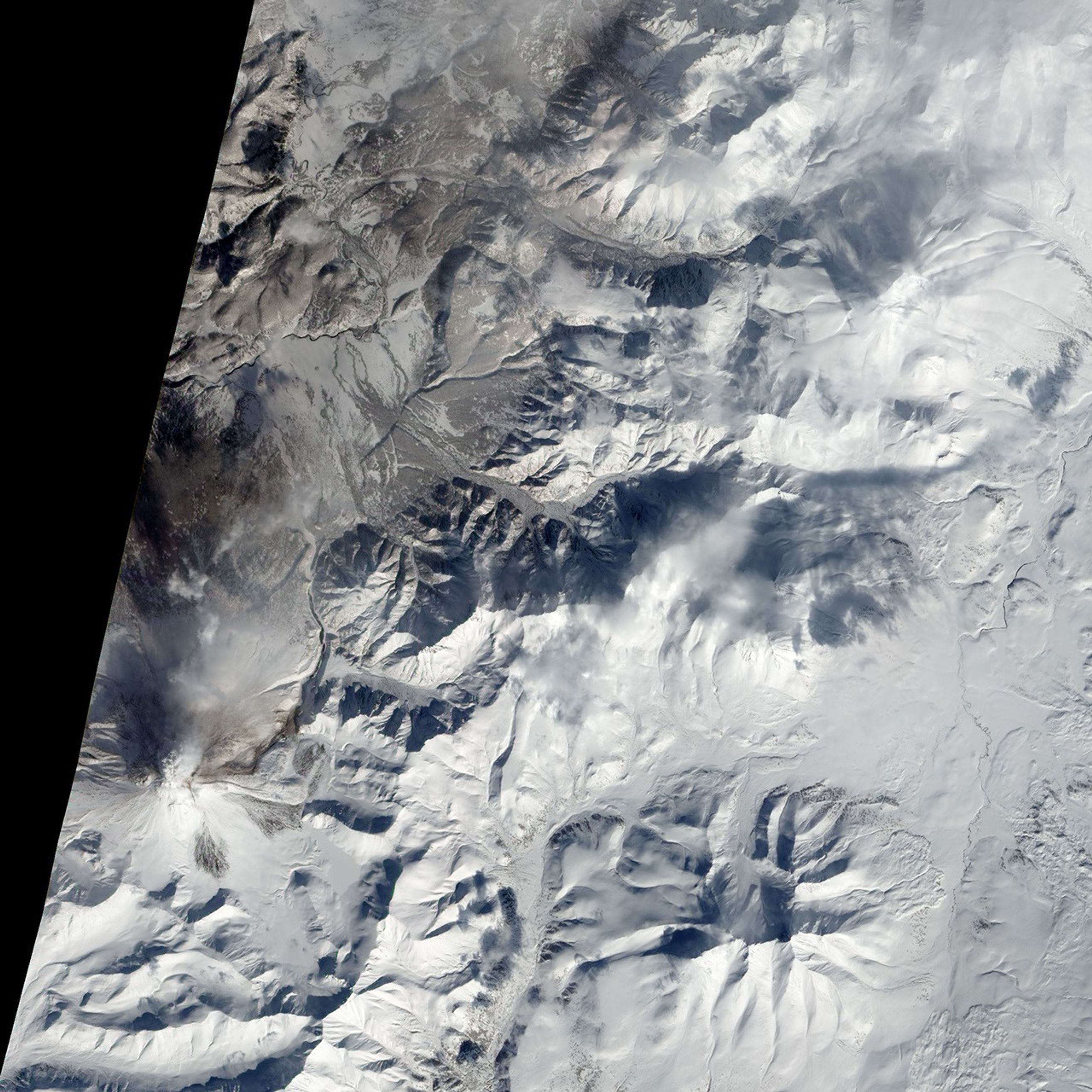


























Kizimen Volcano on Russia’s Kamchatka Peninsula remained active in March 2013. The Advanced Land Imager (ALI) on NASA’s Earth Observing-1 (EO-1) satellite captured this natural-color image on March 12. A plume rose from the summit, while snow covered a lava flow on the volcano’s eastern flank. That lava was actively advancing in February 2012, and still growing a year later.
Kizimen is a steep-sloped stratovolcano composed of alternating layers of volcanic ash, lava, and debris. According to the Global Volcanism Program at the Smithsonian Institution, Kizimen has a shape similar to Mount St. Helens prior to its 1980 eruption. Kizimen experienced a bout of eruptive activity in the late 1920s, then remained quiet for the rest of the 20th century. The volcano began showing signs of unrest in July 2009, with a swarm of seismic activity—up to 120 earthquakes a day. In November 2010, the volcano had a strong fissure eruption, and pyroclastic flows—avalanches of rocks and hot gases—began in February 2011.
Reports from the Kamchatka Volcanic Eruption Response Team noted that Kizimen experienced moderate seismic activity, incandescent lava extrusions, hot avalanches on the eastern and western flanks, and gas and steam eruptions in early March 2013.
References & Resources
- Global Volcanism Program Kizimen Summary, Monthly Reports, and Weekly Reports. Smithsonian Institution. Accessed March 14, 2013.
- Kamchatka Volcanic Eruption Response Team (2013, March 14) VONA/KVERT Daily Report Accessed March 14, 2013.
NASA Earth Observatory image created by Jesse Allen and Robert Simmon, using Advanced Land Imager data from the NASA EO-1 team. Caption by Michon Scott.