















Kavachi is one of the most active submarine volcanoes in the Pacific. This conical seamount, located in the Solomon Islands and named after a sea god of the Gatokae and Vangunu people, rises some 1,200 meters (3,900 feet) from the seafloor. But its summit remains just 20 meters (65 feet) below sea level, which makes it easier for satellites to detect discolorations of the water due to volcanic activity than at deeper undersea volcanoes.
Kavachi has erupted at least 39 times since 1939, with the latest eruptive period beginning in 2021, according to the Smithsonian Institution’s Global Volcanism Program. In 2024, the volcano continued to stir—and satellites continued to capture images of discolored plumes of water.
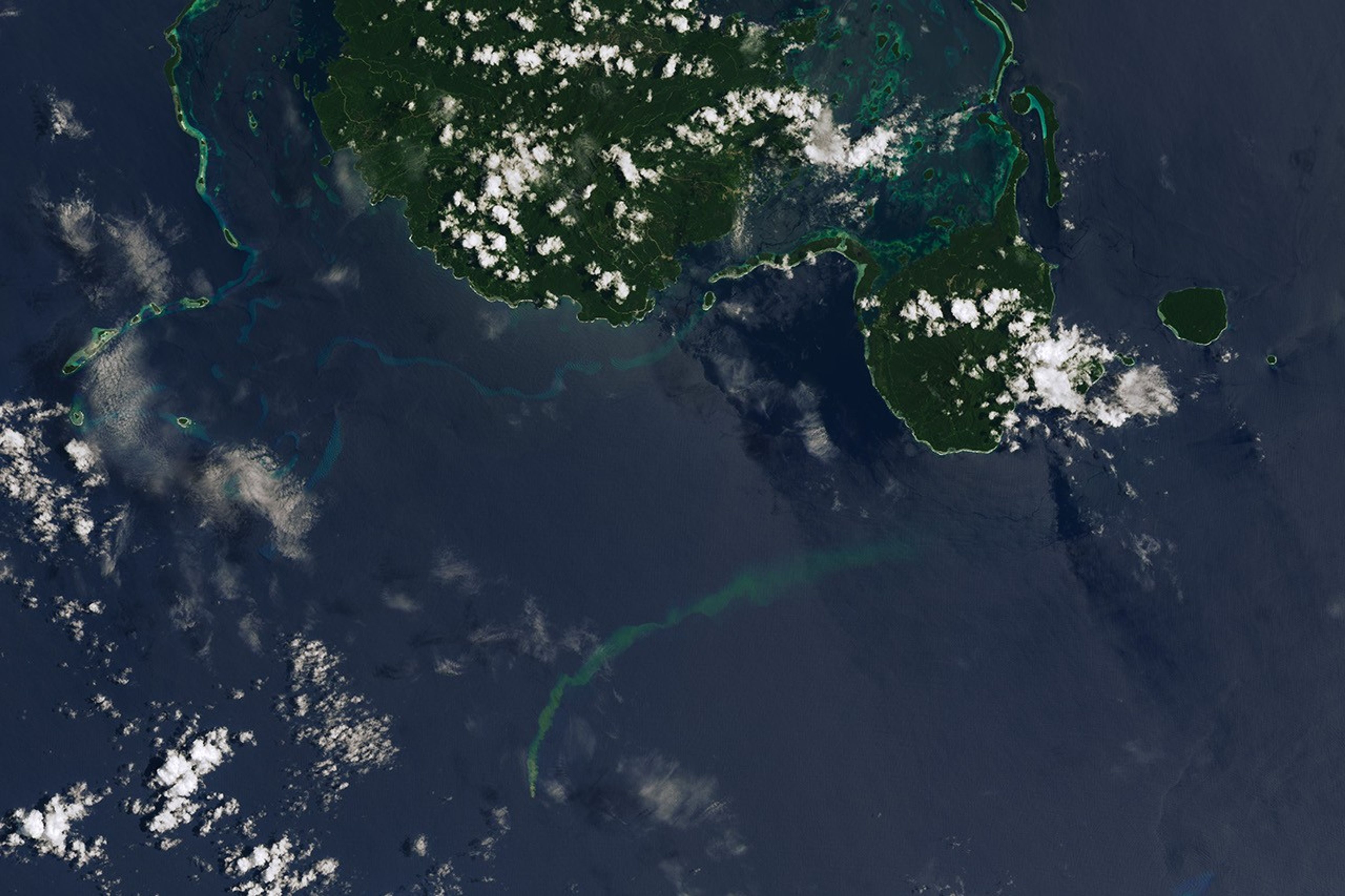
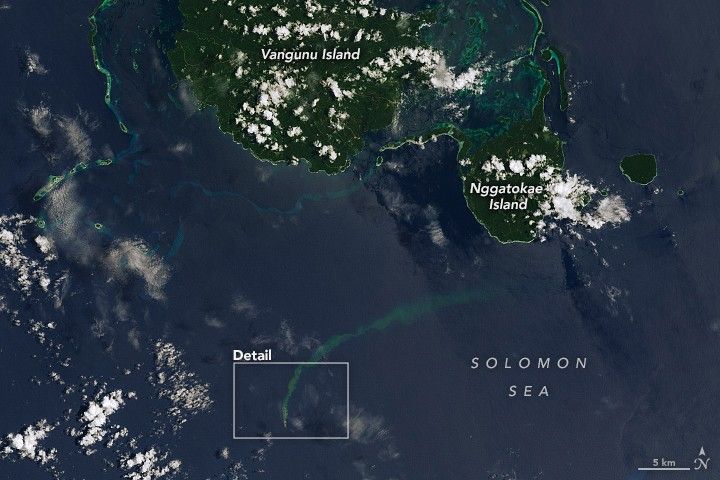
The image above, acquired on March 8 by the OLI (Operational Land Imager) on Landsat 8, shows a plume of discolored water near the undersea volcano. The plume drifted north-northeast toward Nggatokae Island. Vangunu Island, also pictured, lies about 24 kilometers (15 miles) north of Kavachi, and Papua New Guinea is about 800 kilometers (500 miles) to the west.
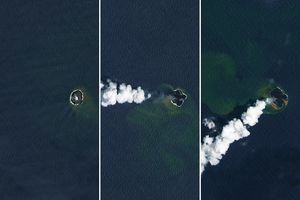
The MODIS (Moderate Resolution Imaging Spectroradiometer) on NASA’s Terra and Aqua captured images of similar underwater plumes near Kavachi on several other occasions in recent weeks, including February 3, 15, and 23.
Previous research has shown such plumes of superheated, acidic water can contain particulate matter, volcanic rock fragments, and sulfur, as well as precipitates of silicon, iron, and aluminum oxides. The color of plumes can offer clues about the composition of the particles within them. Yellow and brown plumes tend to have a higher proportion of iron, while white plumes tend to have a higher proportion of silicon or aluminum.
Though Kavachi is challenging for scientists to access, a lull in activity allowed a team to explore it in 2015. The researchers observed marine life within the crater, including orange and white bacterial mats, silky and hammerhead sharks, bluefin trevally, and snapper.
The authors of a report about the expedition noted that other active submarine volcanos—Vailulu’u Seamount in American Samoa and Kolumbo in Greece—are known to have highly acidic water and “kill zones” that contain carcasses of larger animals. “It is likely that the high crater walls at these sites cause physical entrainment and concentration of vent fluids, while Kavachi’s crater is relatively shallow and subjected to high surface currents that allow rapid mixing to occur,” they wrote in the report.Kavachi formed in a tectonically active area just 30 kilometers (18 miles) northeast of a subduction zone. The volcano produces lavas that range from basaltic, which is rich in magnesium and iron, to andesitic, which contains more silica. It is known for having phreatomagmatic eruptions in which the interaction of magma and water eject steam, ash, volcanic rock fragments, and incandescent bombs out of the water and into the air.
References & Resources
- The Conversation (2022, January 21) Underwater volcanoes: how ocean colour changes can signal an imminent eruption. Accessed March 15, 2024.
- Discovery Canada (2015, September 25) South Pacific—Mother Nature tries to create an island before your very eyes. Accessed March 15, 2024.
- Global Volcanism Program (2022) Kavachi (Solomon Islands). Accessed March 15, 2024.
- NASA Earthdata Earthquakes and Volcanos Data Pathfinder. Accessed March 15, 2024.
- NASA Earth Observatory (2022, March 14) Submarine Eruption of Kavachi Volcano. Accessed March 15, 2024.
- National Geographic (2017, April 19) These Sharks Thrive in an Underwater Volcano. Accessed March 15, 2024.
- National Geographic via YouTube (2015, July 9) Sharks Discovered Inside Underwater Volcano. Accessed March 15, 2024.
- Phillips, B.T., et al. (2016) Exploring the “Sharkcano”: Biogeochemical observations of the Kavachi submarine volcano (Solomon Islands). Oceanography 29(4), 160–169.
- Sakuno, Y. (2021) Trial of Chemical Composition Estimation Related to Submarine Volcano Activity Using Discolored Seawater Color Data Obtained from GCOM-C SGLI. A Case Study of Nishinoshima Island, Japan, in 2020. Water, 13(8), 1100.
- Walker, S.L., et al. (2008) Eruption-fed particle plumes and volcaniclastic deposits at a submarine volcano: NW Rota-1, Mariana Arc. Journal of Geophysical Research 113, B08S11.
- U.S. Geological Survey Earthword-subduction. Accessed March 15, 2024.
NASA Earth Observatory images by Lauren Dauphin, using Landsat data from the U.S. Geological Survey . Story by Adam Voiland and Sara Pratt.