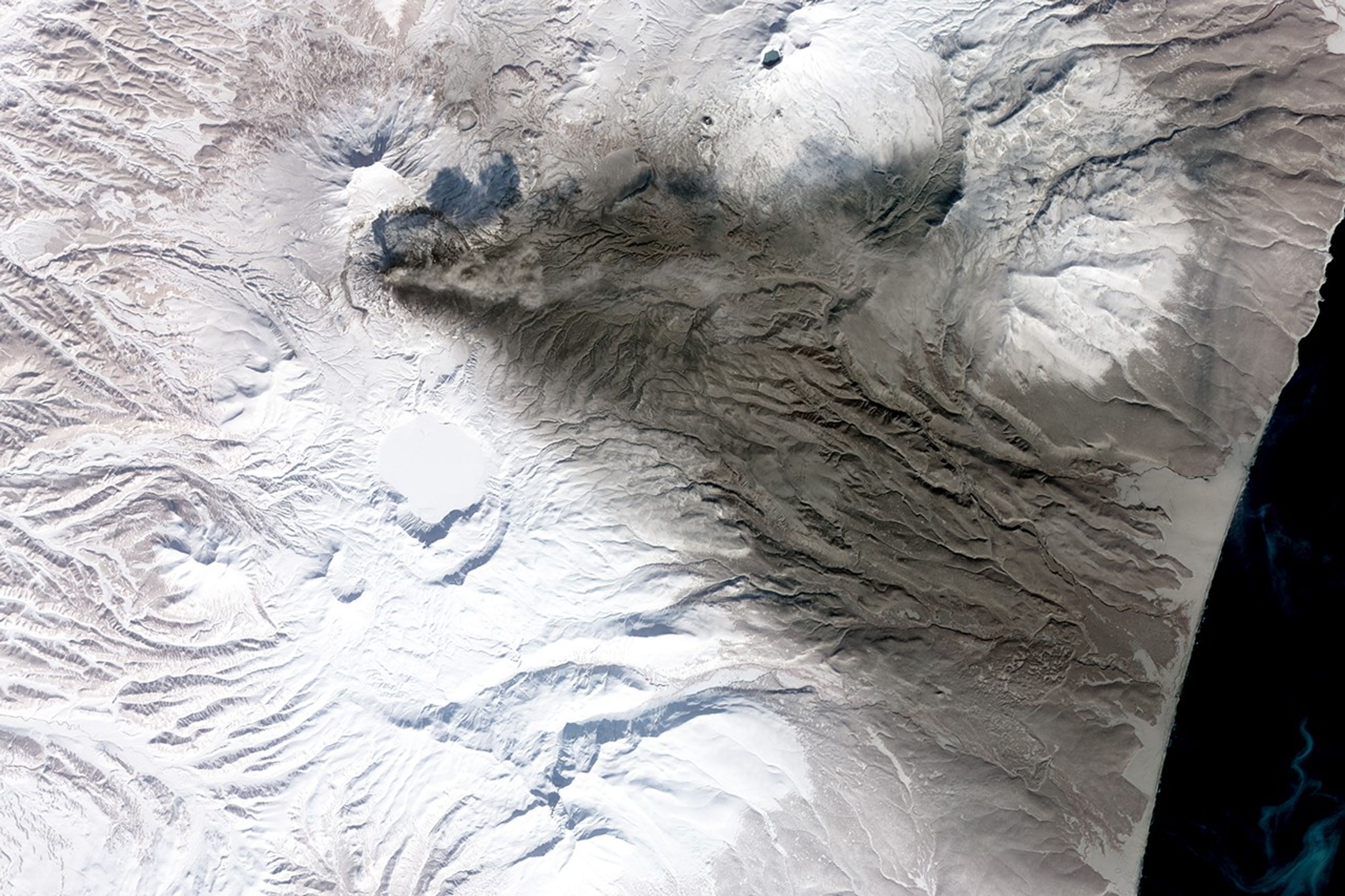













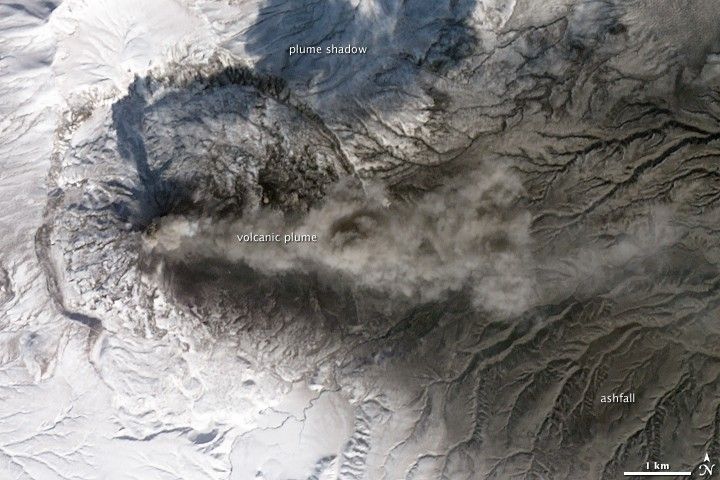
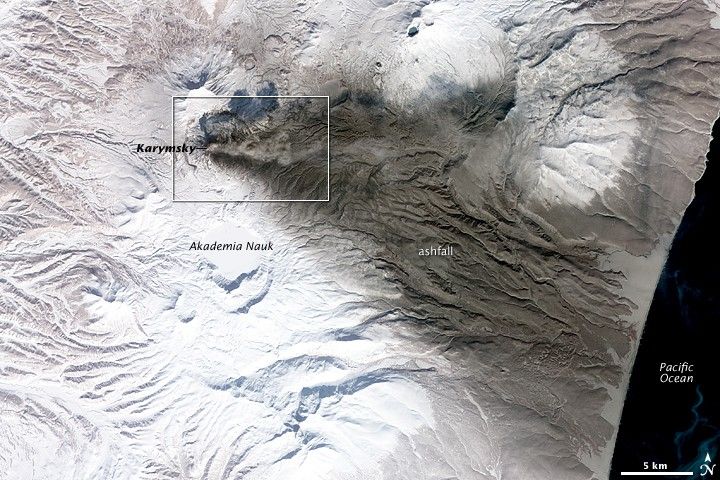
By early March 2009, Karymsky Volcano on Russia’s Kamchatka Peninsula had stained the snowy white landscape charcoal-brown all the way to the coast. The Advanced Spaceborne Thermal Emission and Reflection Radiometer (ASTER) on NASA’s Terra satellite acquired this image of the volcano on March 7, 2009. The top image is a close-up view of the smoking volcano, and the bottom image shows a wider perspective. The ash that settled on the snow rests on a rugged landscape of crests and valleys while the plume of ash overhead appears billowy, like a dark cloud. The plume’s direction mimics that of the preexisting ashfall, indicating that wind directions have not changed since this spate of ash emissions began.
Karymsky is a stratovolcano composed of alternating layers of hardened lava, solidified ash, and rocks thrown out by previous eruptions. After some two millennia of quiet, the volcano became active five centuries ago, and it has remained active since that time.
References & Resources
NASA image created by Jesse Allen, using data provided courtesy of NASA/GSFC/METI/ERSDAC/JAROS, and U.S./Japan ASTER Science Team. Caption by Michon Scott.