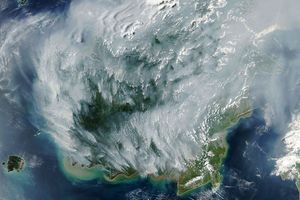































Since the end of December 2012, hundreds of bushfires have raged throughout Australia, fueled by a record-breaking heatwave. Some of the most damaging fires struck Tasmania, a large island off the coast of Victoria. Blazes that raced through the town of Dunalley on January 4 destroyed more than 100 homes.
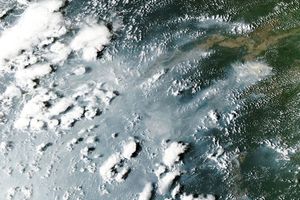
The Moderate Resolution Imaging Spectroradiometer (MODIS) on NASA’s Terra satellite captured this image (top) showing numerous fires across the island on January 6, 2013. Red outlines indicate hot spots where MODIS detected the unusually warm surface temperatures associated with fires.
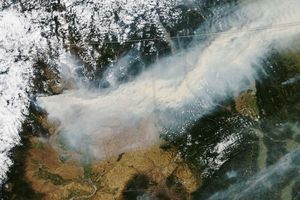
Hundreds of uncontrolled fires also burned throughout New South Wales and Victoria, the two most populous Australian states. Three of the most intense were the Deans Gap fire, the Yarrabin fire, and the Cobbler Road fire. On January 9, 2012, the Moderate Resolution Imaging Spectroradiometer (MODIS) on NASA’s Aqua satellite captured an image (bottom) of the three fires.
Extreme heat and strong winds have fueled the spate of fires. According to the Australian Bureau of Meteorology (BOM), the national average temperature on January 7 reached 40.3°Celsius (104.6°Fahrenheit), breaking a record set in 1972. Temperatures were so extreme that Australian meteorologists were forced to add additional color bands to their forecasting maps.
- References & Resources
- Australian Government Bureau of Meteorology (2013, Jan. 9) Record Breaking Heatwave to Continue this Week. Accessed Jan. 10, 2013.
- Australian Government Bureau of Meteorology (2013, Jan. 9) Special Climate Statement: Extreme January Heat (pdf). Accessed Jan. 10, 2013.
- NSW Current Fires and Incidents (2013, Jan. 8) New South Wales: Major Fire Updates. Accessed Jan. 10, 2013.
- Climate Central (2013, Jan. 9) Epic Heat, Wildfires are Scorching Australian Landscape. Accessed Jan. 10, 2013.
- ABC News (2013, Jan. 9) Australia Swelters Through Hottest Ever Day. Accessed Jan. 10, 2013.
- The Australian (2013, Jan. 11) Battles Won, But The Fire War Goes On. Accessed Jan. 10, 2013.
- The Telegraph (2013, Jan. 10) Australia Races to Control Fires Before it Hits Former Weapons Range. Accessed Jan. 10, 2013.
- Washington Post (2013, Jan. 8) Australian Wildfires. Accessed Jan. 10, 2013.
NASA image courtesy Jeff Schmaltz, LANCE MODIS Rapid Response. Caption by Adam Voiland.