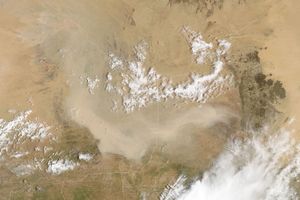




























Late November 2011 offered mostly cloud-free skies and a compelling view of the entire length of Baja California and the Pacific coast of Mexico. In the midst of the clarity, strong northeasterly winds stirred up dust storms on the mainland and the peninsula.
The natural-color images required to make this oblique view were acquired on November 27, 2011, by the Moderate Resolution Imaging Spectroradiometer (MODIS) on NASA’s Aqua satellite. The Ocean Color Team at NASA Goddard processes images like this to help assess the presence of sediment and plankton in the sea. Dust storms interfere with that processing, as the sandy aerosols block much of the incoming sunlight and the outgoing, reflected light.
Dust storms can disturb human activity on land, but once they blow out over the Gulf of California and Pacific Ocean, they help fertilize the waters with nutrients that promote phytoplankton blooms. In winter, the waters around Baja are often full of whales, as the largest creatures in the sea often eat the smallest plankton.
Researchers at the University of Wisconsin put the storm to a practical use. They are working to calibrate measurements on two instruments on the GOES weather satellites, and the dust storm provided a nice event for comparison.
References & Resources
- University of Wisconsin, Cooperative Institute for Meteorological Satellite Studies (2011, December 2) Blowing dust in the Baja California region of Mexico. Accessed January 6, 2012.
NASA image by Norman Kuring, Ocean Color Team. Caption by Mike Carlowicz, with assistance from Norman Kuring.