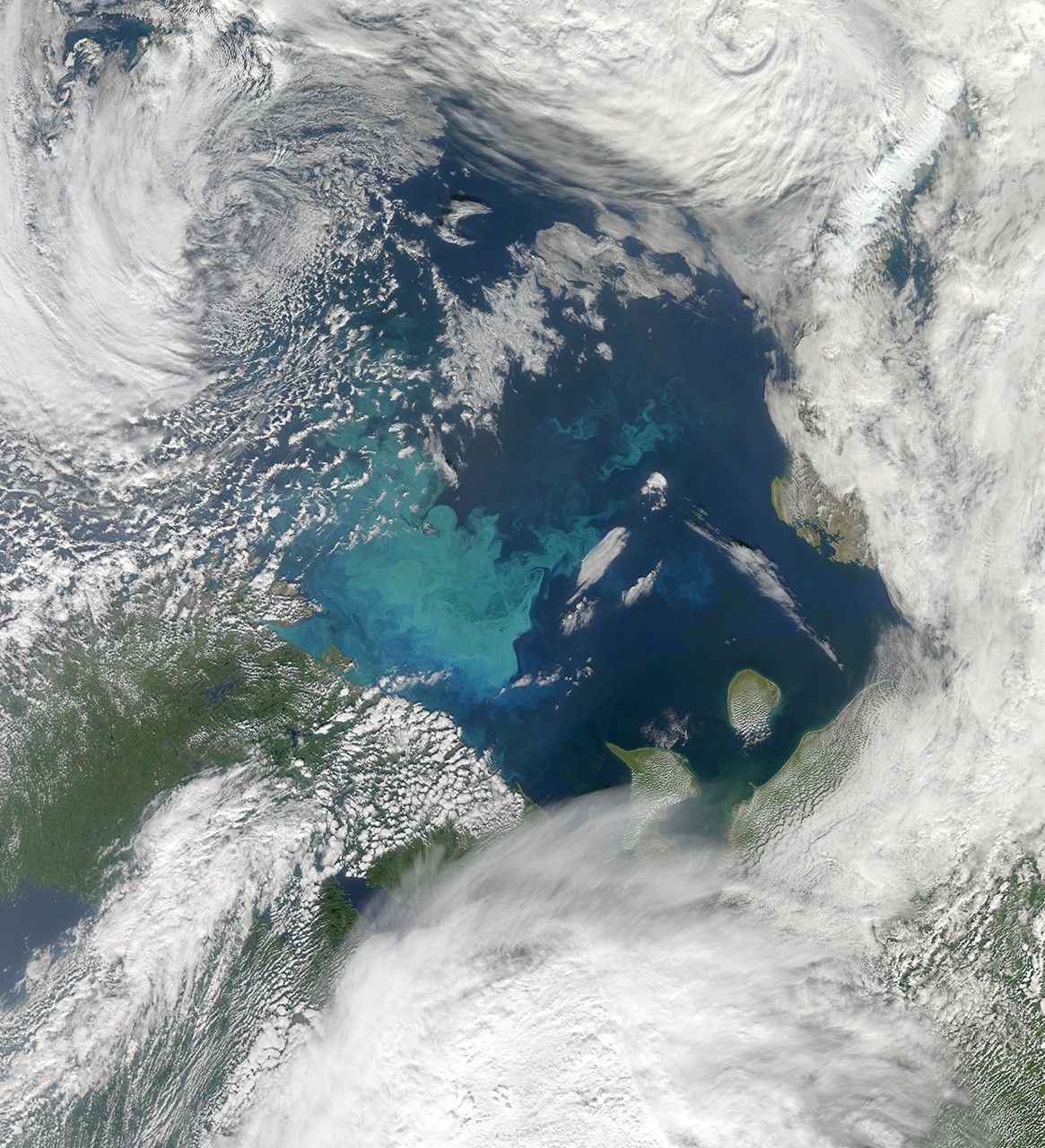


















In the chilly waters of the Barents Sea in mid-August 2009, the ocean switched on its carbon dioxide vacuum: a giant bloom of single-celled, plant-like organisms called phytoplankton. During these blooms, which can cover thousands of square kilometers of the surface of the ocean, a liter of seawater may contain a billion or more phytoplankton cells, each one a microscopic chemical factory that vacuums carbon dioxide out of the surrounding seawater and uses photosynthesis to turn it into stored chemical energy.
This image of the summer bloom in the Barents Sea off the northwesternmost corner of Russia was captured by the Moderate Resolution Imaging Spectroradiometer (MODIS) on NASA’s Aqua satellite on August 19, 2009. The milky-blue color that dominates the bloom suggests that it contains large numbers of coccolithophores, phytoplankton that armor themselves with tiny calcium carbonate (chalk) scales. Chlorophyll and other light-harvesting pigments from other species of phytoplankton can add darker blues, greens, and reddish-browns to the bloom.
All phytoplankton are important to the ocean food web and to the global carbon cycle; as they use up the carbon dioxide dissolved in the water, more carbon dioxide from the atmosphere dissolves into the ocean. In the end, the organisms die or are eaten, and the carbon they withdrew from the atmosphere winds up on the floor of the ocean. Coccolithophores are especially significant in the carbon cycle, however, because they not only sequester carbon through photosynthesis, but also through their calcium carbonate scales, called coccoliths.
When a predator eats a coccolithophore, the scales are not usually digested, and they become concentrated in the predator’s fecal pellets. The pellets are heavier than free-floating scales, so they sink more quickly to the seafloor, providing an additional way for atmospheric carbon dioxide to get stored in the deep ocean. Over millions of years, the coccoliths build up into layers of calcium-rich sediment than can be tens to thousands of meters thick. The sediment eventually gets compressed into rocks such as limestone.
Links
- Spectacular Bloom in the Barents Sea July 24, 2003
- Barents Sea Phytoplankton Bloom September 5, 2006
- Changing Currents Color the Bering Sea a New Shade of Blue What are phytoplankton? Fact SheetGlobal Maps of Phytoplankton Chlorophyll
References & Resources
- Shatto, R., and Slowey, N. (1997). Thinking big: Coccolithophores may be small, but they know how to get attention. Quarterdeck Online, 5 (2). Texas A&M University Department of Oceanography Website. Accessed August 21, 2009.
- NASA’s Earth Observatory. (1999). What is a Coccolithophore? Fact Sheet. Accessed August 21, 2009.
NASA image by Norman Kuring, GSFC Ocean Color Team. Caption by Rebecca Lindsey.