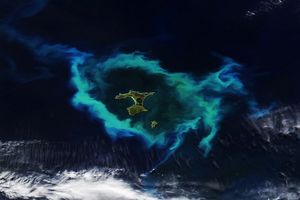



















Living things that can make their own food—autotrophs—are the basis for all food webs. On land the most important autotrophs are plants; in the ocean, the major autotrophs are phytoplankton: microscopic algae, bacteria, and protists that use chlorophyll and other light-harvesting pigments to capture sunlight for photosynthesis. When phytoplankton populations get large enough, their pigments color the surface waters of oceans, seas, and lakes with shades of brown, green, or turquoise.
This image shows a colorful bloom of phytoplankton in the Black Sea on June 4, 2008, along the southern coast near the Turkish cities of Sinop and Samsun. The natural-color image was captured by the Moderate Resolution Imaging Spectroradiometer (MODIS) on NASA’s Aqua satellite. Loops and swirls of blooming phytoplankton follow the coastline, while farther out in the open waters (upper right), the blooms become more spread out. The greenish plumes hugging the coast from Sinop westward to just beyond Samsun may be river plumes. River plumes can contain nutrients that stimulate phytoplankton blooms, but they may also contain sediment and organic matter that can color the water.
The different colors of blooms in different locations may be due to differences in the number and type of organisms. Turkish scientists analyzing phytoplankton types and abundance in the southern Black Sea in 1999 and 2000 identified nearly 150 different species of phytoplankton. Over-fertilization of the Black Sea from agricultural runoff and wastewater has changed the amount and types of phytoplankton that grow throughout the year. These changes likely have a cascading effect on the rest of the food web.
References & Resources
- References
- Bat, L., Sahin, F., Ustun, F., Kideys, A.E., and Satilmis, H.H. (2007). The Qualitative and Quantitative Distribution in Phytoplankton and Zooplankton of Southern Black Sea of Cape Sinop, Turkey in 1999-2000. In Proceedings of the Oceans 2007-Europe Conference, 18-21 June 2007,(pp.1-6). doi.10.1109/OCEANSE.2007.4302224/ Accessed June 8, 2008.
NASA image courtesy the MODIS Rapid Response Team. Caption by Rebecca Lindsey.