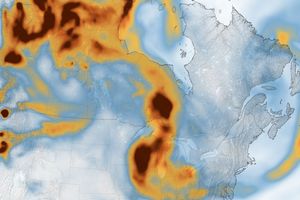
























Fires in central and western Canada impacted air quality in late June and early July 2006. Smoke includes carbon monoxide, a gas that is toxic in high concentrations. The Measurements of Pollution in the Troposphere (MOPITT) sensor on NASA’s Terra satellite measured carbon monoxide between June 29 and July 5, 2006. This image maps the carbon monoxide that accumulated over the area during that period.
MOPITT measures carbon monoxide in parts per billion by volume (ppbv). A measurement of 100 ppbv means that out of every billion air molecules in the air column, 100 of them are carbon monoxide. In this image, the colors indicate the carbon monoxide concentrations, ranging from 0 (blue) to 300 (red). These measurements indicate the carbon monoxide concentration at approximately 3 kilometers above the Earth’s surface. Accumulations of carbon monoxide in excess of 150 ppbv are widespread, with small areas of concentrations near 300 ppbv. Patches of gray indicate areas where MOPITT could not collect data, likely due to clouds.
References & Resources
NASA image created by Jesse Allen, Earth Observatory, using data provided by the National Center for Atmospheric Research (NCAR) and the University of Toronto MOPITT Teams