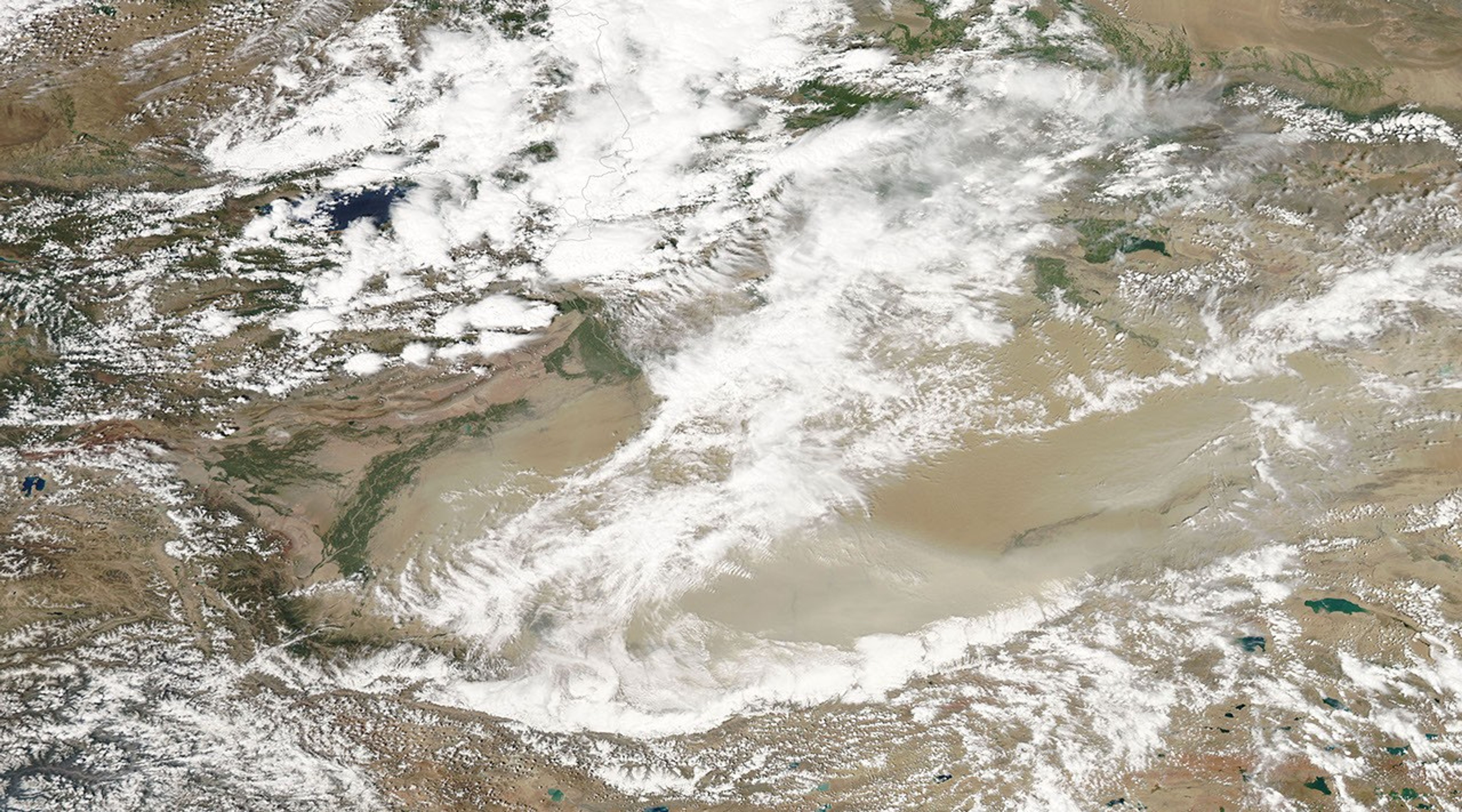
















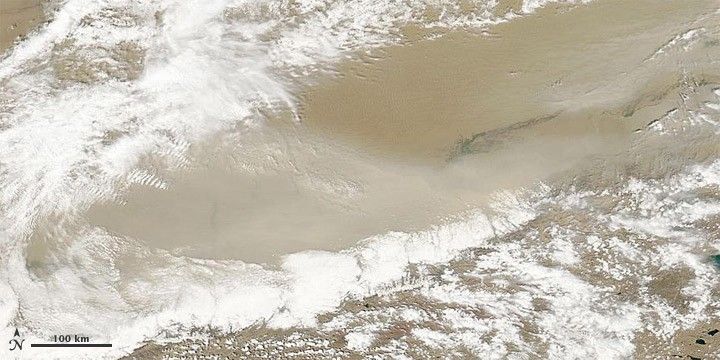
Dust stirred in western China’s Taklimakan Desert at the beginning of August 2012. The Moderate Resolution Imaging Spectroradiometer (MODIS) on NASA’s Aqua satellite captured this natural-color image on August 2, 2012. It shows dust and clouds along the desert’s southern rim.
The Taklimakan Desert sits inside the Tarim Basin, and it is the biggest, hottest, driest desert in China. Wind and water scrape the rocks of the steep slopes around the basin, wearing away fine sediments that are then deposited near the bottom of the basin. Marching sand dunes, some reaching a height of 200 meters (650 feet), cover about 85 percent of the desert floor, and the contents of these dunes provide ample material for dust storms that generally blow eastward out of the desert.
In early August 2012, clouds—perhaps associated with the same weather system that stirred the dust—mixed with that dust over the Taklimakan. Near the desert’s southern rim, the dust was thick enough to completely hide the desert floor below.
References & Resources
- World Wildlife Fund, McGinley, M. (2007). Taklimakan Desert. Encyclopedia of Earth. Accessed August 3, 2012.
NASA image courtesy LANCE MODIS Rapid Response Team, Goddard Space Flight Center. Caption by Michon Scott.