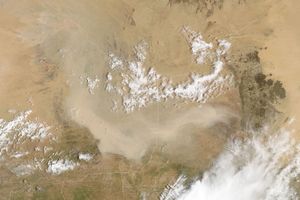














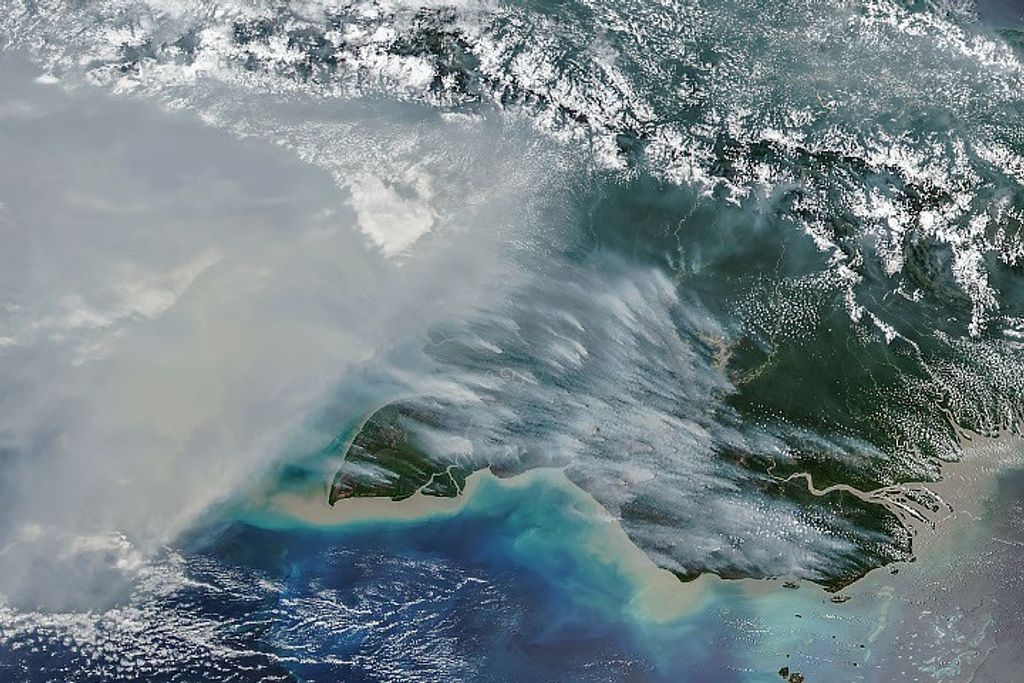
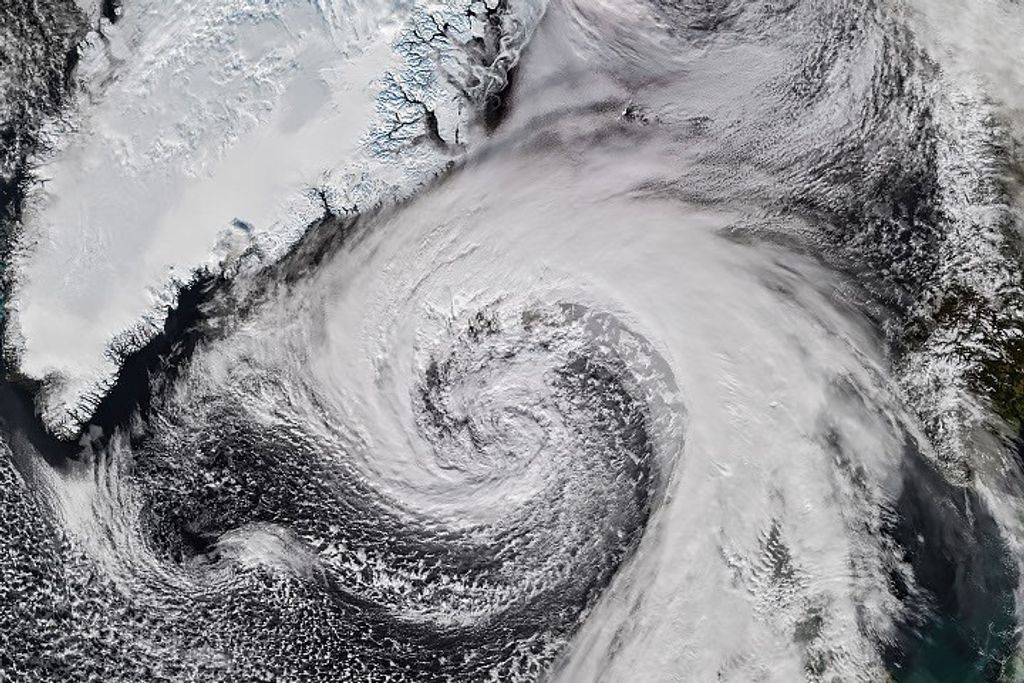









Dust plumes formed over the Taklimakan Desert in mid-August 2009. The Moderate Resolution Imaging Spectroradiometer (MODIS) on NASA’s Terra satellite captured this image of the western half of the desert on August 15, 2009, on the third consecutive day of dust storm activity. Nearly opaque dust not only fills the western half of the Tarim Basin in which the Taklimakan Desert sits, but even pushes past the basin’s northwestern rim. From its western edge, the dust cloud forms a V shape that opens toward the east. The dust’s thickness may be slightly exaggerated in this image as this area has been observed near the edge of the satellite swath (where the satellite has to look through a longer path of the atmosphere to see the ground).
The Taklimakan Desert sits between the mountain ranges of the Tien Shan (or Tian Shan) in the north and the Kunlun Shan in the south. Far from any ocean, the desert experiences few, if any, effects of the rainy season of the Asian monsoon that waters other parts of the continent. Because the basin lacks drainage, any water that enters it can only evaporate away, leaving behind salt. The Taklimakan Desert qualifies as China’s biggest, hottest, and driest. It also qualifies as one of the world’s largest shifting sand deserts, with dunes reaching a height of up to 200 meters (656 feet).
References & Resources
- World Wildlife Fund, McGinley, M. (2007). Taklimakan Desert. Encyclopedia of Earth. Accessed August 17, 2009.
NASA image courtesy MODIS Rapid Response Team, Goddard Space Flight Center. Caption by Michon Scott.