















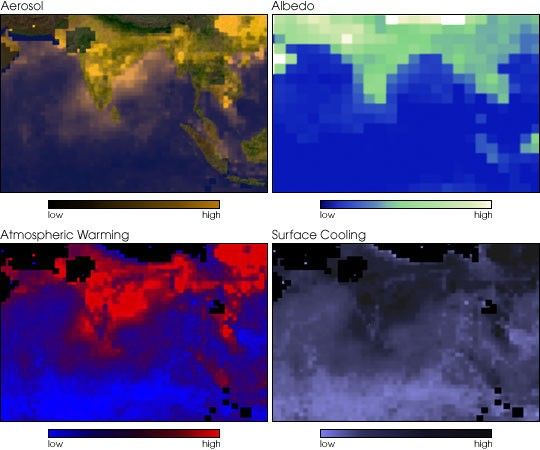
Aerosols that contain black carbon both absorb and reflect incomingsunlight. Even as these atmospheric particles reduce the amount ofsunlight reaching the surface, they increase the amount of solar energyabsorbed in the atmosphere, thus making it possible to both cool thesurface and warm the atmosphere. The images above show satellite measurementsof the region studied during the Indian Ocean Experiment (INDOEX)—a vastregion spanning the Arabian Sea and Bay of Bengal (west to east), andfrom the foot of the Himalayan Mountains, across the Indian subcontinentto the southern Indian Ocean (north to south).
The 8-day composite image at upper left shows aerosol pollution (brownishpixels) in the lower atmosphere over the INDOEX study area, as measuredby the Moderate-resolution Imaging Spectroradiometer (MODIS) aboardTerra. These data were composited from March 14-21, 2001.
The upper right image shows the total solar energy reflected back to space,as measured by the Clouds and Earth's Radiant Energy System (CERES)aboard Terra. White pixels show high values, greens are intermediatevalues, and blues are low. Note how the aerosols, particularly over theocean, increase the amount of energy reflected back to space.
The lower left image shows the absorption of the black carbon aerosols in theatmosphere. Where the aerosols are most dense, the absorption ishighest. Red pixels indicate the highest levels of absorption, blues arelow.
The lower right image shows that the aerosol particles reduce the amount ofsunlight reaching the surface. Dark pixels show where the aerosols exerttheir cooling influence on the surface (or a high magnitude of negativeradiative forcing). The bright pixels show where there is much lessaerosol pollution and the incoming sunlight is relatively unaffected.
For more information, animations, and high-resolution images, read New NASA Satellite Sensor and Field Experiment Shows Aerosols Cool the Surface but Warm the Atmosphere.
References & Resources
Images and animations by Tom Bridgman, NASA GSFC Science Visualization Studio; Data courtesy Terra CERES and MODIS Science Teams, NASA LaRC and GSFC, and Scripps Institution of Oceanography
None