






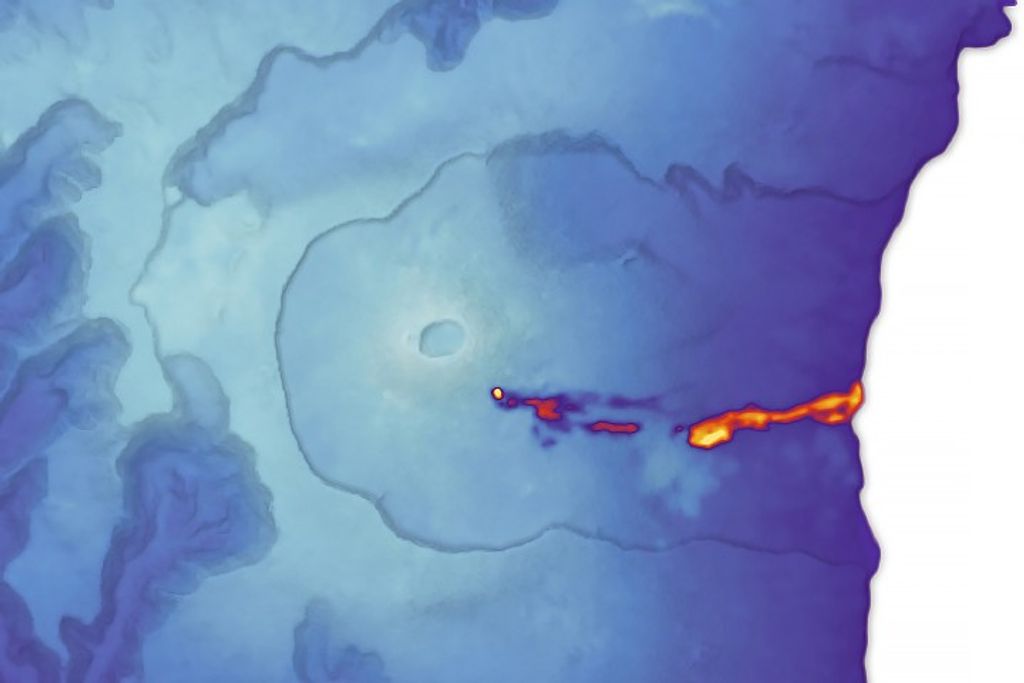




















In late May 2015, the highest volcano in the Galapagos Islands erupted for the first time in 33 years. The explosive eruption at Wolf volcano on Isabela Island sent volcanic gases and ash roughly 15 kilometers (50,000 feet) into the sky, while lava flowed through a fissure, down eastern and southeastern slopes, and eventually reached the sea. In early June, the sulfur-rich lava flows on the slopes appeared to subside.
The wide image and closeup of Wolf was acquired on June 11, 2015, by the Advanced Spaceborne Thermal Emission and Reflection Radiometer (ASTER) on the Terra satellite. The false-color images combine near-infrared, red, and green light (ASTER bands 3-2-1), with vegetated areas appearing in red and lava generally appearing charcoal or black. Note, however, the infrared (IR) image on the top right, where the heat signature of the freshly placed lava appears as white streaks. (The image is smaller because the sensor has lower resolution.)
From June 12-16, seismologists from Ecuador’s Instituto Geofisico-Escuela Politécnica Nacional (IG) detected increased activity inside the caldera near the southern rim. The 7-kilometer (4 mile) wide caldera is nearly 700 meters deep. New lava is paving over deposits that were laid down in a 1982 eruption. Wolf is a shield volcano, with relatively broad but gentle slopes (like a Polynesian warrior’s shield) where one lava flow tend to spread out across previous flows. The volcano rises 1,710 meters (5,609 feet) above sea level, sitting near the equator and atop a volcanic hot spot.
In the early days of the 2015 eruption, conservation groups feared for the safety of a rare species of pink iguanas, which are only found on Isabela Island, and for the local population of giant tortoises and yellow iguanas. Neither species has been endangered so far by the eruption because ash and lava have tended to flow east and southeast, while the animals live mostly to the north and west of the summit.
References & Resources
- Eruptions Blog by Erik Klemetti (2015, May 25) New Eruption Started in the Galapagos Islands. Accessed June 29, 2015.
- Galapagos Conservancy (2015, June 18) Pink iguana population stable following Wolf Volcano Eruption. Accessed June 29, 2015.
- Global Volcanism Program, via The Smithsonian Institution (2015) Wolf Volcano. Accessed June 29, 2015.
- The Guardian (2015, June 4) Wolf volcano erupts on Galapagos Island. Accessed June 29, 2015.
- Instituto Geofisico-Escuela Politécnica Nacional (2015, June 26) Informe Volcánico Especial Galápagos No. 4. Accessed June 29, 2015.
- NASA Earth Observatory (2009, February 13) Wolf Volcano, Galapagos Islands.
- Volcano Discovery (2015, June 28) Wolf volcano (Isabela Island, Galapagos): strong eruption 25 May 2015. Accessed June 29, 2015.
NASA Earth Observatory image by Jesse Allen, using data from NASA/GSFC/METI/ERSDAC/JAROS, and U.S./Japan ASTER Science Team. Caption by Mike Carlowicz.





