



















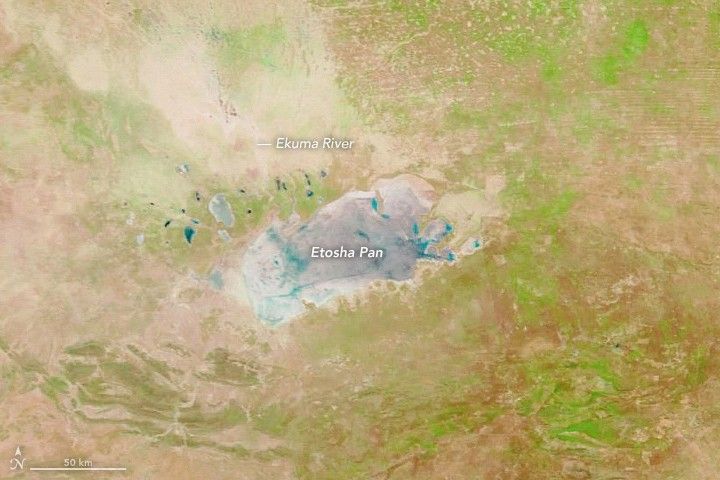
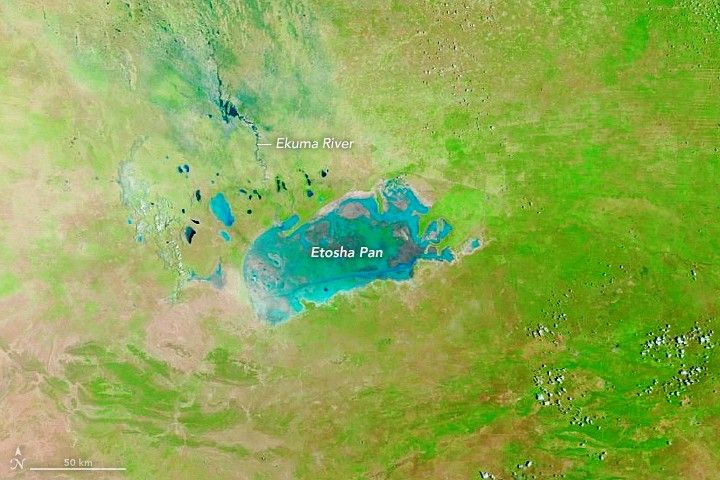
December 11, 2019-January 17, 2020
Etosha Pan Refills
The Etosha Pan in northern Namibia is an ephemeral wonder. For much of the year, the salt pan is bone dry, and winds pick up its dust and salt and spread it across the dry landscape. But in years when the wet season brings abundant rains, the large, shallow basin stands out as a temporary oasis.
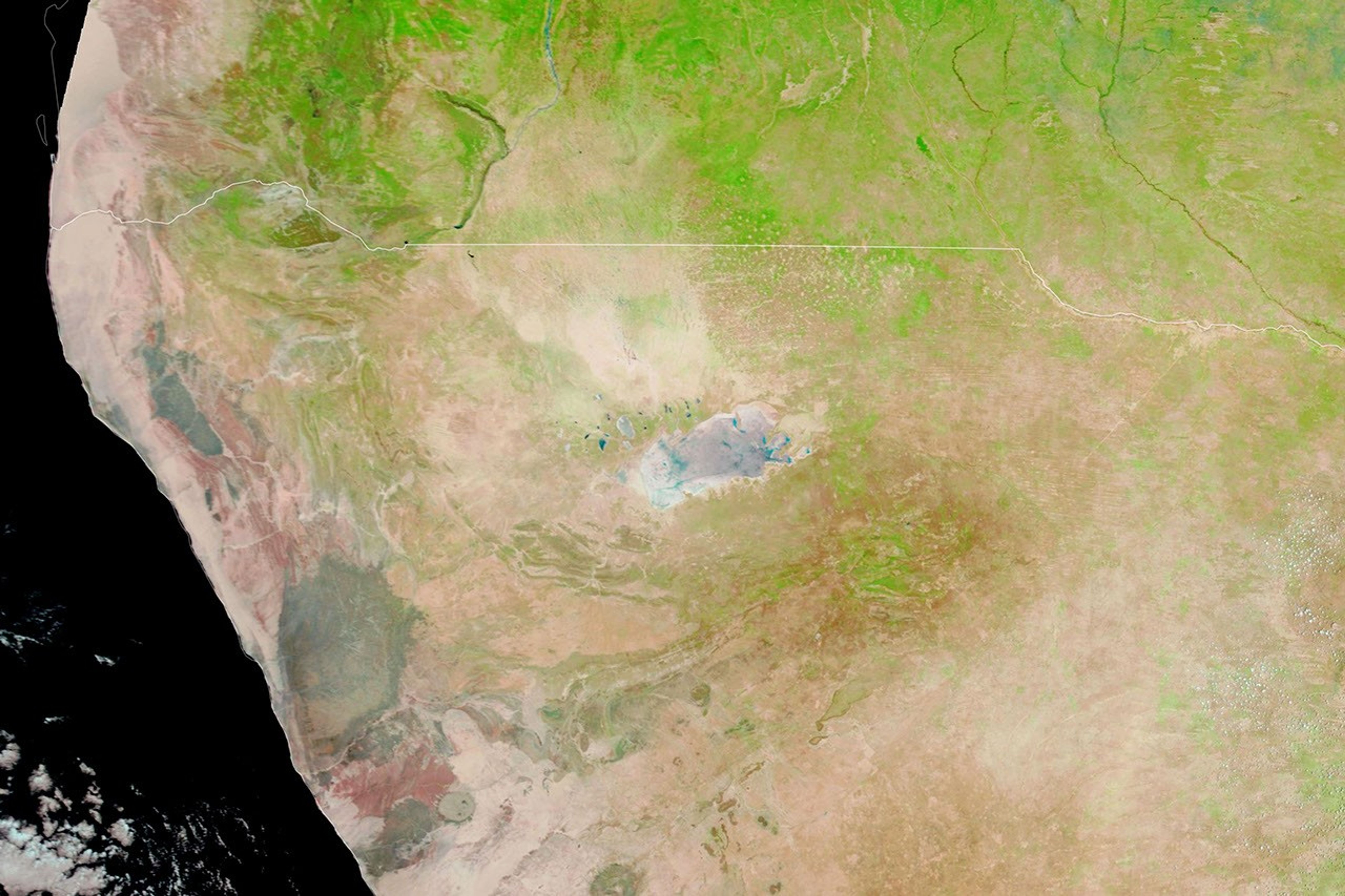
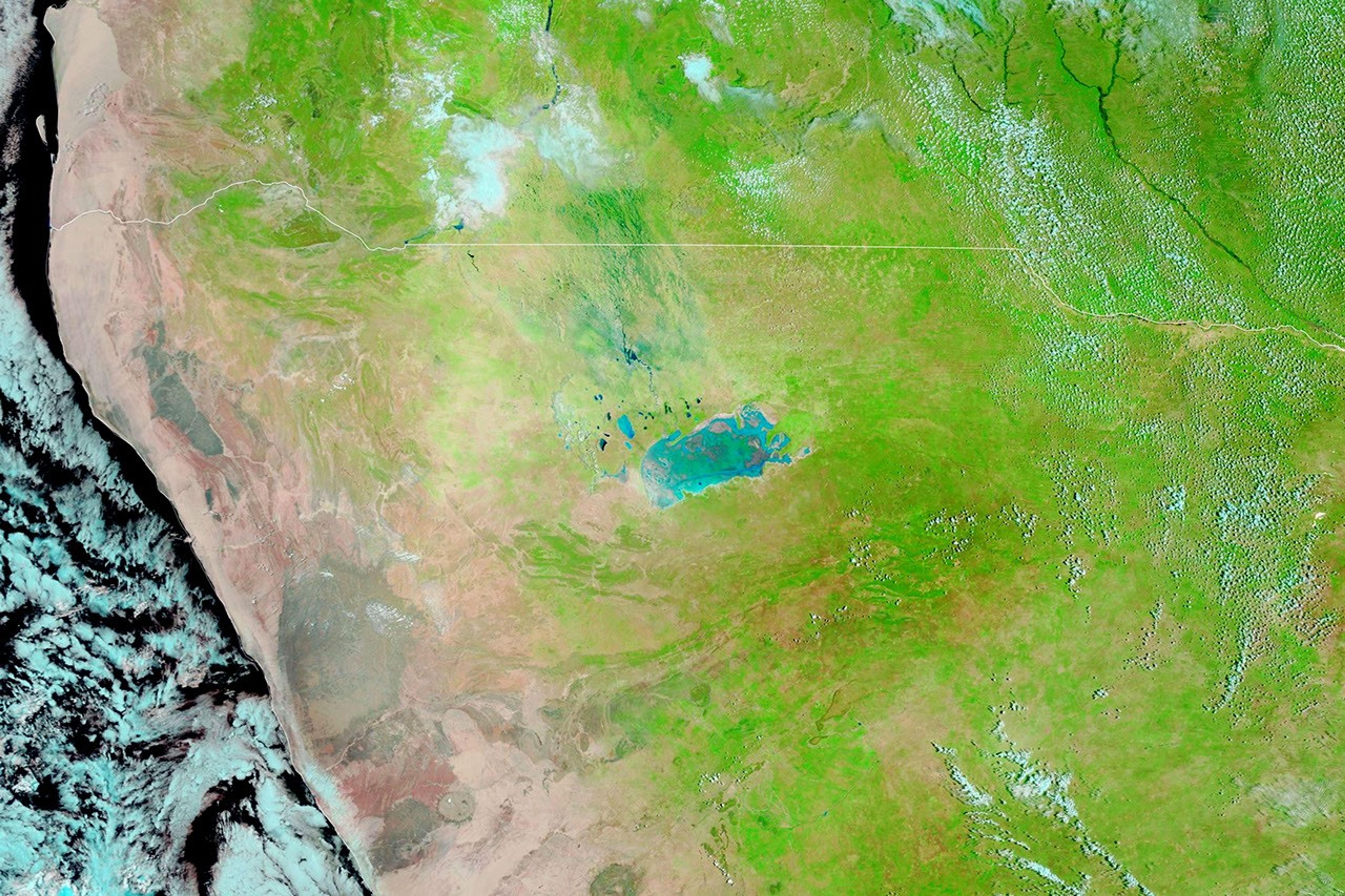
After months of drought in southwest Africa, rains finally came to the region and filled streams and rivers with enough water to reach the inland salt pan. According to several news reports from Namibia, most of the country received above-average rainfall starting in late December 2019. The central and northern reaches of Namibia around the Etosha Pan were particularly soaked, as were parts of Zambia and Angola.
The Moderate Resolution Imaging Spectroradiometer (MODIS) on NASA’s Terra satellite acquired false-color images of Etosha Pan on December 11, 2019 and January 17, 2020. The image combines visible and near-infrared light such that vegetation appears bright green and water is teal.
The Etosha Pan stretches roughly 130 kilometers by 50 kilometers (80 by 30 miles), though it is quite shallow. The basin is connected to hundreds of small streams and channels that start in Angola, but it takes a substantial amount of rain for water to move far enough through the system (seeping into the riverbeds along the way) to fill the pan. The most prominent tributary is the Ekuma River. Once that water arrives, the area becomes a haven for flamingos, pelicans, and other birds, as well as rhinos and impalas.
The water in Etosha Pan this year has a chance to stay around for awhile. According to a forecast from the Southern African Regional Climate Outlook Forum, Namibia is expected to receive high rainfall in the second half of the rainy season, which lasts through March. However, reservoirs and lakes in the region are still quite low—roughly 20 percent of capacity.
References & Resources
- All Africa (2020, January 14) Zimbabwe: Lake Kariba Fails to Generate Water Despite Rains. Accessed January 21, 2020.
- NASA Earth Observatory (2020) Long-Term Drought in Africa.
- NASA Earth Observatory (2013, March 12) World of Change: Mapping Fire in Etosha National Park.
- The Namibian (2020, January 15) Namibia gets above-average rainfall. Accessed January 21, 2020.
- New Era (2020, January 21) More rains expected until March. Accessed January 21, 2020.
- New Era (2020, January 15) Torrential rain leaves parts of Zambezi flooded. Accessed January 21, 2020.
NASA Earth Observatory images by Lauren Dauphin, using MODIS data from NASA EOSDIS/LANCE and GIBS/Worldview. Story by Michael Carlowicz.