














Record-breaking rainfall brought devastating flash floods and landslides to Missouri, Kentucky, and other parts of the central United States in the last week of July 2022. As noted previously by the Intergovernmental Panel on Climate Change and the American Meteorological Society, extreme precipitation events and weather are becoming more likely with climate change.
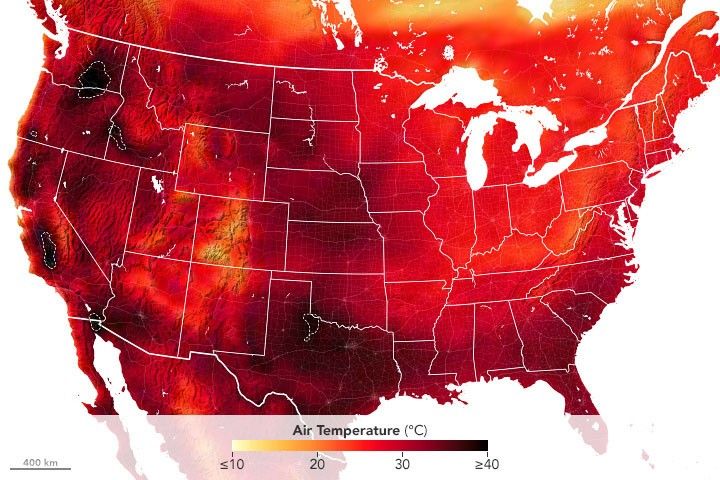
The map above depicts a satellite-based estimate of rainfall from July 25-31, 2022. The darkest reds reflect the highest rainfall amounts, with broad swaths of Missouri, Arkansas, Illinois, Indiana, and Kentucky receiving more than 20 centimeters (8 inches) of rain. The data are remotely sensed estimates that come from the Integrated Multi-Satellite Retrievals for GPM (IMERG), a product of the Global Precipitation Measurement (GPM) satellite mission. Due to the averaging of the satellite data, local rainfall amounts may be significantly higher when measured from the ground.
The deluge started on July 25-26 around St. Louis, Missouri, where a series of “training thunderstorms” rolled through the region one after the other. The National Weather Service (NWS) noted that rainfall rates occasionally reached two inches per hour, and nearly 8 inches fell in eight hours across a long swath from Montgomery County, Missouri, to St. Clair County, Illinois. Lambert International Airport (St. Louis) set a new record with 8.64 inches (21.95 cm) of rain in 24 hours; the previous record was set in 1915 by the remnants of a hurricane.
NWS added that 25 percent of the city’s annual rain fell in just 12 hours; 7.31 inches (18.57 cm) is the normal total for July and August combined. Flash floods swamped several parts of the St. Louis metro area, causing extensive damage to residences and businesses. Two days later, several hours of evening downpours fell on saturated soils and into tributaries and storm drains that were already overflowing, leading to a second bout of flash floods.
In Appalachian mountain communities of eastern Kentucky, heavy rain on July 27-28 quickly ran down hillsides, causing mudslides and filling rural valleys with flood water. Dozens of people died and hundreds remain unaccounted for amid power and communications outages. Between 8 and 10 inches (20 to 25 cm) of rain fell within 48 hours, and 4 more inches arrived on July 31. The state and federal government has declared much of eastern Kentucky a major disaster area. The NWS office in Jackson, Kentucky, recorded its wettest July on record with 14.86 inches (37.74 cm) of rain.
NWS noted that both the St. Louis and Kentucky rains and flash floods were one-in-1000 years events. Recent events and scientific analyses suggest that once-rare events are becoming more likely as Earth’s atmosphere warms and can hold more moisture.
The floods come just a few months after Missouri, Illinois, and Kentucky were struck by extreme thunderstorms and tornadoes in wintertime.
References & Resources
- Associated Press (2022, August 2) More rain, more bodies in flooded Kentucky mountain towns. August 2, 2022.
- Reuters (2022, August 2) Kentucky floods kill at least 37 as more storms forecast. August 2, 2022.
- NASA Goddard Institute for Space Studies (2012, August) The New Climate Dice: Public Perception of Climate Change. August 2, 2022.
- NASA Jet Propulsion Laboratory (2022, April 26) Clusters of Weather Extremes Will Increase Ricks to Corn Crops, Society. August 2, 2022.
- National Weather Service - Jackson, Kentucky (2022, August 1) July 2022 climate summary. August 2, 2022.
- National Weather Service - St. Louis (2022, August 1) July 26, 2022 Historic Flash Flooding in the St. Louis Metro Area. August 2, 2022.
- Nature (2018, November 22) Why extreme rains are gaining strength as the climate warms. August 2, 2022.
- Yale Climate Connections (2022, July 29) Kentucky floods claim at least 16 lives, devastate region. August 2, 2022.
- Yale Climate Connections (2022, July 26) Record rain in St. Louis is what climate change looks like. August 2, 2022.
NASA Earth Observatory image by Lauren Dauphin, using IMERG data from the Global Precipitation Mission (GPM) at NASA/GSFC. Story by Michael Carlowicz .