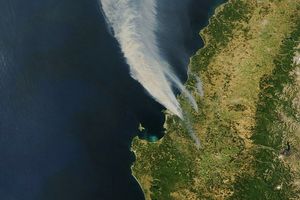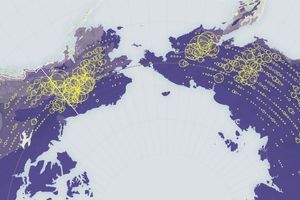










Like many other locations across the world, agricultural fires in Guinea-Bissau and Guinea have a daily cycle, with little activity in the morning and increasing amounts in the afternoon. This pair of images from the Moderate Resolution Imaging Spectroradiometer (MODIS) sensors on NASA’s Terra and Aqua satellites shows Senegal, a country on the western coast of Africa, on May 7, 2005, during the morning (local time) pass of the Terra satellite (top) and during the afternoon (local time) pass of the Aqua satellite (below). In the interval between the two passes (roughly 3 hours), the number of fires (marked in red) detected by the sensors increased dramatically.
The widespread nature of the fires, their location, and the time of year suggest these are agricultural fires being used to clear and renew pasture or farmland. While they are not necessarily immediately hazardous, such fires can have a strong impact on weather, climate, human health, and natural resources.
References & Resources
NASA image courtesy the MODIS Rapid Response Team, , NASA-GSFC.