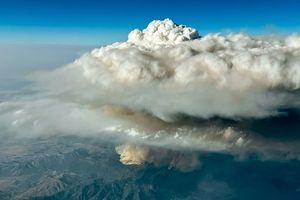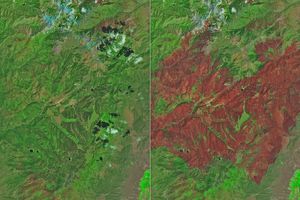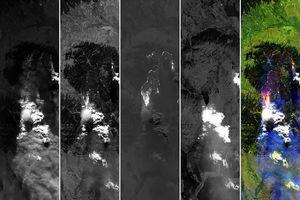


















On August 30, 2009, the Station Fire was aggressively spreading north of the city of Los Angeles. The northward-viewing camera of the Multi-Angle Imaging SpectroRadiometer (MISR) on NASA’s Terra satellite captured this image of the fire mid-morning on August 30. Heat, drought, and dense, dry underbrush all contributed to the Station Fire’s rapid spread.
Besides smoke plumes that blow toward the northeast, the fire has spawned pyrocumulus clouds—tall, pillowy clouds with well-defined borders. Pyrocumulus clouds are similar to regular cumulus clouds, but the heat that forces the air to rise (which leads to cooling and condensation of water vapor) comes from the fire instead of sun-warmed ground. The clouds appear as opaque white patches hovering over the smoke.
MISR observes the sunlit Earth continuously, and views the entire planet between 82 degrees north and 82 degrees south latitude every nine days. MISR was built and is managed by NASA’s Jet Propulsion Laboratory (JPL), Pasadena, California. JPL provides additional information related to this image.
References & Resources
Image courtesy JPL Photojournal. Caption by Michon Scott, based on Smoke from Station Fire Blankets Southern California.