

















Editor’s Note: Today’s caption is the answer to Earth Observatory’s August Puzzler.
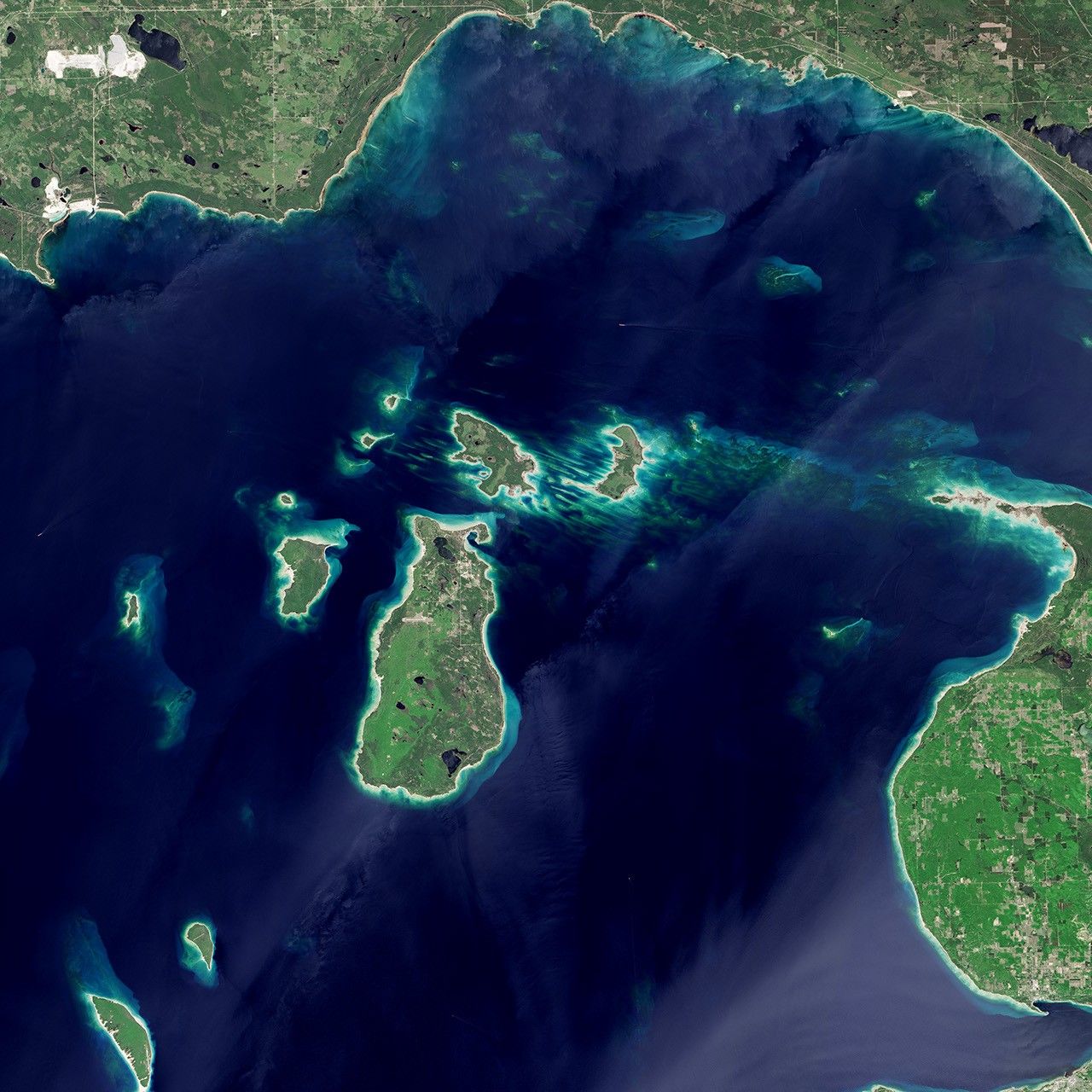
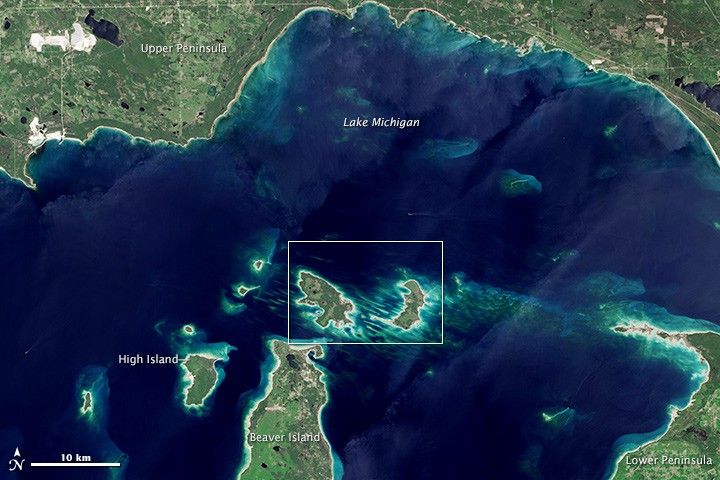
Over thousands of years, retreating glaciers scoured and carved out much of the basin that now holds Lake Michigan. But in some parts of the lake, patches of erosion-resistant rock still protrude above the water. A cluster of small islands in the far northern reaches of the lake—the Beaver Island archipelago—are composed of limestone bedrock covered with a layer of sand and gravel (glacial “till”).
Except for Beaver Island, the largest of the group, the islands are unpopulated. About 700 people live on Beaver Island, mainly in a small town on the northern part of the island. A Native American community survived on Garden Island until as recently as the 1900s, but the size of the community dwindled until the last remaining resident died in the 1940s.
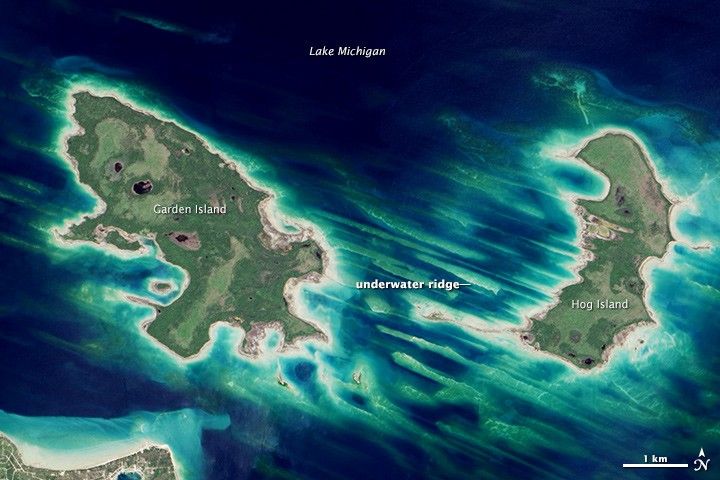
The Operational Land Imager (OLI) on Landsat 8 captured the top image of Garden and Hog islands on May 24, 2013. The lower image, a broader view, shows Beaver Island and the other islands in the context of the great lake. Dense forests, swamps, and sandy beaches dominate the landscape. Offshore, deeper waters appear dark blue, while shallow areas are turquoise.
The shallows around Garden and Hog islands contain numerous parallel rock ridges interspersed by deeper channels. These reef areas offer ideal spawning ground for various species of fish, notably lake trout and perch. Federal and state resource managers have attempted to replenish depleted lake trout populations by stocking northern Lake Michigan waters.
To make stocking as effective as possible, researchers have used airborne lidar to map the lake floor around the islands, producing detailed maps of spawning areas near Hog Island and at five other sites. Read more about that project here.
References & Resources
- Barnes et al (2003, July 3) Bathymetry and selected perspective views of 6 reef and coastal areas inââ¬Â¨ Northern Lake Michigan. Accessed August 23, 2013.
- Gillespie et alGeology of Michigan and the Great Lakes (pdf). Accessed August 23, 2013.
- NOAA Lake Michigan Geomorphology. Accessed August 23, 2013.
- State of Minnesota The Islands of the Beaver Group (pdf). Accessed August 23, 2013.
- University of Wisconsin (2012) Great Lakes: How They Were Made. Accessed August 23, 2013.
NASA Earth Observatory image by Jesse Allen and Robert Simmon, using Landsat data from the U.S. Geological Survey. Caption by Adam Voiland. Congratulations to Cyndy Hunting and CEM for being the quickest to solve the puzzler. Also congratulations to Shawn O for providing interesting details about the submerged ridges.