




















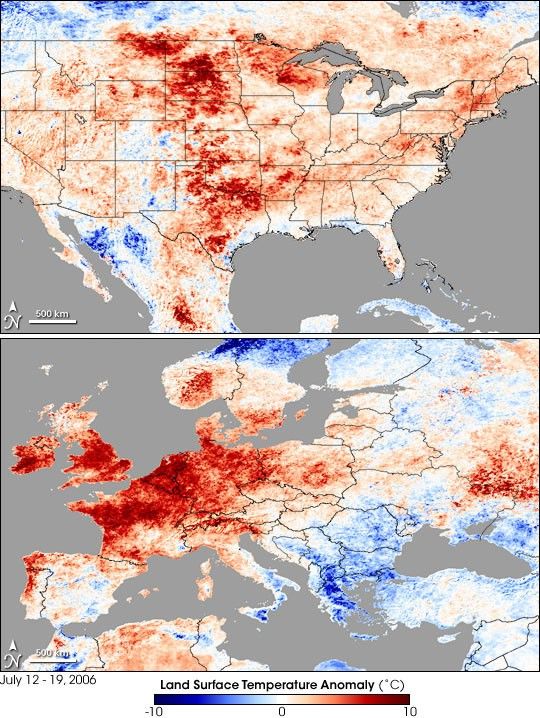
Deep red across both Europe and the United States in these land surface temperature images says one thing: July was hot. This image shows the difference in land surface temperatures from July 12-19, 2006, compared to the average temperatures during that period for the past six years (2000-2005). The measurements were made by the Moderate Resolution Imaging Spectroradiometer (MODIS) on NASA’s Terra satellite. Dark red shows areas where 2006 land surface temperatures were up to 10 degrees Celsius warmer than recent years.
Most of the United States was unusually warm, especially the U.S. Midwest from North Dakota to Texas. Across the Atlantic, Ireland, Britain, France, and Germany were extremely warm as well. Air temperatures in many parts of the United States soared to or past 40 degrees Celsius (about 100 degrees Fahrenheit), and Britain, Germany, and the Netherlands experienced their hottest July on record, reported the Associated Press and United Press International. Farmers on both sides of the Atlantic were facing major crop loss, and on both continents, power companies struggled to keep up with electricity demands.
References & Resources
NASA image created by Jesse Allen, Earth Observatory, using data provided courtesy of Zhengming Wan, MODIS Land Surface Temperature Group, Institute for Computational Earth System Science , University of California, Santa Barbara.