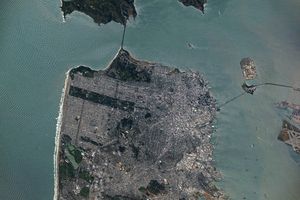





















A powerful storm system brought high winds and heavy downpours toparts of central and northern California, causing localizedflooding and knocking out power in the San Francisco Bay area.The weather station on Angel Island in San Francisco Bay measuredstrong wind gusts, including one that peaked at 156 kilometers perhour (98 miles per hour). This storm system was brought in by apowerful subtropical jet steam, which provided moisture and strongupper-level winds. The system spawned thunderstorms that broughtlightning and sizeable hail around Sacramento. Coastal regionsalso measured heavy rainfall, though there was no widespreadflooding there.
The Tropical Rainfall Measuring Mission (TRMM) monitors rainfallbased on a near-real-time, Multi-satellite Precipitation Analysis(MPA) at NASA’s Goddard Space Flight Center. This imageshows MPA rainfall totals for the central and northern West Coastfrom February 22 to March 1, 2006. The highest rainfall totals forthe period are around 120 millimeters, about 5 inches, shown inred. These rainfall amounts occur along the western slopes of the coastal range,in the Klamath Mountains near the border with Oregon, and over thenorthern Sierra Nevada on the downwind side of the SacramentoValley. The mountains forced moisture from the humid air risingover the slopes. MPA rainfall totals for the San Francisco Bayarea are rather light, while the areas around Sacramento receiveda little over 70 millimeters, about 3 inches, shown in the brighter greens.
The TRMM satellite was launched into service in November of 1997.It was engineered to measure rainfall over the global Tropicsusing both passive and active sensors, including the first andonly precipitation radar in space. TRMM is a joint missionbetween NASA and the Japanese space agency, JAXA.
References & Resources
Image produced by Hal Pierce (SSAI/NASA GSFC) and caption by Steve Lang (SSAI/NASA GSFC).