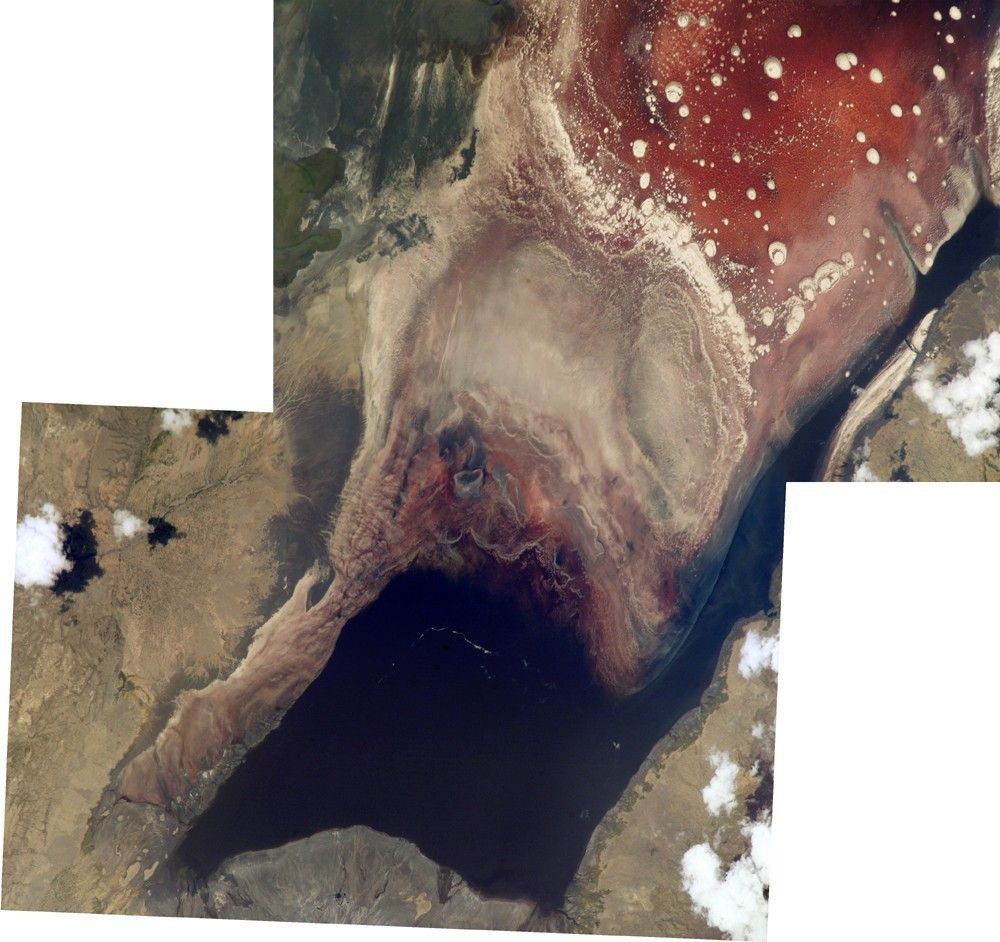

















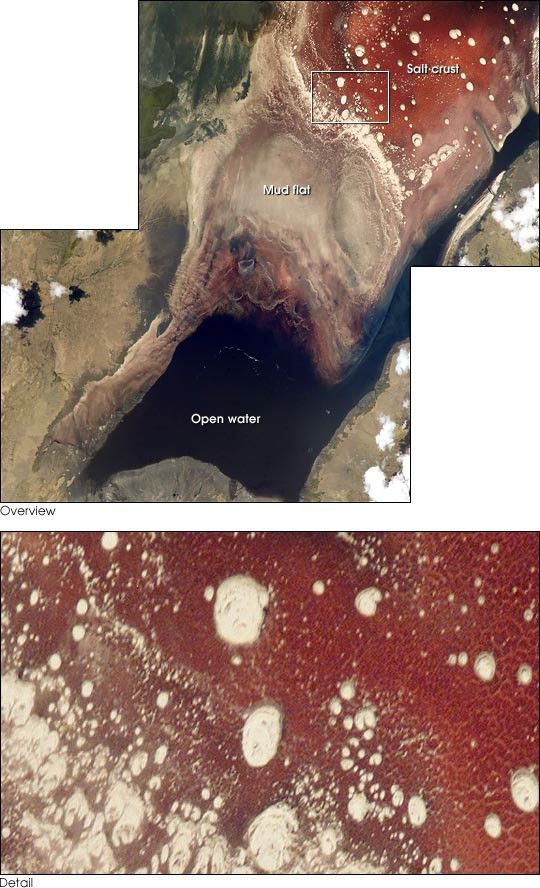
If Lake Natron, in Africa’s Great Rift Valley had a colortheme, it would be pink. The alkali salt crust on the surface of thelake is often colored red or pink by the salt-loving microorganisms thatlive there. And the lake is the only breeding area for the 2.5 millionLesser Flamingoes thatlive in the valley. These flamingoes flock along saline lakes in theregion, where they feed on Spirulina (a blue-green algae with redpigments). Lake Natron is the only breeding location for LesserFlamingoes because its caustic environment is a barrier againstpredators trying to reach their nests. The temperatures in the mud canreach 50 degrees Celsius (122 degrees Farenheit), and depending onrecent rainfall, the alkalinity can reach a pH of 9 to 10.5 (almost asalkaline as straight ammonia). Even more amazing than the ability of theflamingoes to live in these conditions, is the fact that an endemicspecies of fish, the alkaline tilapia thrives in the waters at the edgesof the hotspring inlets. Because of the unique biodiversity,Tanzania named the Lake Natron Basin to the RamsarList of Wetlands of International Importance on 4 July2001.
This mosaic of photographs of the southern portion of Lake Natronshows the largest open lagoon area, and island mud flat, and a largearea of pink salt crust. The images were taken by astronauts from theInternational Space Station on 11 November 2002, using a digital camera,400 mm lens, and 2 x extender, in order to capture the details of thesalt crust structures. The colors show the actual colors viewed by theastronauts. Each time the lake is photographed, there are differencesin the pattern of its salt crust, and the red colors of the blue-greenalgae and bacteria on the surface of the crust.
Previous examples of the appearance of Lake Natron salt crusts as photographed from the Space Shuttle:
February 1984
March 1989
July 1999
References & Resources
ISS005-E-2054, ISS005-E-2055, and the mosaic were provided by the Earth Sciences and Image Analysis Laboratory at Johnson Space Center. Additional images taken by astronauts and cosmonauts can be viewed at the NASA-JSC Gateway to Astronaut Photography of Earth.