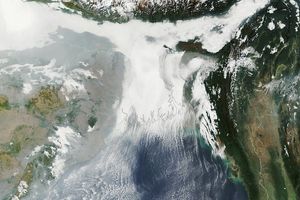






















Meteorologists break convective clouds into two main groups: closed-celled and open-celled. On February 1, 2016, the Moderate Resolution Imaging Spectroradiometer on NASA’s Terra satellite acquired an image that juxtaposes both types. The upper image shows an expanse of closed-celled clouds, while the lower image offers a more detailed view of open-celled clouds.
Closed-cell clouds look similar to a capped honeycomb from above, with opaque cumulus clouds at the center of the cells. Open-celled clouds have the opposite look. Rather than being at the center of a cell, lines of clouds trace the cell borders, leaving the centers cloud-free.
Both open- and closed-cell clouds get their general shape from Rayleigh-Bernard cells, the hexagonal patterns that form naturally when fluids are heated from below. The main difference between the two cloud types relates to the flow of air. Moist, warm air rises in the center of closed cells and sinks around the edges. Open-cell clouds have air sinking in the center of cells and rising along the edges. In both cases, clouds form when parcels of warm air rise, expand, and cool enough for water vapor to condense into liquid droplets.
The presence of open or closed-cell stratocumulus clouds offer clues about the distribution of precipitation. Uninterrupted decks of closed-cell clouds generally produce little to no rain, whereas open cells open up as rain begins to fall. In this image, rain is likely falling in the linear band of open-celled clouds that cuts through the center of the image.
Decks of closed-cell clouds tend to be more stable than their open-celled counterparts. Studies of satellite observations show that pockets of open cells tend to oscillate, forming and disappearing over a period of about three hours. In contrast, closed-cell clouds keep the same structure for more than ten hours.
While quite common, cellular cloud patterns were unknown to meteorologists until the launch of the first weather satellites. The closely-packed mesh of clouds were too large to be recognized by ground-based instruments and even airplanes. The first image of open-cell convection was published in February 1961, after the launch of the TIROS-1 satellite.
References & Resources
- American Meteorological Society Convection Cell. Accessed February 4, 2016.
- Conway, E. (1997) An Introduction to Satellite Image Interpretation: Open-Cell Convection (Baltimore, MD: Johns Hopkins University Press)
- Feingold, G. et al, (2010, August 12) Precipitation-generated oscillations in open cellular cloud fields. Nature, 466, 849-852.
- Koren, I. (2013, August 27) Adaptive behavior of marine cellular clouds. Scientific Reports, 3 (2507).
- Krueger, A. & Fritz, S. (1961, February) Cellular Cloud Patterns Revealed by Tiros 1. Tellus 13 (1).
- NASA Earth Observatory (2002, April 25) Closed Small Cell Clouds in the South Pacific. Accessed February 4, 2016.
- NASA Earth Observatory (2002, February 23) Open-cell cloud formation over the Bahamas. Accessed February 4, 2016.
- Noteboom, S. (2006) Open Cell Convection and Closed Cell Convection. Accessed February 4, 2016.
- Weather Underground (2012, December 14) Open-Cell Convection. Accessed Accessed February 4, 2016.
NASA image by Jeff Schmaltz, LANCE/EOSDIS Rapid Response. Caption by Adam Voiland.