




















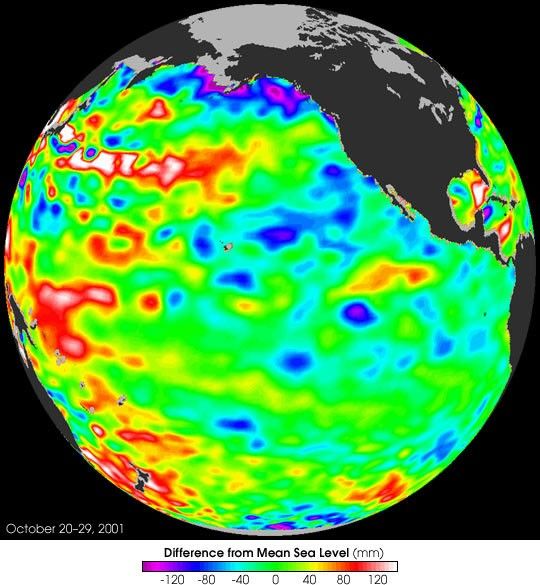
Like fall and winter of 2000, this year’s TOPEX/Poseidon satellite datashows that the Pacific Ocean continues to be dominated by the strongPacific Decadal Oscillation, which is larger than the El Niño/La Niñapattern. The data, taken during a ten-day collection cycle ending Oct.29, 2001, show that the near-equatorial ocean has been very quiet in thepast year, and sea levels and sea surface temperatures are near normal.Above-normal sea surface heights and warmer ocean temperatures,indicated by the red and white areas, still blanket the far westerntropical Pacific and much of the north mid-Pacific. Red areas are about10 centimeters (4 inches) above normal; white areas show the sea surfaceheight is between 14 and 32 centimeters (6 to 13 inches) abovenormal.
In the western Pacific, the buildup of the Pacific DecadalOscillation pattern, first noted by TOPEX/Poseidon oceanographers morethan three years ago, has outlasted both the El Niño and La Niña of thepast few years. This warmth contrasts with the Bering Sea, Gulf ofAlaska and the west coast of the United States, where lower than normalsea surface levels and cool ocean temperatures continue, as indicated bythe blue areas. The blue areas are between 5 and 13 centimeters (2 and 5inches) below normal, while the purple areas range from 14 to 18centimeters (6 to 7 inches) below normal.
According to oceanographer Dr. William Patzert of NASA’s JetPropulsion Laboratory, Pasadena, Calif., the striking similarity betweendata taken in 2000 and the same time period in 2001 indicates thatwinter weather forecasts for this year will be similar to last year.
References & Resources
Image courtesy TOPEX/POSEIDON, NASA Jet propulsion Laboratory