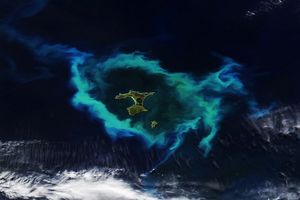




















Late May 2010 brought peacock-hued swirls of blue and green to the North Atlantic. The iridescent waters formed a giant arc hundreds of kilometers across, extending from west of Ireland to the Bay of Biscay. The Moderate Resolution Imaging Spectroradiometer (MODIS) on NASA’s Terra satellite captured this natural-color image on May 22, 2010. The vibrant colors are from tiny organisms, phytoplankton, that grow explosively in the North Atlantic—from Iceland to the shores of France—in the spring and summer.
Phytoplankton require nutrients to reproduce, and phytoplankton blooms are often tied to events that bring nutrients to the ocean surface, such as dust plumes. Volcanic ash can also contribute nutrients for phytoplankton blooms. Researchers from the University of Hamburg’s Institute of Geophysics found that a 2008 eruption of the Kasotochi Volcano in the Aleutian Islands generated a massive phytoplankton bloom in the Northeast Pacific Ocean. They concluded that iron-rich ash falling on waters that are otherwise poor in iron can create conditions in which phytoplankton thrive.
MODIS acquired this image after weeks of eruptive activity at Iceland’s Eyjafjallajökull Volcano. Considering that ash plumes from that volcano closed airspace over much of Europe, one might wonder whether ash provided fertilizer for this bloom. In this case, the answer is probably no. The North Atlantic Ocean already contains plenty of iron, and these waters experience massive phytoplankton blooms every spring and summer.
References & Resources
- Langmann, B., Zaksek, K., Hort, M., Duggen, S. (2010, April 27). Volcanic ash as fertiliser for the surface ocean. Atmospheric Chemistry and Physics, 10, 3891-3899.
NASA image by Jeff Schmaltz, MODIS Rapid Response Team. Caption by Holli Riebeek and Michon Scott.