
























July 2, 2001
Rare Earth in Bayan Obo
With names like cerium, lanthanum, and ytterbium, rare earth elements aren’t exactly household names. But the consumer products they are used in—such as magnets, camera lenses, and batteries—certainly are.
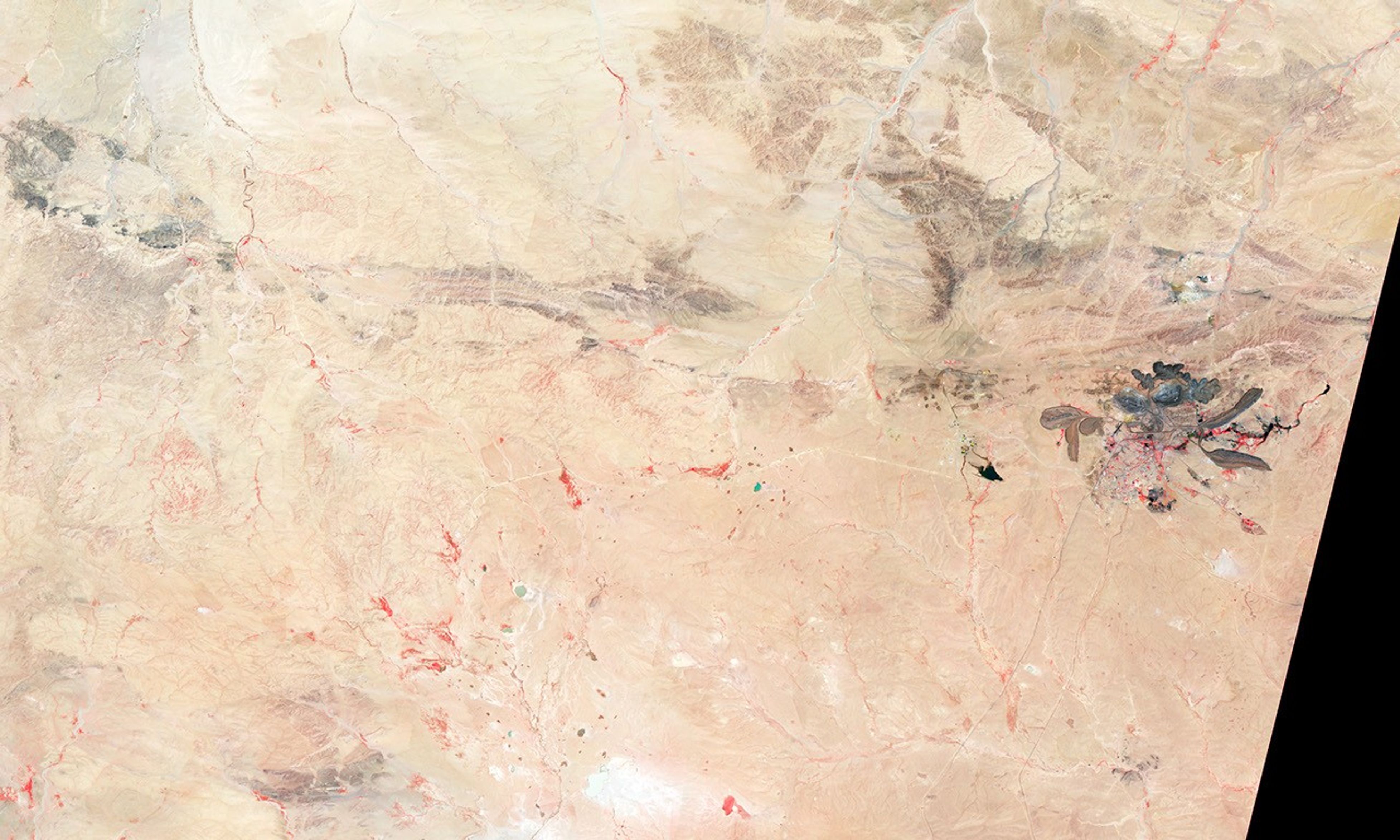
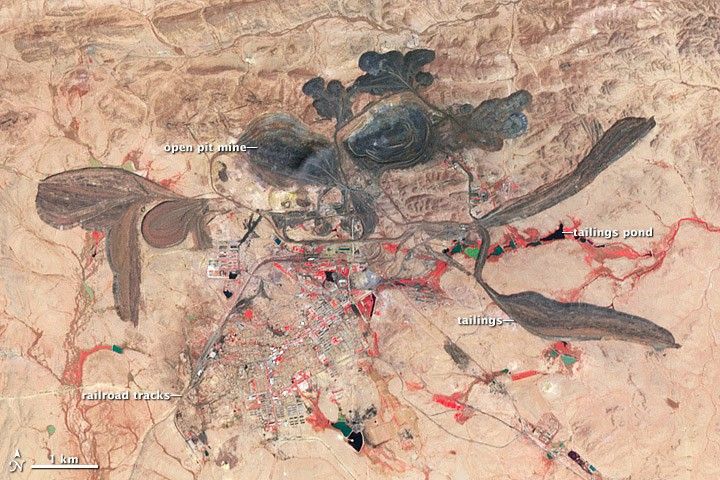
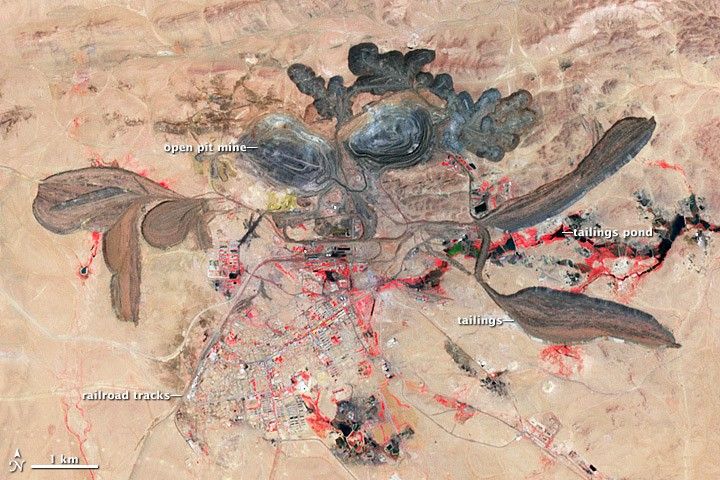
There are 17 rare earth elements in all, but these key metals aren’t as rare as the name suggests. (In fact, some are relatively abundant in Earth’s crust.) The vast majority of rare earths—96 percent of the market—come from China. About half come from Bayan Obo, the mine shown above. On July 2, 2001 (top) and June 30, 2006 (bottom), the Advanced Spaceborne Thermal Emission and Reflection Radiometer (ASTER) on NASA’s Terra satellite acquired these false-color views of the mine in the Nei Mongol Autonomous Region.
Vegetation appears red, grassland is light brown, rocks are black, and water surfaces are green. Two circular open-pit mines are visible, as well as a number of tailings ponds and tailings piles. Use the image comparison tool to see how the mine has grown larger since 2001. According to a U.S. Geological Survey (USGS) report, China produced about 81,000 tons of rare earth metals in 2001; the number jumped to about 120,000 by 2006.
Such an intensive mining operation has a definite impact on the surrounding environment. According to the Chinese Society of Rare Earths, 9,600 to 12,000 cubic meters (340,000 to 420,000 cubic feet) of waste gas—containing dust concentrate, hydrofluoric acid, sulfur dioxide, and sulfuric acid—are released with every ton of rare metals that are mined. Approximately 75 cubic meters (2,600 cubic feet) of acidic wastewater, plus about a ton of radioactive waste residue are also produced.
According to a USGS report, the United States has enough rare earth elements in the ground to meet global demand for decades to come. But until California’s Mountain Pass Mine recently reopened, few of these minerals were being mined in the U.S.
References & Resources
- Tse, Pui-Kwan. (2011) China’s Rare-Earth Industry. U.S. Geological Survey Open-File Report 2011-2042.
- Long, Keith. (2010) The Principal Rare Earth Elements Deposits of the United States—A Summary of Domestic Deposits and a Global Perspective. U.S. Geological Survey Open-File Report 2011ââ¬â104.
- Long, Keith. (2011) The Future of Rare Earth Elements—Will These High-Tech Industry Elements Continue in Short Supply? U.S Geological Survey Open-File Report 2011-1189.
- Humphries, Mark. (2011) Rare Earth Elements: The Global Supply Chain. Congressional Research Service. Accessed April 19, 2012.
- Hurst, Cindy. The Rare Earth Dilemma: China’s Rare Earth Environmental and Safety Nightmare. Accessed April 19, 2012.
NASA Earth Observatory images by Jesse Allen and Robert Simmon, using data from the NASA/GSFC/METI/ERSDAC/JAROS, and U.S./Japan ASTER Science Team.