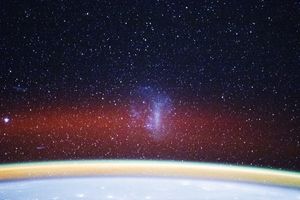
















Red colors of the aurora are dominant in this image captured by a digital still camera in September 2001. Auroras are caused when high-energy electrons pour down from the Earth’s magnetosphere and collide with atoms. Red aurora occurs from 200 km to as high as 500 km altitude and is caused by the emission of 6300 Angstrom wavelength light from oxygen atoms. The light is emitted when the atoms return to their original unexcited state. The white spot in the image is from a light on the inside of the Station that is reflected off the inside of the window. The pale blue arch on the left side of the frame is sunlight reflecting of the atmospheric limb of the Earth.
At times of peaks in solar activity, there are more geomagnetic storms and this increases the auroral activity viewed on Earth and by astronauts from orbit. By using a digital camera with a long exposure time, astronauts can capture a part of the light from the multicolored displays they observe, and downlink those images to Earth.
Information and forecasts of geomagnetic activity and aurora observations can be found at http://spaceweather.com/.
References & Resources
Image ISS003-E-6816 was provided by the Earth Sciences and Image Analysis Laboratory, Johnson Space Center. Additional images taken by astronauts can be viewed at NASA-JSC's Gateway to Astronaut Photography of Earth.