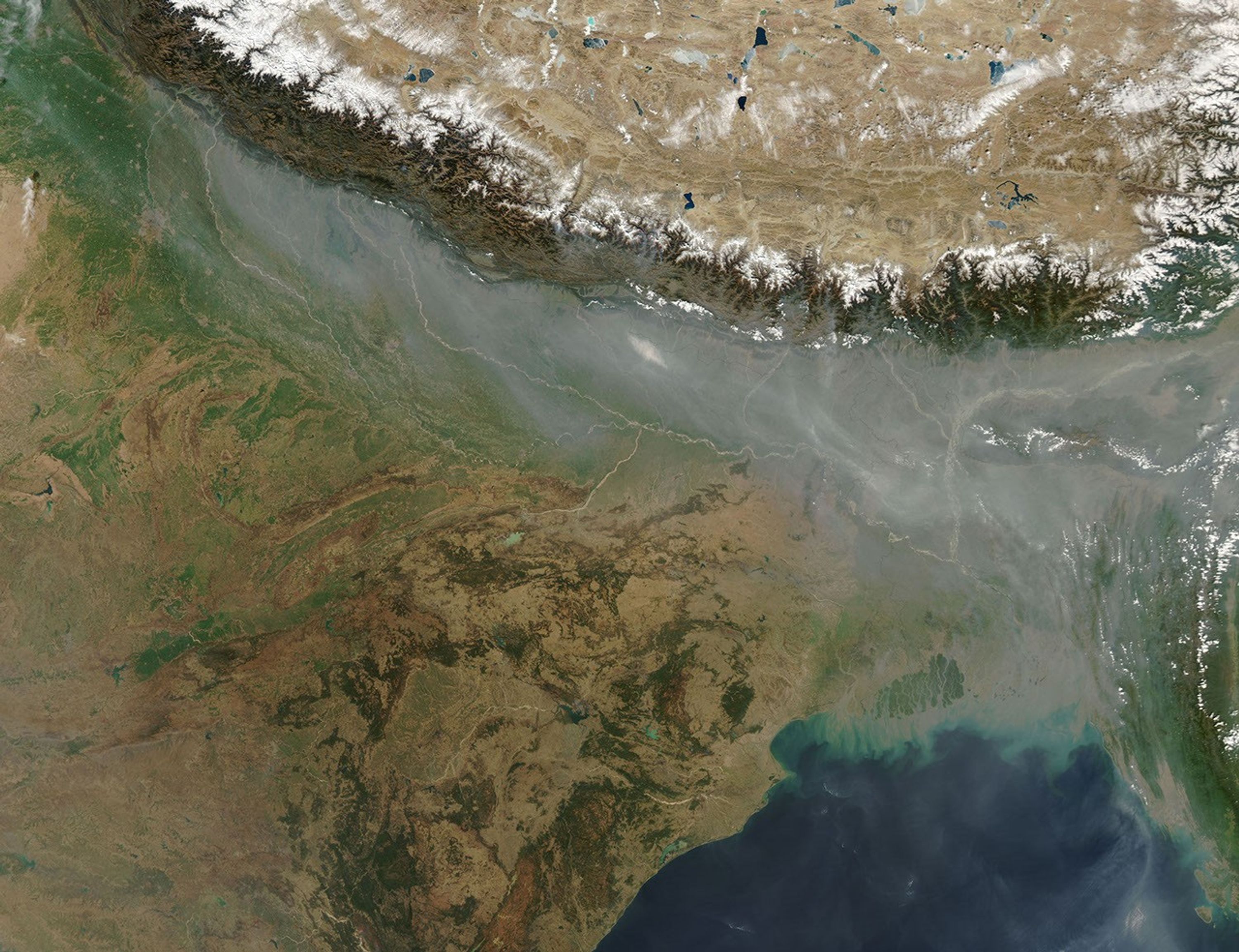























A pale band of haze hangs along the front of the Himalaya Mountains in Nepal, India, and Bangladesh in this photo-like image, taken on February 5, 2006, by the Moderate Resolution Imaging Spectroradiometer (MODIS) on NASA’s Aqua satellite. In this image, haze covers northern India, just south of the Himalaya. Haze also intrudes into the skies of southern Nepal and Bangladesh. The skies over the more mountainous northern Nepal and Bhutan appear clear.
One source of the haze is the fires that burn throughout the region. These fires were probably deliberately set for agricultural purposes. Another source of the haze is India’s cities. A megacity is an urban center with 10 million or more inhabitants. As of 2003, India held three of the world’s megacities: Mumbai, Delhi, and Calcutta. Moreover, smaller cities dot the landscape, appearing in this image as beige splotches. One city, shown in the upper left, produces its own discernible plume of haze.
It is common to see dense haze in northern India, Nepal, and Bangladesh during the winter. The haze lingers near the base of the mountains because of a temperature inversion. In normal conditions, the air near the ground is warmer than the air above it. Warm air rises and carries with it pollution from fires or cities. The pollution disperses when it is mixed with cooler air high above the ground. During the Himalayan winter, cold air rushes down the mountains onto the plain. This makes the air near the ground cooler than the air above it, essentially trapping a pocket of cold air over the plain. Smoke from fires and regular pollution from cities are also trapped in the pocket of cold air and don’t disperse as they would under normal conditions. As a result, haze builds until the inversion lifts. The haze shown in this image had been accumulating for several days, and is visible in several other MODIS images, including one acquired on February 1, 2006.
- Further Reading:
- Marshall, J. (2005) Megacity, Mega Mess. Nature (437) 312-314.
References & Resources
NASA image courtesy Jeff Schmaltz, MODIS Land Rapid Response Team at NASA GSFC