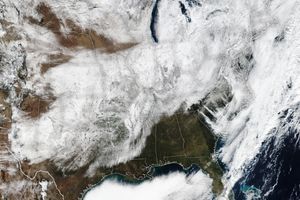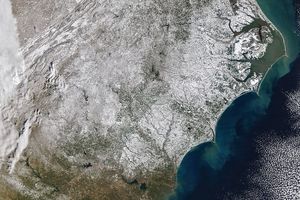
















Snow cover sprawled across the northeastern United States in early March 2013. The Moderate Resolution Imaging Spectroradiometer (MODIS) on NASA’s Terra satellite captured this natural-color image on March 9. Snow cover stretched from West Virginia into Canada, and from the western shore of Lake Ontario to the Atlantic Ocean.
The snow cover lingered in the wake of another winter nor'easter. Meteorologist Jeff Masters of Weather Underground noted that while the storm was bringing significant snowfall to the eastern United States, the storm center was roughly 600 miles (1,000 kilometers) east-southeast of New York City. The storm’s sheer size—roughly 1,000 miles (1,600 kilometers) across—enabled it to affect such a large area.
The storm deposited more than 6 inches (15 centimeters) of snow cover on 17 states, coating the Plains and Midwest before heading east. Some of the highest snowfall totals occurred in the Appalachian Mountains, including 24 inches (61 centimeters) in Franklin, West Virginia.
Snow wasn’t the only hazard posed by the storm; parts of the Massachusetts coast also suffered a storm surge. Arriving during the morning high tide cycle on March 8, the surge led to street flooding, structure damage, and erosion.
References & Resources
- Masters, J. (2013, March 8) Sprawling Nor’easter still bringing heavy snow, damaging coastal floods. Accessed March 12, 2013.
- Weather.com (2013, March 9) Photos: Winter Storm Saturn. Accessed March 12, 2013.
- Weather Underground (2013, March 7) Winter Storm Saturn. Accessed March 12, 2013.
NASA image courtesy Jeff Schmaltz, LANCE MODIS Rapid Response. Caption by Michon Scott.