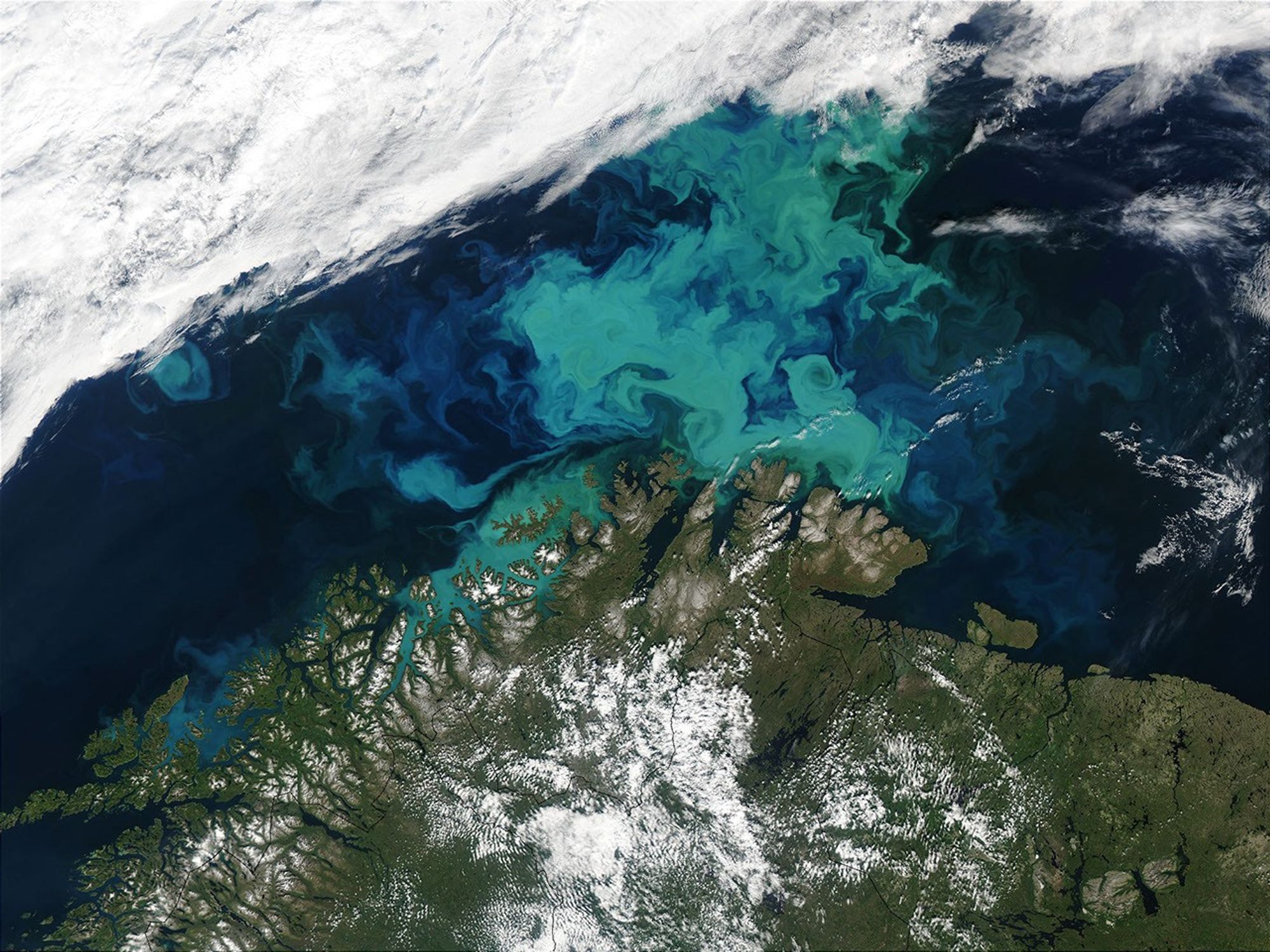




























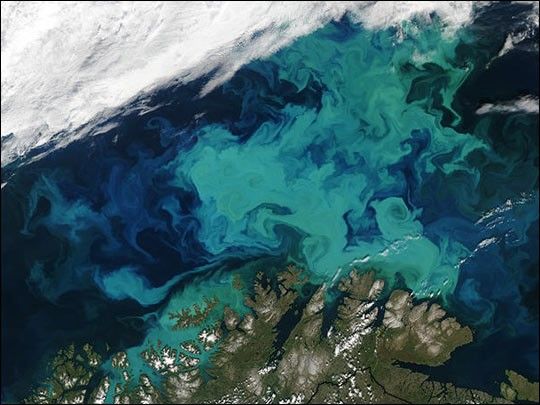
The Barents Sea north of Norway was awash in colorful swirls of blue and green on July 19, 2003. This spectacular display of color reveals the biological richness of these cold, nutrient-rich waters—a bloom of tiny marine plants called phytoplankton. The colors can be produced by a variety of pigments, including chlorophyll, that the plants use to harness sunlight for photosynthesis. The brightest blue color is sometimes the result of a kind of phytoplankton called a coccolithophore that has a calcium carbonate (chalk) covering. This chalky covering is bright white, and mixes with the blue reflection off the water to produce brilliant hues.
Near the coast, the reflection coming back to the spacecraft may be mixed with sediment and other organic matter churned up by tides or washed out to sea by rivers. The influx of nutrients that comes from the outflow of rivers is one reason why phytoplankton blooms are common in coastal areas. Another reason is that coastal areas are often areas where cold water from deep in the ocean wells up to the surface and displaces surface waters that may have become depleted of nutrients by the growth of a previous generation of marine plants.
This Moderate Resolution Imaging Spectroradiometer (MODIS) image was captured by the Aqua satellite. The high-resolution image provided above is 500 meters per pixel. The MODIS Rapid Response System provides this image at MODIS’ maximum spatial resolution of 250 meters.
References & Resources
Image courtesy Jacques Descloitres, MODIS Rapid Response Team at NASA GSFC