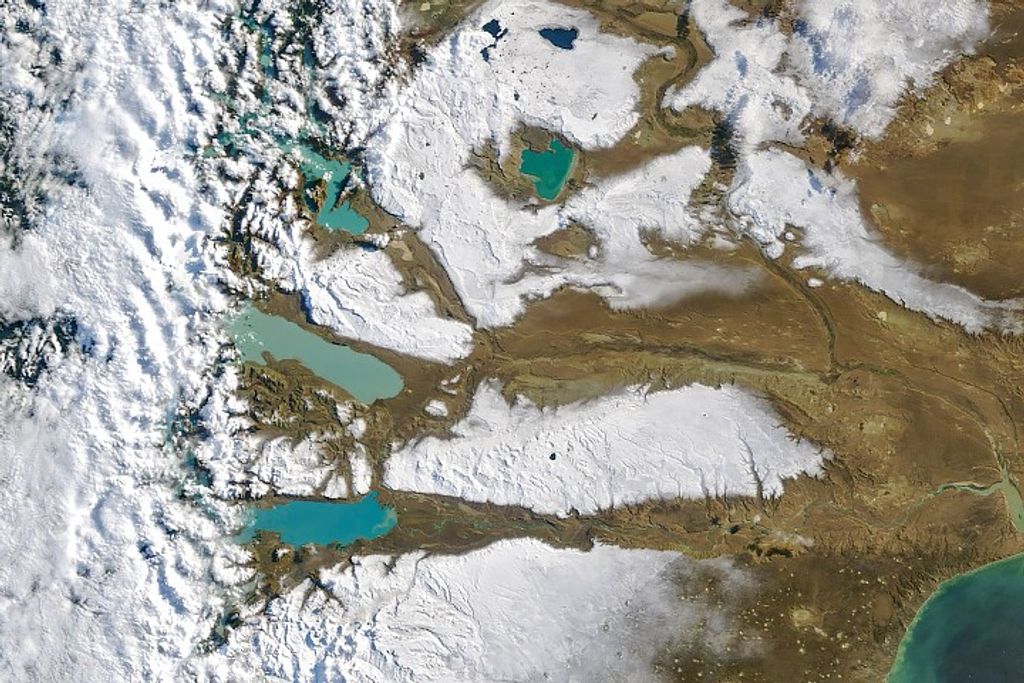


















Snow-covered deserts are rare, but that’s exactly what the Moderate Resolution Imaging Spectroradiometer (MODIS) on NASA’s Aqua satellite observed as it passed over the Taklimakan Desert in western China on January 2, 2013. Snow has covered much of the desert since a storm blew through the area on December 26. The day after the storm, Chinese Central Television (CNTV) reported that the Xinjian Uygyr autonomous region was among the hardest hit.
The Taklimakan is one of the world’s largest—and hottest—sandy deserts. Water flowing into the Tarim Basin has no outlet, so over the years, sediments have steadily accumulated. In parts of the desert, sand can pile up to 300 meters (roughly 1,000 feet) high. The mountains that enclose the sea of sand—the Tien Shan in the north and the Kunlun Shan in the south—were also covered with what appeared to be a significantly thicker layer of snow in January 2013.
Further Reading
- Earth Observatory (2012, Dec. 16) Snow on Sand Near Dunhuang, China. Accessed Jan. 2, 2013.
- Earth Observatory (2008, Feb. 22) Snow in the Taklimakan Desert. Accessed Jan. 2, 2013.
References & Resources
- China View (2012, Dec. 27) Cold wave hits China. Accessed Jan. 2, 2013.
- Xinhuanet (2013, Dec. 26) China Braces for Cold Snap. Accessed Jan. 2, 2013.
- Xinhuanet (2013, Dec. 26) Temperature Continues to Drop as Cold Snap Lingers. Accessed Jan. 2, 2013.
- Global Times (2012, Dec. 31) Beautiful Snow Scenery in Altay, NW China. Accessed Jan. 2, 2013.
NASA image courtesy Jeff Schmaltz, LANCE MODIS Rapid Response. Caption by Adam Voiland.