




















The ocean is more than just a hue of blue; it runs a gamut of greens to grays and everything in between. The Moderate Resolution Imaging Spectroradiometer (MODIS) on NASA’s Aqua satellite acquired this image showing swirls of color in the Arabian Sea on November 23, 2018.
The image appears like a watercolor painting—a blend of art and science. Like a photographer adjusting lighting and using filters, Norman Kuring of NASA’s Ocean Biology group works with various software programs and color-filtering techniques to draw out the fine details in the water. The detailed swirls in the chlorophyll-rich water are all quite real; Kuring simply separates and enhances certain shades and tones in the MODIS data to make the biomass more visible.
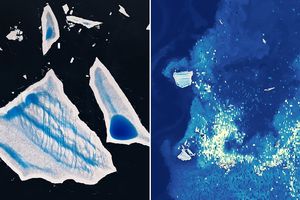
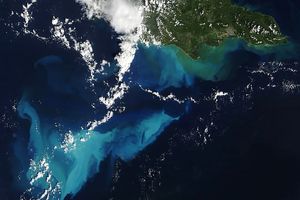
The range of ocean colors represents various types of activity occurring in the waters. For instance, different kinds of sediment—from a variety of soils, rock types, and organic debris—can flow into the ocean and color the water many shades near the shore. Scientists use satellite imagery to monitor sediment outflow and other debris such as dissolved organic material, which can affect water quality.
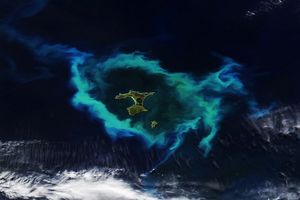
Water color can also be affected by the presence of phytoplankton, plant-like organisms that serve as the center of the aquatic food web. Phytoplankton abundance depends on the availability of carbon dioxide, sunlight, and nutrients, but also other factors including water temperature, salinity, depth, wind, and abundance of animals grazing on them. When conditions are right, phytoplankton populations can grow explosively, a phenomenon known as a bloom.
Phytoplankton blooms—drawn into thin swirling ribbons by turbulent eddies—commonly occur in the Arabian Sea. In the northern Arabian Sea, phytoplankton blooms are strongly influenced by monsoon winds. Large blooms tend to occur in the summer when strong southwesterly winds blow from the ocean towards land, mixing the water. Blooms also happen in the winter when northeast winds blow offshore.
References & Resources
- NASA Earth Observatory (2017, November 1) Finding Life in the Benguela Current.
- NASA Earth Observatory (2010, March 8) Phytoplankton Bloom in the Arabian Sea.
- NASA Earth Observatory (2014, May 10) Societal Benefits of Ocean Color.
Ocean imagery by Norman Kuring, NASA’s Ocean Color web. Story by Kasha Patel.