























APOD
Astronomy Picture of the Day
Discover the cosmos! Each day a different image or photograph of our fascinating universe is featured, along with a brief explanation written by a professional astronomer.
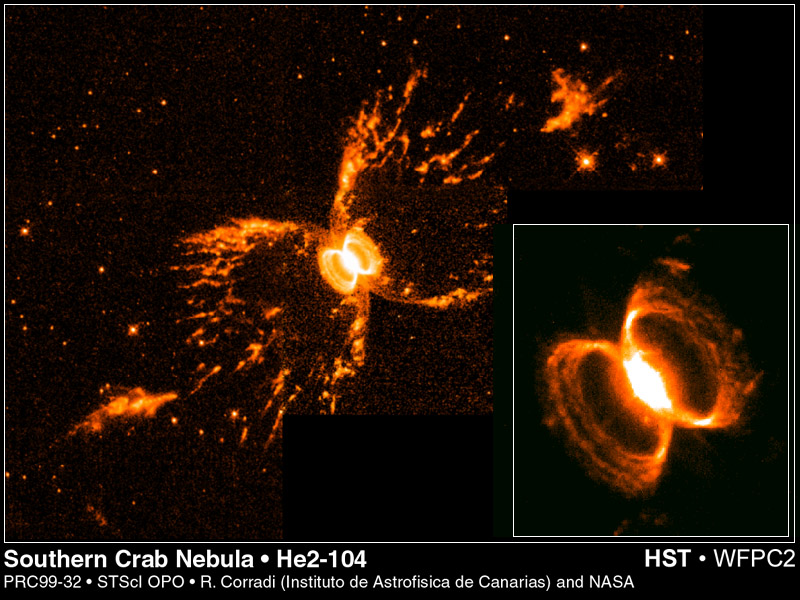
Symbiotic Star Bubbles
Explanation: The two stars at the center of this nebula are very different. One is a white dwarf star with a mass similar to our Sun but with a radius as small as our Earth . The other star is a red giant , a star also with mass near our Sun but with a radius so large it could fill the orbit of the Earth. The strange symbiotic relationship between these two stars in the He2-104 system has created a planetary nebula shaped like an hourglass within an hourglass . The red giant star turns out to be a Mira variable , a pulsating star that is dumping mass into an accretion disk surrounding the white dwarf . Astronomers speculate that when enough mass falls onto the white dwarf, a thermonuclear explosion occurs creating another expanding hourglass-shaped nebula. The above photograph was taken with the WFPC2 instrument onboard the Hubble Space Telescope . The hourglasses from the two most recent explosions are visible with the last one highlighted in the inset.
| Date | August 31, 1999 |
|---|---|
| Credit | Credit: R. Corradi (Instituto de Astrofisica de Canarias) et al., NASA |
| Authors & editors: | Robert Nemiroff (MTU) & Jerry Bonnell (UMCP) |
| A service of: |
ASD at NASA / GSFC, NASA Science Activation & Michigan Tech. U. |