






















APOD
Astronomy Picture of the Day
Discover the cosmos! Each day a different image or photograph of our fascinating universe is featured, along with a brief explanation written by a professional astronomer.

Brown Dwarf Gliese 229B
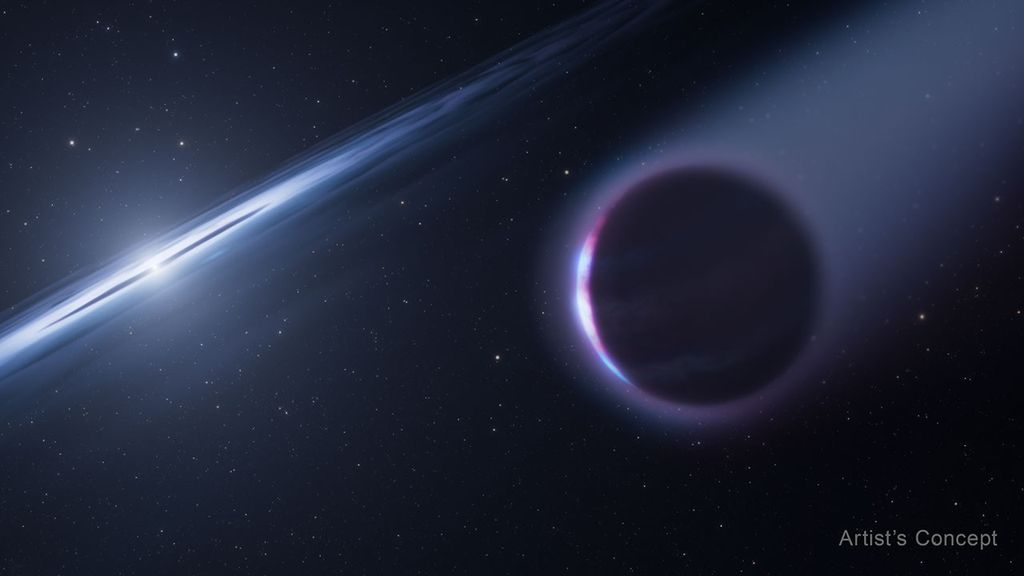
Explanation: The spot near the bottom is an image of an unusual type of object: a brown dwarf . A brown dwarf is sometimes called a “failed star” because it does not have enough mass to shine by nuclear fusion . A brown dwarf is more massive than a planet , though, and thought to have formed through stellar-like nebular condensation . Brown dwarfs and planets are likely quite abundant, but usually difficult to see in the glare of brighter stars they orbit. New techniques , such as using coronagraphic masks to block the light of the bright star, are allowing the detection of these faint stellar companions. Above , much of the bright light of central Gliese 229A has been blocked and digitally subtracted, leaving the clearest image yet of Gliese 229B . Perfecting techniques like this increases ability to detect still dimmer Earth-type planets orbiting nearby stars .
| Date | March 24, 1999 |
|---|---|
| Credit | Credit: R.H. Brown, D. Trilling (U. Arizona), C. Ftaclas (Michigan Tech), IRTF |
| Authors & editors: | Robert Nemiroff (MTU) & Jerry Bonnell (UMCP) |
| A service of: |
ASD at NASA / GSFC, NASA Science Activation & Michigan Tech. U. |