

























APOD
Astronomy Picture of the Day
Discover the cosmos! Each day a different image or photograph of our fascinating universe is featured, along with a brief explanation written by a professional astronomer.
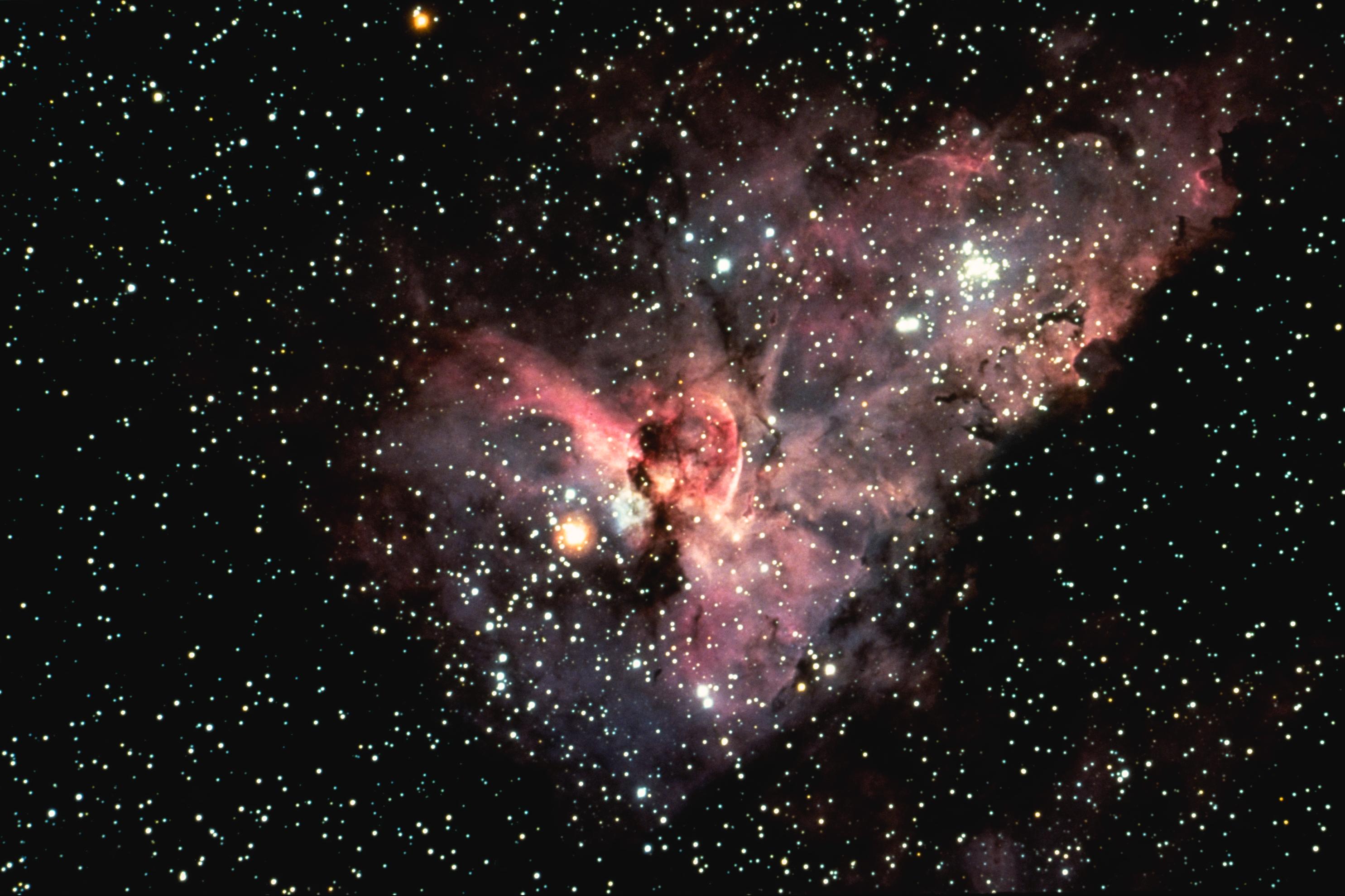
The Keyhole Nebula
Explanation: The dark dusty Keyhole Nebula gets its name from its unusual shape. Officially designated NGC 3324, the Keyhole Nebula is a smaller region superposed on the larger Eta Carina Nebula . These nebulae were created by the dying star Eta Carina , which is prone to violent outbursts during its final centuries. Noted and discussed as early as 1840 when a spectacular explosion became visible, the Eta Carina system now appears to be undergoing an unusual period of change . An emission nebula that contains much dust , the Keyhole Nebula is roughly 9,000 light years distant. This photogenic nebula can be seen in the south with even a small telescope. The Keyhole Nebula was recently discovered to contain highly structured clouds of molecular gas .
| Date | May 23, 1999 |
|---|---|
| Credit | Credit: NOAO, NSF; Copyright: AURA |
| Authors & editors: | Robert Nemiroff (MTU) & Jerry Bonnell (UMCP) |
| A service of: |
ASD at NASA / GSFC, NASA Science Activation & Michigan Tech. U. |