


























APOD
Astronomy Picture of the Day
Discover the cosmos! Each day a different image or photograph of our fascinating universe is featured, along with a brief explanation written by a professional astronomer.
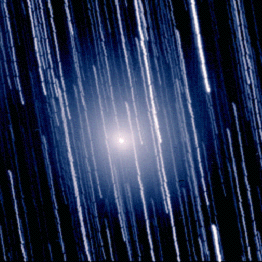
Tempel-Tuttle: The Leonid Comet
Explanation: Star trails streak this composite time exposure of Comet Tempel-Tuttle recorded by T. Puckett on January 26, 1998. Then passing through the inner solar system on its 33 year orbit around the Sun, Tempel-Tuttle brightened unexpectedly, but binoculars or small telescopes were still required to visually observe it. Tempel-Tuttle is also called “the Leonid Comet” as the yearly Leonid meteor shower results when the Earth crosses this comet's orbital plane and encounters cometary dust . So, while not rivaling spectacular naked-eye comets like Hyakutake or Hale-Bopp , Tempel-Tuttle still puts on a show. When the Earth plunges through Tempel-Tuttle's debris tail in November of this year, many sky-watchers are anticipating an extremely active meteor shower to result, perhaps even a meteor storm !
| Date | November 13, 1999 |
|---|---|
| Credit | Credit & Copyright: T. Puckett (Puckett Observatory) |
| Authors & editors: | Robert Nemiroff (MTU) & Jerry Bonnell (UMCP) |
| A service of: |
ASD at NASA / GSFC, NASA Science Activation & Michigan Tech. U. |