




























APOD
Astronomy Picture of the Day
Discover the cosmos! Each day a different image or photograph of our fascinating universe is featured, along with a brief explanation written by a professional astronomer.
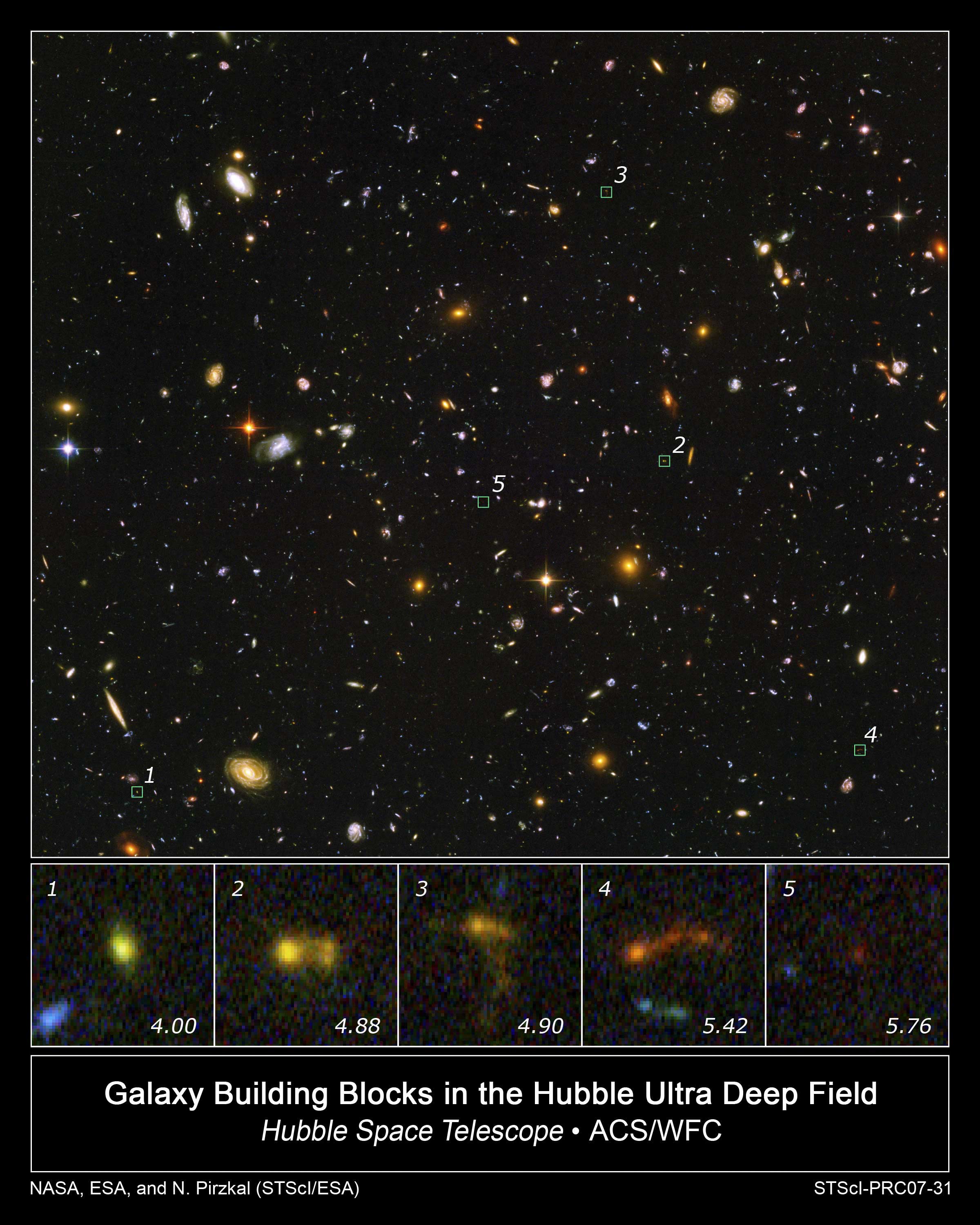
Building Galaxies in the Early Universe
Explanation: What was the very early universe like? To help find out, astronomers pointed the Hubble Space Telescope between bright nearby objects to create one of the deepest images ever -- the Hubble Ultra Deep Field (HUDF). The resulting HUDF is like a jewel box of strange and distant galaxies. A recent analysis of the HUDF focused on the smallest, faintest and most compact galaxies imaged. These small galaxies are thought to be the building blocks of modern galaxies . Analysis shows that these small galaxies are indeed themselves frequently merging to form large galaxies. An image of this field with the Spitzer Space Telescope shows a lack of infrared emission that would be expected from old stars, indicating that these small galaxies are very young, possibly only a few million years old. Therefore the young blue stars might be members of the first-ever generation of stars . Part of the HUDF is shown above , while one blue building-block galaxy, highly redshifted by the universe so as to appear more yellow, is shown in the upper left inset.
| Date | September 10, 2007 |
|---|---|
| Credit | Credit: NASA , ESA , and N. Pirzkal ( STScI / ESA ) et al. |
| Authors & editors: | Robert Nemiroff (MTU) & Jerry Bonnell (UMCP) |
| A service of: |
ASD at NASA / GSFC, NASA Science Activation & Michigan Tech. U. |