





















APOD
Astronomy Picture of the Day
Discover the cosmos! Each day a different image or photograph of our fascinating universe is featured, along with a brief explanation written by a professional astronomer.
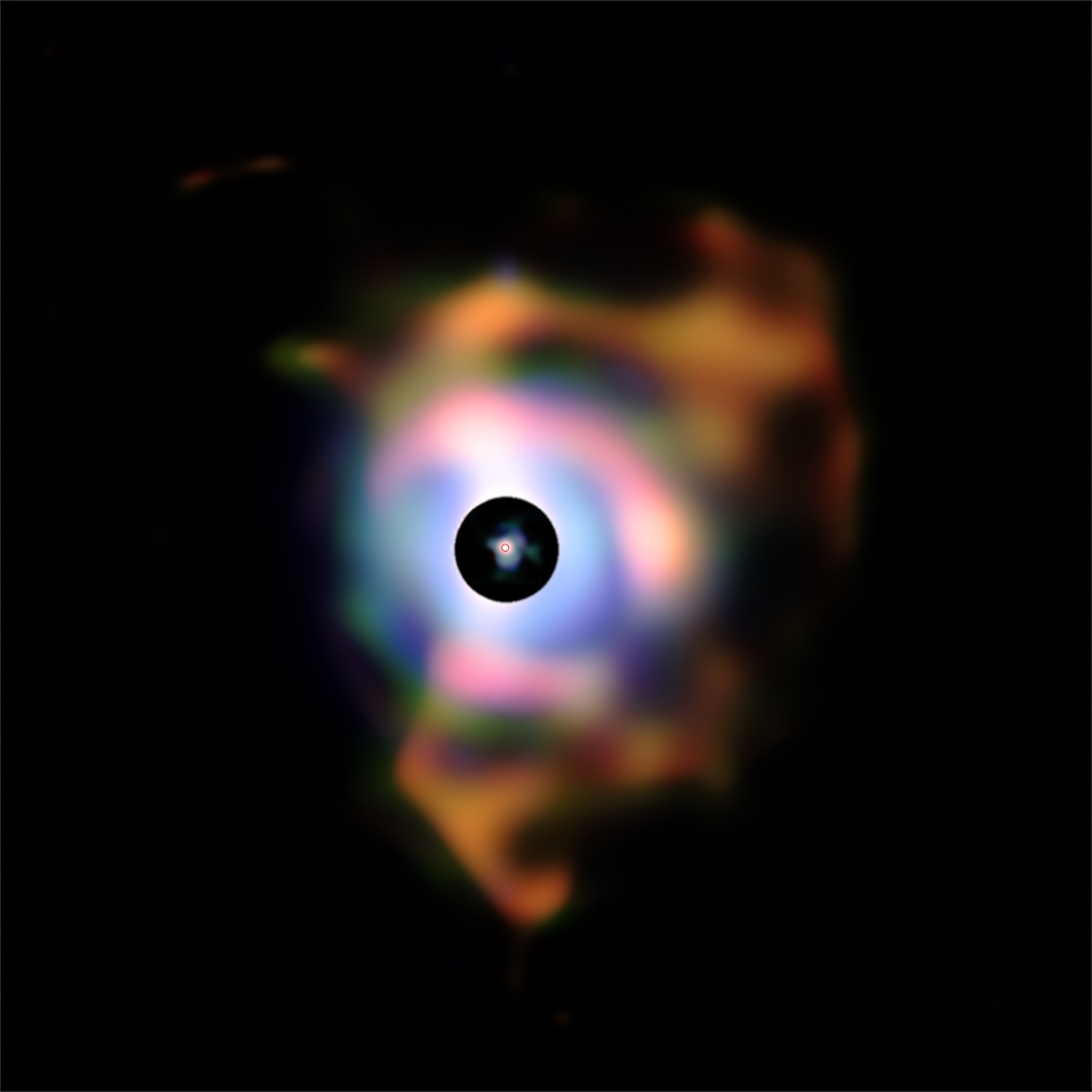
Stardust and Betelgeuse
Explanation: An expansive nebula of dust is seen to surround red supergiant star Betegeuse in this remarkable high resolution composite, an infrared VLT image from the European Southern Observatory. Betelgeuse itself is outlined by the small, central red circle. If found in our own solar system its diameter would almost encompass the orbit of Jupiter. But the larger envelope of circumstellar dust extends some 60 billion kilometers into space, equivalent to about 400 times the Earth-Sun distance. The dust is likely formed as the swollen atmosphere of the supergiant sheds material into space, a final phase in the evolution of a massive star . Mixing with the interstellar medium , the dust could ultimately form rocky terrestrial planets like Earth . The central bright portion of the outer image has been masked to reveal fainter extended structures. The field of view is 5.63 arcseconds across.
| Date | June 28, 2011 |
|---|---|
| Credit | ESO , Pierre Kervella ( LESIA, Observatoire de Paris ), et al. |
| Authors & editors: | Robert Nemiroff (MTU) & Jerry Bonnell (UMCP) |
| A service of: |
ASD at NASA / GSFC, NASA Science Activation & Michigan Tech. U. |