
























APOD
Astronomy Picture of the Day
Discover the cosmos! Each day a different image or photograph of our fascinating universe is featured, along with a brief explanation written by a professional astronomer.
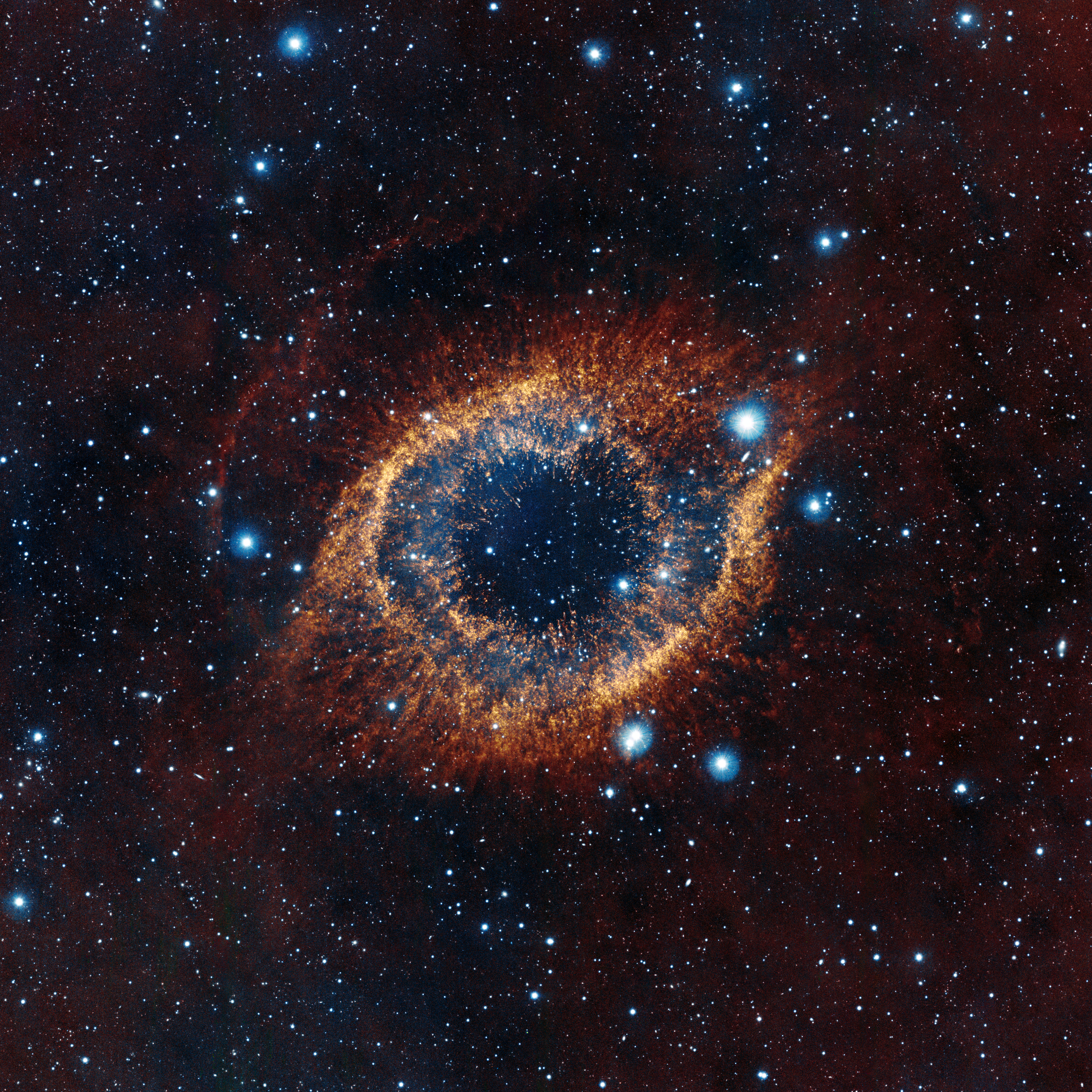
The Helix Nebula from the VISTA Telescope
Explanation: Will our Sun look like this one day? The Helix Nebula is one of brightest and closest examples of a planetary nebula , a gas cloud created at the end of the life of a Sun-like star. The outer gasses of the star expelled into space appear from our vantage point as if we are looking down a helix . The remnant central stellar core, destined to become a white dwarf star , glows in light so energetic it causes the previously expelled gas to fluoresce . The Helix Nebula , given a technical designation of NGC 7293 , lies about 700 light-years away towards the constellation of the Water Bearer ( Aquarius ) and spans about 2.5 light-years. The above picture was taken three colors on infrared light by the 4.1-meter Visible and Infrared Survey Telescope for Astronomy (VISTA) at the European Southern Observatory 's Paranal Observatory in Chile . A close-up of the inner edge of the Helix Nebula shows complex gas knots of unknown origin .
| Date | January 31, 2012 |
|---|---|
| Credit | Credit: ESO / VISTA /J. Emerson; Acknowledgment: Cambridge Astronomical Survey Unit |
| Authors & editors: | Robert Nemiroff (MTU) & Jerry Bonnell (UMCP) |
| A service of: |
ASD at NASA / GSFC, NASA Science Activation & Michigan Tech. U. |