

























APOD
Astronomy Picture of the Day
Discover the cosmos! Each day a different image or photograph of our fascinating universe is featured, along with a brief explanation written by a professional astronomer.
Solar Granules at Record High Resolution
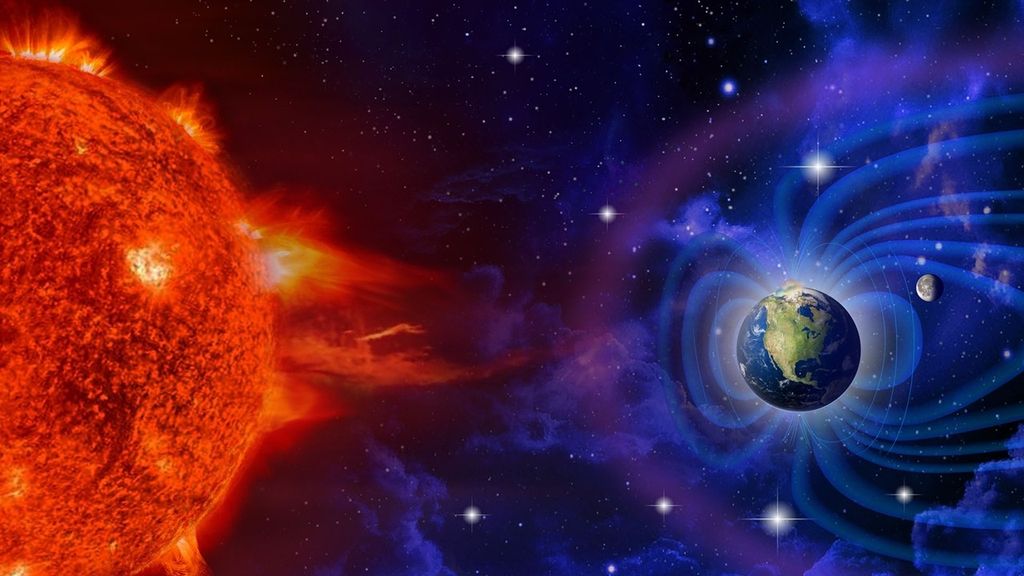
Explanation: Why does the Sun's surface keep changing? The help find out, the US National Science Foundation (NSF) has built the Daniel K. Ino uye Solar Telescope in Hawaii , USA . The Inouye telescope has a larger mirror that enables the capturing of images of higher resolution, at a faster rate, and in more colors than ever before . Featured are recently-released first-light images taken over 10 minutes and combined into a 5-second time-lapse video. The video captures an area on the Sun roughly the size of our Earth, features granules roughly the size of a country, and resolves features as small as 30-kilometers across. Granule centers are bright due to the upwelling hot solar plasma , while granule edges are dim due to the cooled plasma falling back. Some regions between granules edges are very bright as they are curious magnetic windows into a deep and hotter solar interior. How the Sun's magnetic field keeps changing , channeling energy, and affecting the distant Earth, among many other topics , will be studied for years to come using data from the new Inouye telescope .
Astrophysicists: Browse 2,100+ codes in the Astrophysics Source Code Library
| Date | February 3, 2020 |
|---|---|
| Credit | Image Credit: NSO , NSF , AURA , Inouye Solar Telescope |
| Authors & editors: | Robert Nemiroff (MTU) & Jerry Bonnell (UMCP) |
| A service of: |
ASD at NASA / GSFC, NASA Science Activation & Michigan Tech. U. |