




















APOD
Astronomy Picture of the Day
Discover the cosmos! Each day a different image or photograph of our fascinating universe is featured, along with a brief explanation written by a professional astronomer.
Simulation: A Disk Galaxy Forms
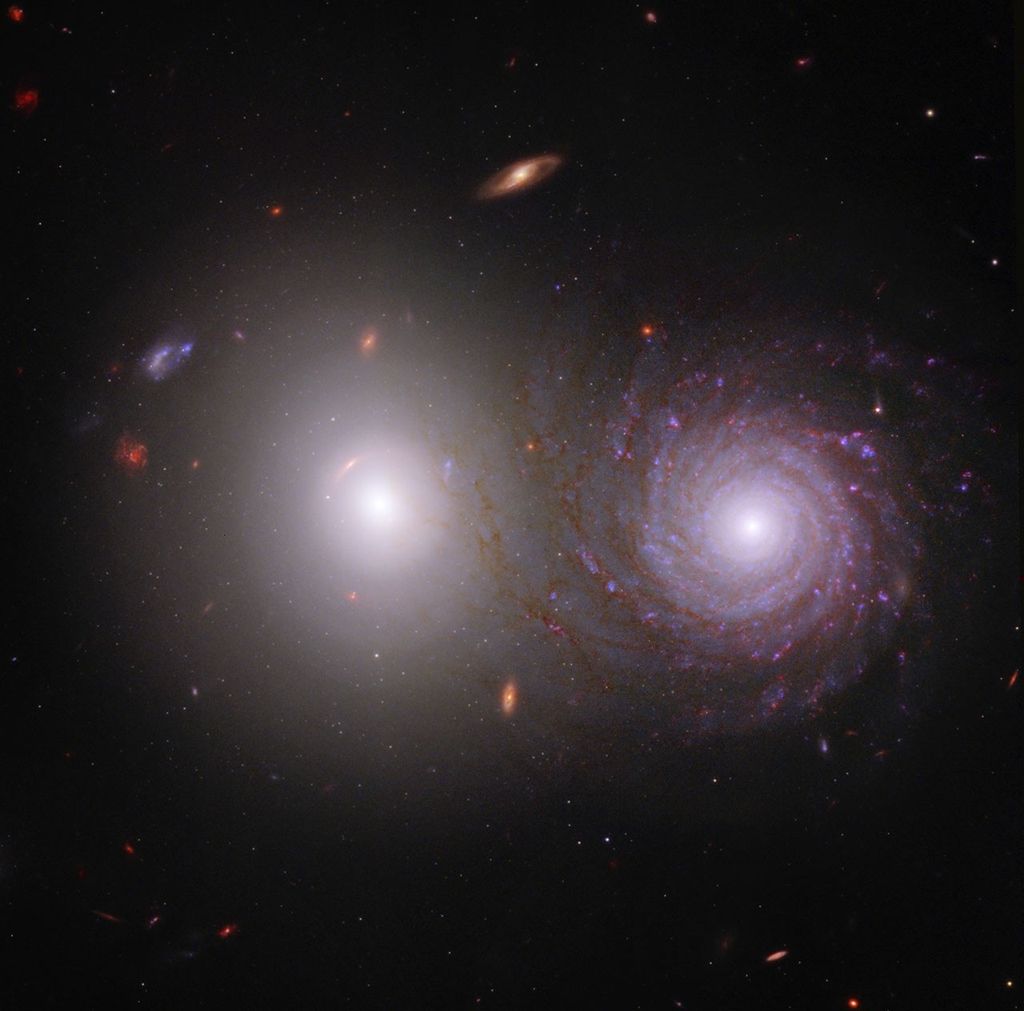
Explanation: How did we get here? We know that we live on a planet orbiting a star orbiting a galaxy , but how did all of this form? Since our universe moves too slowly to watch, faster-moving computer simulations are created to help find out. Specifically, this featured video from the Illustris TNG collaboration tracks gas from the early universe ( redshift 12) until today ( redshift 0). As the simulation begins, ambient gas falls into and accumulates in a region of relatively high gravity . After a few billion years, a well-defined center materializes from a strange and fascinating cosmic dance . Gas blobs -- some representing small satellite galaxies -- continue to fall into and become absorbed by the rotating galaxy as the present epoch is reached and the video ends. For the Milky Way Galaxy , however, big mergers may not be over -- recent evidence indicates that our large spiral disk Galaxy will collide and coalesce with the slightly larger Andromeda spiral disk galaxy in the next few billion years.
Open Science: Browse 3,000+ codes in the Astrophysics Source Code Library
| Date | May 31, 2023 |
|---|---|
| Credit | Video Credit: TNG Collaboration , MPCDF , FAS Harvard U. ; Music: World's Sunrise ( YouTube: Jimena Contreras ) |
| Authors & editors: | Robert Nemiroff (MTU) & Jerry Bonnell (UMCP) |
| A service of: |
ASD at NASA / GSFC, NASA Science Activation & Michigan Tech. U. |