
























APOD
Astronomy Picture of the Day
Discover the cosmos! Each day a different image or photograph of our fascinating universe is featured, along with a brief explanation written by a professional astronomer.
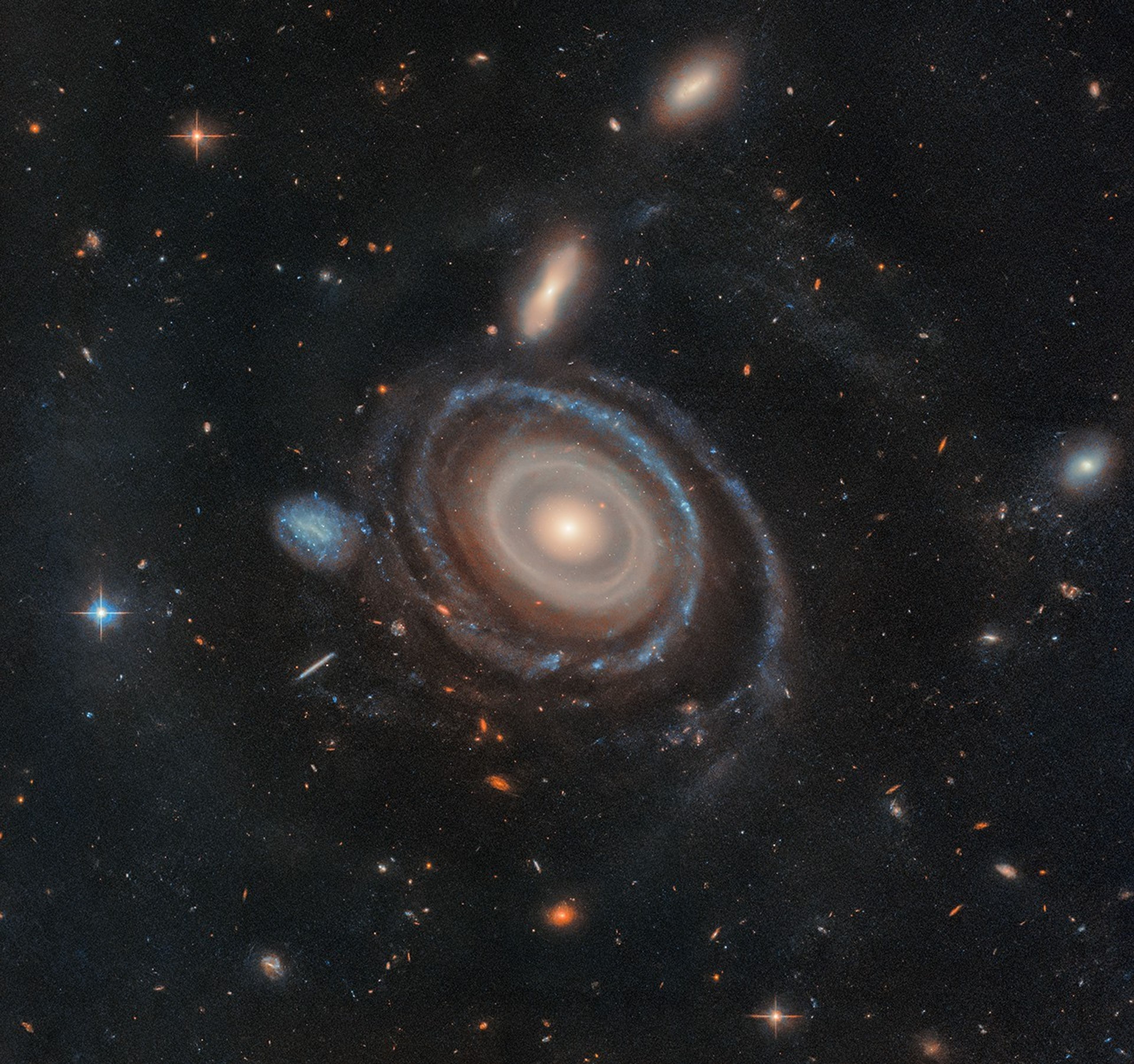
LEDA 1313424: The Bullseye Galaxy
Explanation: The giant galaxy cataloged as LEDA 1313424 is about two and a half times the size of our own Milky Way. Its remarkable appearance in this recently released Hubble Space Telescope image strongly suggests its nickname “The Bullseye Galaxy”. Known as a collisional ring galaxy it has nine rings confirmed by telescopic observations, rippling from its center like waves from a pebble dropped into a pond. Of course, the pebble dropped into the Bullseye galaxy was a galaxy itself. Telescopic observations identify the blue dwarf galaxy at center-left as the likely collider, passing through the giant galaxy's center and forming concentric rings in the wake of their gravitational interaction. The Bullseye Galaxy lies some 567 million light-years away toward the constellation Pisces. At that distance , this stunning Hubble image would span about 530,000 light-years.
| Date | February 7, 2025 |
|---|---|
| Credit | Image Credit: NASA , ESA , Imad Pasha (Yale), Pieter van Dokkum (Yale) |
| Authors & editors: | Robert Nemiroff (MTU) & Jerry Bonnell (UMCP) |
| A service of: |
ASD at NASA / GSFC, NASA Science Activation & Michigan Tech. U. |