

























APOD
Astronomy Picture of the Day
Discover the cosmos! Each day a different image or photograph of our fascinating universe is featured, along with a brief explanation written by a professional astronomer.
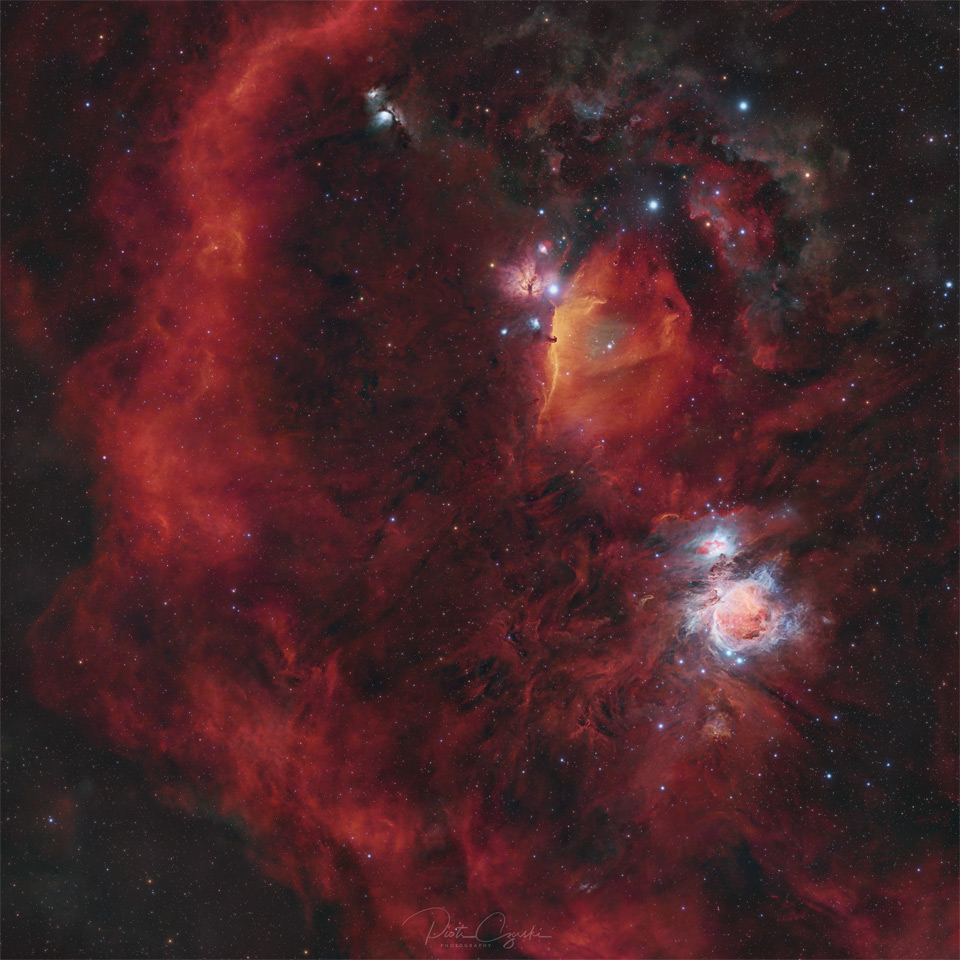

Orion's Cradle
Explanation: Cradled in red-glowing hydrogen gas, stars are being born in Orion. These stellar nurseries lie at the edge of the giant Orion molecular cloud complex , some 1,500 light-years away. This detailed view spans about 12 degrees across the center of the well-known constellation, with the Great Orion Nebula , the closest large star -forming region, visible toward the lower right. The deep mosaic also includes, near the top center, the Flame Nebula and the Horsehead Nebula . Image data acquired with a hydrogen-alpha filter adds other remarkable features to this wide-angle cosmic vista: pervasive tendrils of energized atomic hydrogen gas and portions of the surrounding Barnard's Loop . While the Orion Nebula and many stars in Orion are easy to see with the unaided eye, emission from the extensive interstellar gas is faint and much harder to record , even in telescopic views of the nebula-rich complex.
Sky Surprise: What picture did APOD feature on your birthday? (after 1995)
| Date | February 18, 2026 |
|---|---|
| Credit | Image Credit & Copyright: Piotr Czerski |
| Authors & editors: | Robert Nemiroff (MTU) & Jerry Bonnell (UMCP) |
| A service of: |
ASD at NASA / GSFC, NASA Science Activation & Michigan Tech. U. |