

























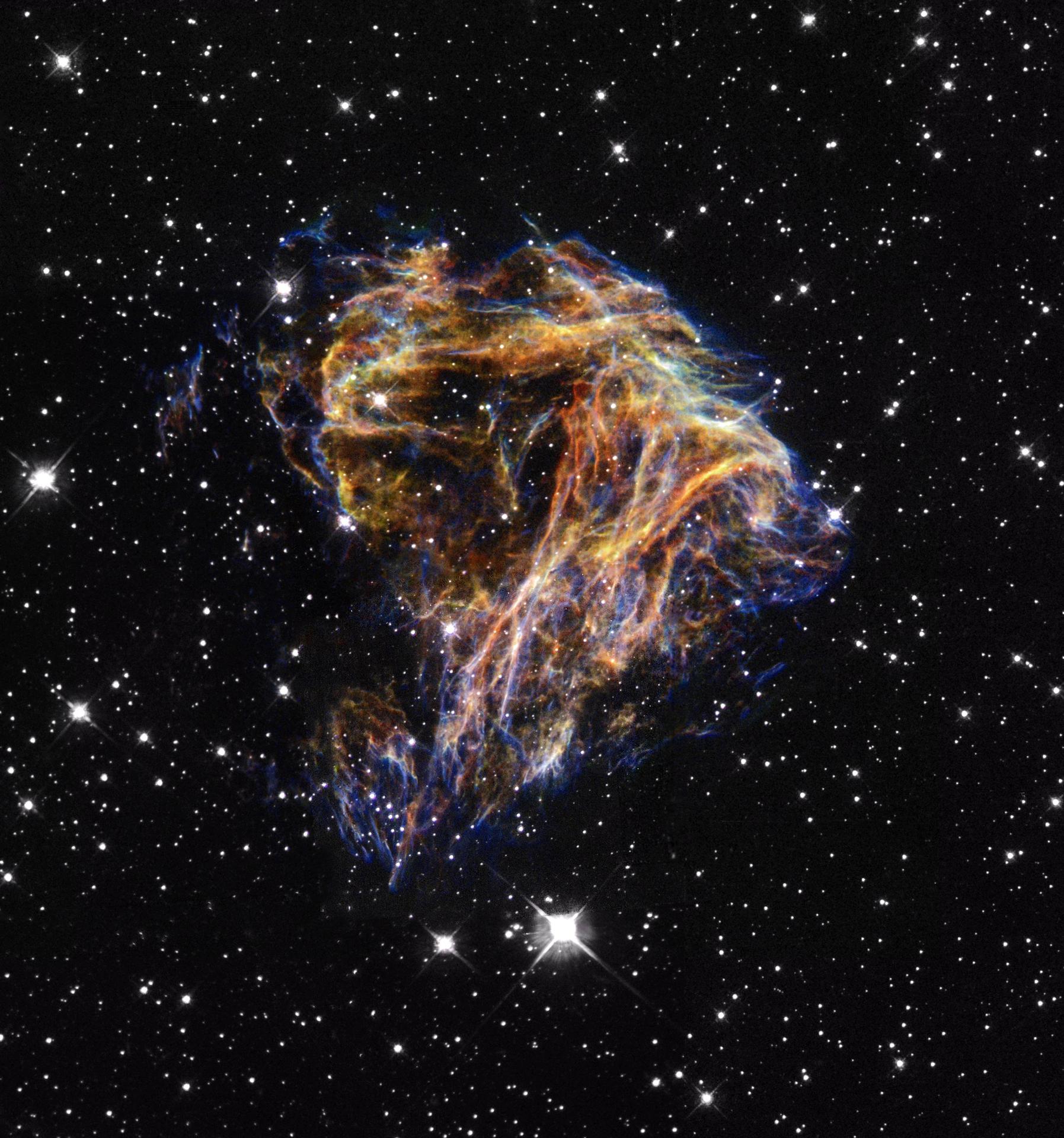
N 49 (DEM L 190)
Resembling the puffs of smoke and sparks from a summer fireworks display in this Hubble Space Telescope image, these delicate filaments are actually sheets of debris from a stellar explosion in a neighboring galaxy. Hubble's target was a supernova remnant within the Large Magellanic Cloud (LMC), a nearby, small companion galaxy to the Milky Way visible from the Southern Hemisphere. Denoted N 49, or DEM L 190, this remnant is from a massive star that died in a supernova blast whose light would have reached Earth thousands of years ago. This filamentary material will eventually be recycled into building new generations of stars in the LMC. Our own Sun and planets are constructed from similar debris of supernovae that exploded in the Milky Way billions of years ago. This seemingly gentle structure also harbors a very powerful spinning neutron star that may be the central remnant from the initial blast. It is quite common for the core of an exploded supernova star to become a spinning neutron star (also called a pulsar — because of the regular pulses of energy from the rotational spin) after the immediate shedding of the star's outer layers. In the case of N 49, not only is the neutron star spinning at a rate of once every 8 seconds, it also has a super-strong magnetic field a thousand trillion times stronger than Earth's magnetic field. This places this star into the exclusive class of objects called "magnetars." The neutron star in N 49 is also emitting X-rays, whose energies are slightly less than that of soft gamma rays. High-resolution X-ray satellites have resolved a point source near the center of N 49, the likely X-ray counterpart of the soft gamma-ray repeater. Diffuse filaments and knots throughout the supernova remnant are also visible in X-rays. The filamentary features visible in the optical image represent the blast wave sweeping through the ambient interstellar medium and nearby dense molecular clouds.
Image Credit: NASA and the Hubble Heritage Team (STScI/AURA); Acknowledgment: Y.-H. Chu (UIUC), S. Kulkarni (Caltech), and R. Rothschild (UCSD)
- X
https://science.nasa.gov/image-detail/amf-0301627/
TakenJuly 1, 2000
ProducerMSFC
Image CreditNASA and the Hubble Heritage Team (STScI/AURA); Acknowledgment: Y.-H. Chu (UIUC), S. Kulkarni (Caltech), and R. Rothschild (UCSD)
Size1795x1920px
PIA Number0301627
