






















Bipolar Planetary Nebula PN Hb 12
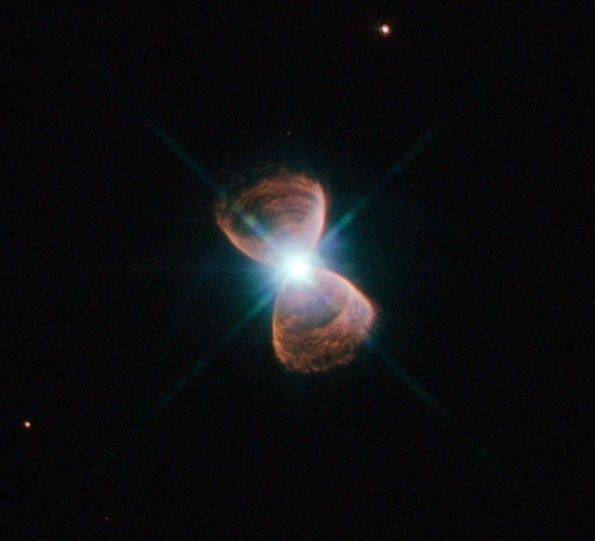
This image shows an example of a bipolar planetary nebula known as PN Hb 12 — also known as Hubble 12 — in the constellation Cassiopeia. The striking shape of this nebula, reminiscent of a butterfly or an hourglass, was formed as a Sun-like star approached the end of its life and puffed its outer layers into the surrounding space. For bipolar nebulae, this material is funneled toward the poles of the aging star, creating the distinctive double-lobed structure. Observations using NASA's Hubble Space Telescope and the New Technology Telescope have found that bipolar planetary nebulae located towards the central bulge of our Milky Way appear to be preferentially oriented with respect to the galactic disk — a surprising result given their varied and chaotic formation.
Image Credit: NASA, ESA, and A. Zijlstra (The University of Manchester)
- X
https://science.nasa.gov/image-detail/amf-4e31527c-4e8c-48d2-a17b-8aff599700c2/
Image CreditNASA, ESA, and A. Zijlstra (The University of Manchester)
Size595x541px