




















Retina Nebula
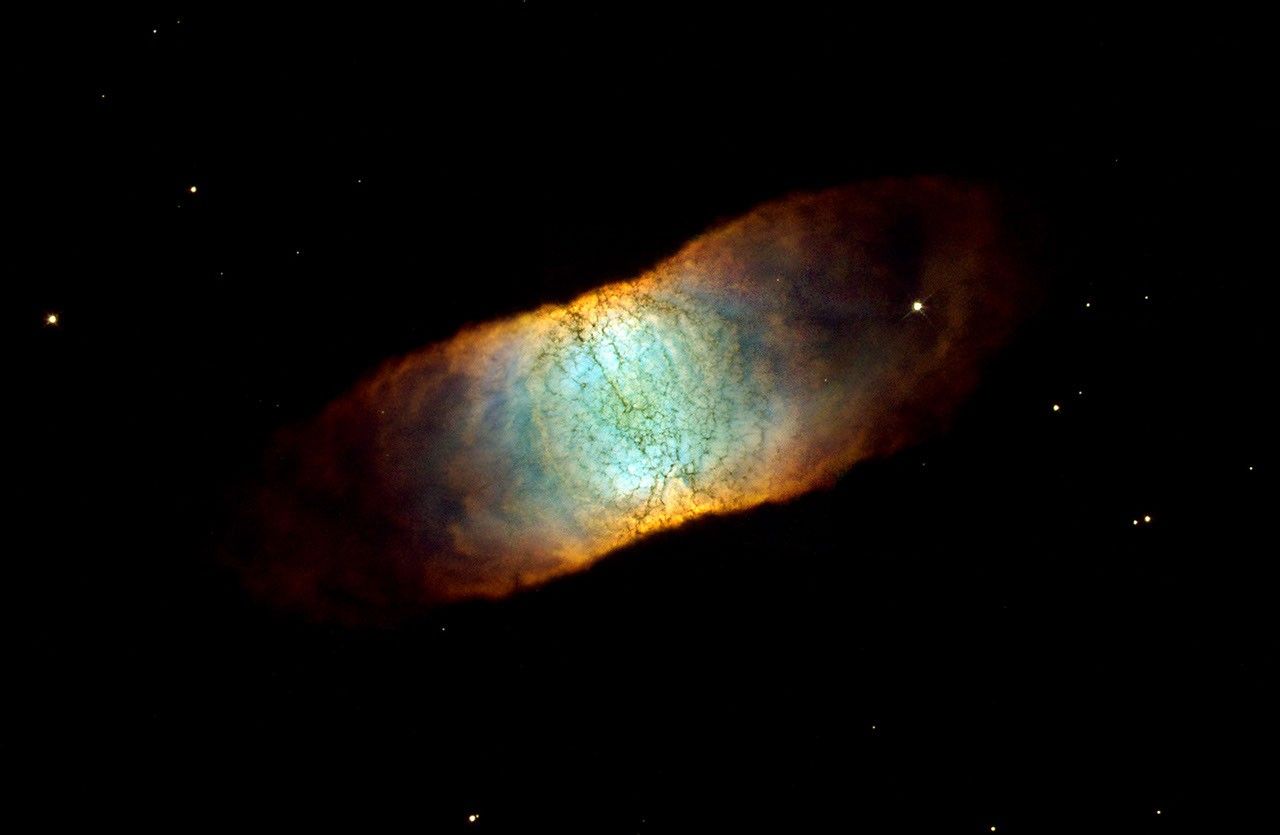
Like many other so-called planetary nebulae, IC 4406 (also known as the Retina Nebula) exhibits a high degree of symmetry; the left and right halves are nearly mirror images of the other. If we could fly around IC 4406 in a starship, we would see that the gas and dust form a vast doughnut of material streaming outward from the dying star. From Earth, we are viewing the doughnut from the side. This side view allows us to see the intricate tendrils of dust that have been compared to the eye's retina. In other planetary nebulae, like the Ring Nebula (NGC 6720), we view the doughnut from the top. The doughnut of material confines the intense radiation coming from the remnant of the dying star. Gas on the inside of the doughnut is ionized by light from the central star and glows. Light from oxygen atoms is rendered blue in this image; hydrogen is shown as green, and nitrogen as red. The range of color in the final image shows the differences in concentration of these three gases in the nebula. One of the most interesting features of IC 4406 is the irregular lattice of dark lanes that criss-cross the center of the nebula. These lanes are about 160 astronomical units wide (1 astronomical unit is the distance between Earth and the Sun). They are located right at the boundary between the hot glowing gas that produces the visual light imaged here and the neutral gas seen with radio telescopes. We see the lanes in silhouette because they have a density of dust and gas that is a thousand times higher than the rest of the nebula. The dust lanes are like a rather open mesh veil that has been wrapped around the bright doughnut.
Image Credit: NASA and the Hubble Heritage Team (STScI/AURA); Acknowledgment: C.R. O'Dell (Vanderbilt University)
- X
https://science.nasa.gov/image-detail/amf-5d24366b-5957-4e90-a8a7-e330584b00e0/
Image CreditNASA and the Hubble Heritage Team (STScI/AURA); Acknowledgment: C.R. O'Dell (Vanderbilt University)
Size2859x1866px