

























N44C Nebula
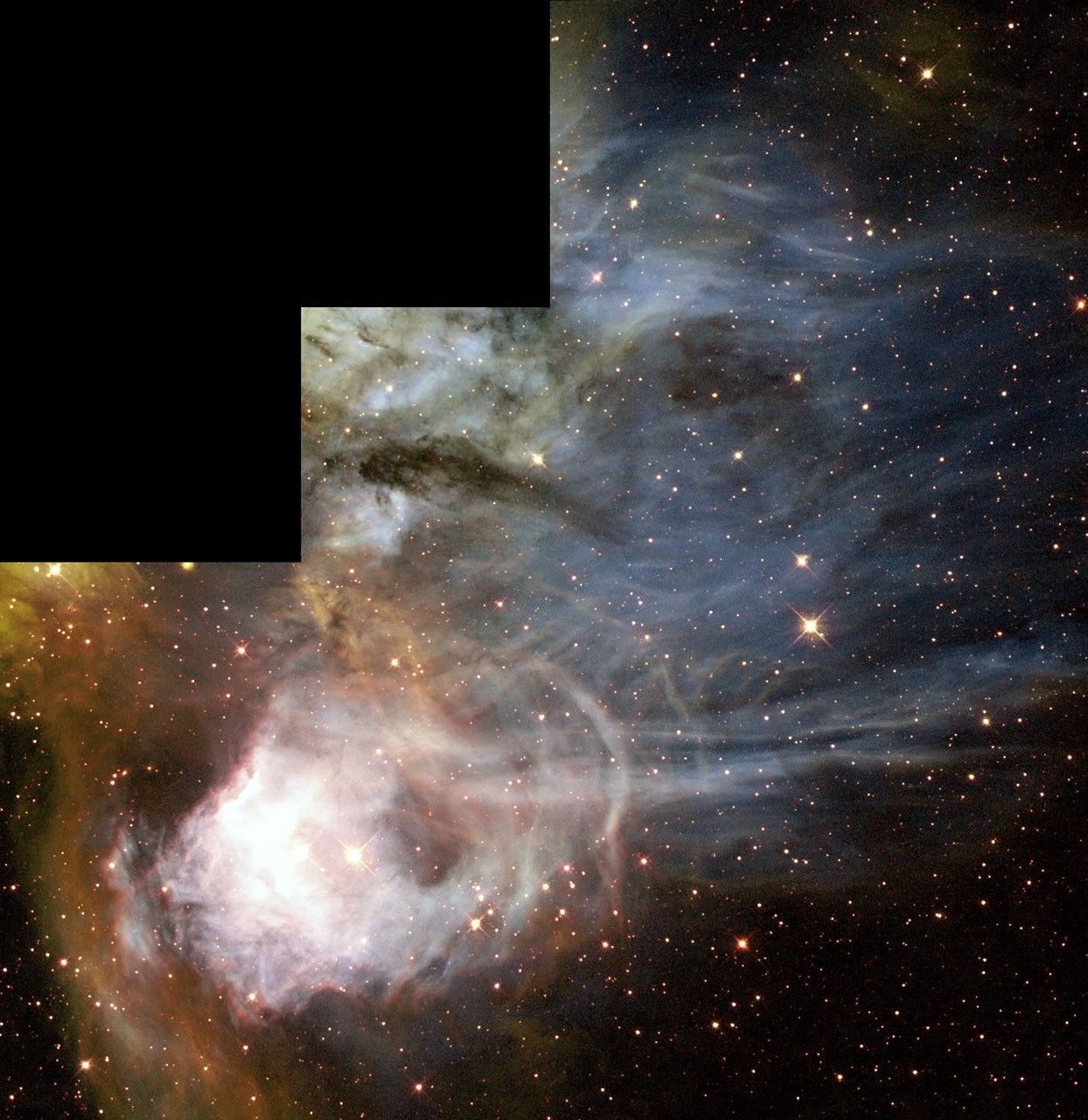
Resembling the hair in Botticelli's famous portrait of the birth of Venus, softly glowing filaments stream from a complex of hot young stars. This image of a nebula known as N44C comes from the archives of NASA's Hubble Space Telescope. It was taken with the Wide Field and Planetary Camera 2 in November 1996. N44C is the designation for a region of glowing hydrogen gas surrounding an association of young stars in the Large Magellanic Cloud, a nearby, small, companion galaxy to the Milky Way visible from the Southern Hemisphere. N44C is peculiar because the star mainly responsible for illuminating the nebula is unusually hot. The most massive stars, ranging from 10-50 times more massive than the Sun, have maximum temperatures of 54,000 to 90,000 degrees Fahrenheit (30,000 to 50,000 Kelvin). The star illuminating N44C appears to be significantly hotter, with a temperature of about 135,000 degrees Fahrenheit (75,000 Kelvin)! Ideas proposed to explain this unusually high temperature include the possibility of a neutron star or black hole that intermittently produces X-rays but is now "switched off." In the top right of this Hubble image is a network of nebulous filaments that inspired comparison to Botticelli. The filaments surround a Wolf-Rayet star, another kind of rare star characterized by an exceptionally vigorous "wind" of charged particles. The shock of the wind colliding with the surrounding gas causes the gas to glow. N44C is part of the larger N44 complex, which includes young, hot, massive stars, nebulae, and a "superbubble" blown out by multiple supernova explosions. Part of the superbubble is seen in red at the very bottom left of the image.
Image Credit: NASA and the Hubble Heritage Team (STScI/AURA) Acknowledgment: D. Garnett (University of Arizona)
- X
https://science.nasa.gov/image-detail/amf-9888171d-9f9b-470a-b19f-dc0c4848ba6c/
Image CreditNASA and the Hubble Heritage Team (STScI/AURA) Acknowledgment: D. Garnett (University of Arizona)
Size1460x1502px