
























N44F
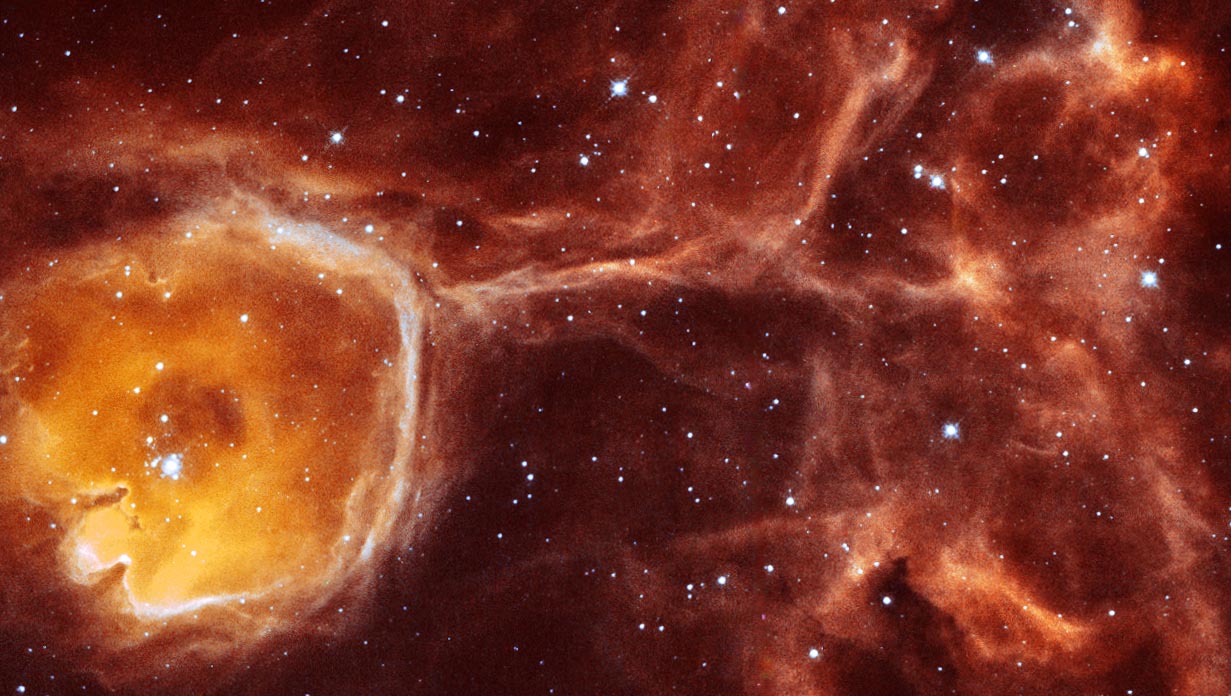
In this unusual image, NASA's Hubble Space Telescope captures a rare view of the celestial equivalent of a geode — a gas cavity carved by the stellar wind and intense ultraviolet radiation from a hot young star. The object, called N44F, is being inflated by a torrent of fast-moving particles (called a "stellar wind") from an exceptionally hot star once buried inside a cold dense cloud. Compared with our Sun (which is losing mass through the so-called "solar wind"), the central star in N44F is ejecting more than a 100 million times more mass per second. The hurricane of particles moves much faster at about 4 million miles per hour (7 million kilometers per hour), as opposed to about 0.9 million miles per hour (1.5 million kilometers per hour) for our Sun. Because the bright central star does not exist in empty space but is surrounded by an envelope of gas, the stellar wind collides with this gas, pushing it out like a snowplow. This forms a bubble, whose striking structure is clearly visible in the crisp Hubble image. The nebula N44F is one of a handful of known interstellar bubbles. Bubbles like these have been seen around evolved massive stars (Wolf-Rayet stars), and also around clusters of stars (where they are called "super-bubbles"). But they have rarely been viewed around isolated stars, as is the case here. N44F is located about 160,000 light-years in our neighboring dwarf galaxy the Large Magellanic Cloud. It is part of the larger N44 complex, which is a large super-bubble, blown out by the combined action of stellar winds and multiple supernova explosions.
Image Credit: NASA, ESA, Y. Nazé (University of Liège, Belgium), and Y.-H. Chu (University of Illinois, Urbana)
- X
https://science.nasa.gov/image-detail/n44f/
Image CreditNASA, ESA, Y. Nazé (University of Liège, Belgium), and Y.-H. Chu (University of Illinois, Urbana)
Size1231x696px