
















Swift’s Science
Originally designed as a satellite dedicated to studying GRBs — gamma-ray bursts, the most powerful explosions in the cosmos — Swift also monitors active galaxies powered by supermassive black holes, studies stars undergoing X-ray flares, nova outbursts, and supernova explosions, observes comets and asteroids in our own solar system, and conducts long-term observations of a variety of objects. Swift now occupies a place at the crossroads of multiwavelength, time domain, and multimessenger astronomy.
The mission was born as a multiwavelength observatory, with three co-aligned telescopes operating across a broad energy range, from red visible light to gamma rays with energies up to 250,000 times greater. The UVOT (Ultraviolet/Optical Telescope) and XRT (X-ray Telescope) are led by astronomers at Penn State at University Park, Pennsylvania, while the BAT (Burst Alert Telescope) is led by astronomers at NASA’s Goddard Space Flight Center in Greenbelt, Maryland.
Time domain astronomy involves the study of astronomical objects across various divisions of time, from microseconds to decades or more. Swift’s flexible planning system enables astronomers to request "target-of-opportunity" observations that can be commanded from the ground in as little as 10 minutes, or to set up monitoring programs for observing specific sources lasting as little as a few minutes to multiple months. The system can schedule up to 75 independent targets a day.
NASA’s Goddard Space Flight Center
Multimessenger astronomy involves detecting light — the best-known astrophysical “messenger” — emitted from sources discovered by observatories sensitive to non-electromagnetic signals, like gravitational waves or high-energy particles. Beginning in 2015, observatories on the ground began directly detecting gravitational waves — ripples in space-time generated by orbiting masses — from merging black holes. Just two years later, on Aug. 17, 2017, spacecraft detected a GRB associated with a gravitational wave detection — the first time light had been seen from one of these events. While Swift did not detect the burst, it and many other facilities studied the afterglow and the expanding cloud of debris, dubbed a kilonova, in great detail.
NASA’s Goddard Space Flight Center
Swift’s original goal was to enable the discovery and rapid localization of GRBs and to quickly observe their afterglows in visible, ultraviolet, and X-ray light. This was especially important for an elusive population called short GRBs, whose gamma rays peak in less than two seconds. Until Swift, it had been impossible to identify the locations of these bursts rapidly and precisely enough to observe their afterglows. In May 2005, Swift achieved this milestone with GRB 050509B, which lasted just 0.03 seconds. Swift turned to the burst fast enough to detect 11 X-ray photons, making this the first short burst with a detected afterglow. These observations validated long-standing theoretical models suggesting that short GRBs come from mergers of two neutron stars, objects with the mass of the Sun that have been crushed to the size of a city.
Additional Swift Discoveries & Milestones
-
2023: Swift finds a black hole repeatedly nibbling on a star
Using Swift, scientists discovered a black hole in a distant galaxy repeatedly nibbling on a Sun-like star. The object heralded a new era of Swift science made possible by a novel method for analyzing data from the satellite’s XRT.
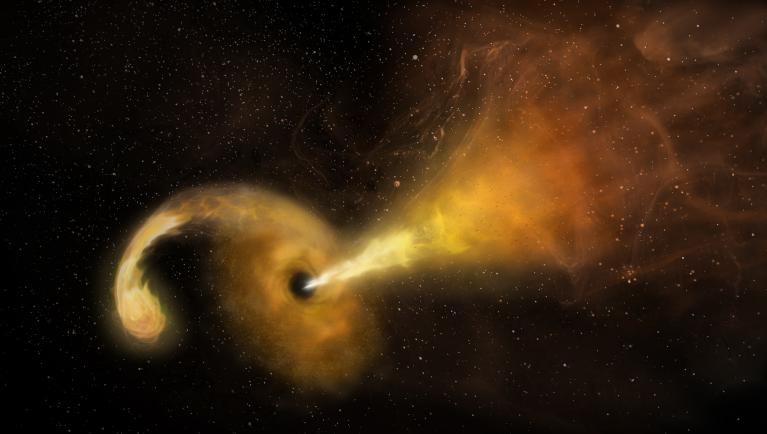 A star succumbs to the tidal forces around a supermassive black hole in this artist’s concept.NRAO/AUI/NSF/NASA
 -
2022: Swift observes the BOAT GRB
On Sunday, Oct. 9, 2022, a pulse of intense radiation swept through the solar system so exceptional that astronomers quickly dubbed it the BOAT — the brightest of all time.
 Swift's XRT captured the afterglow of GRB 221009A about an hour after it was first detected. The bright rings form as a result of X-rays scattered by otherwise unobservable dust layers within our galaxy that lie in the direction of the burst. The dark vertical line is an artifact of the imaging system.NASA/Swift/A. Beardmore (University of Leicester)
 -
2020: Swift tallies water from interstellar comet 2I/Borisov
For the first time, Swift tracked water loss from an interstellar comet as it approached and rounded the Sun. The object, 2I/Borisov, traveled through the solar system in late 2019.
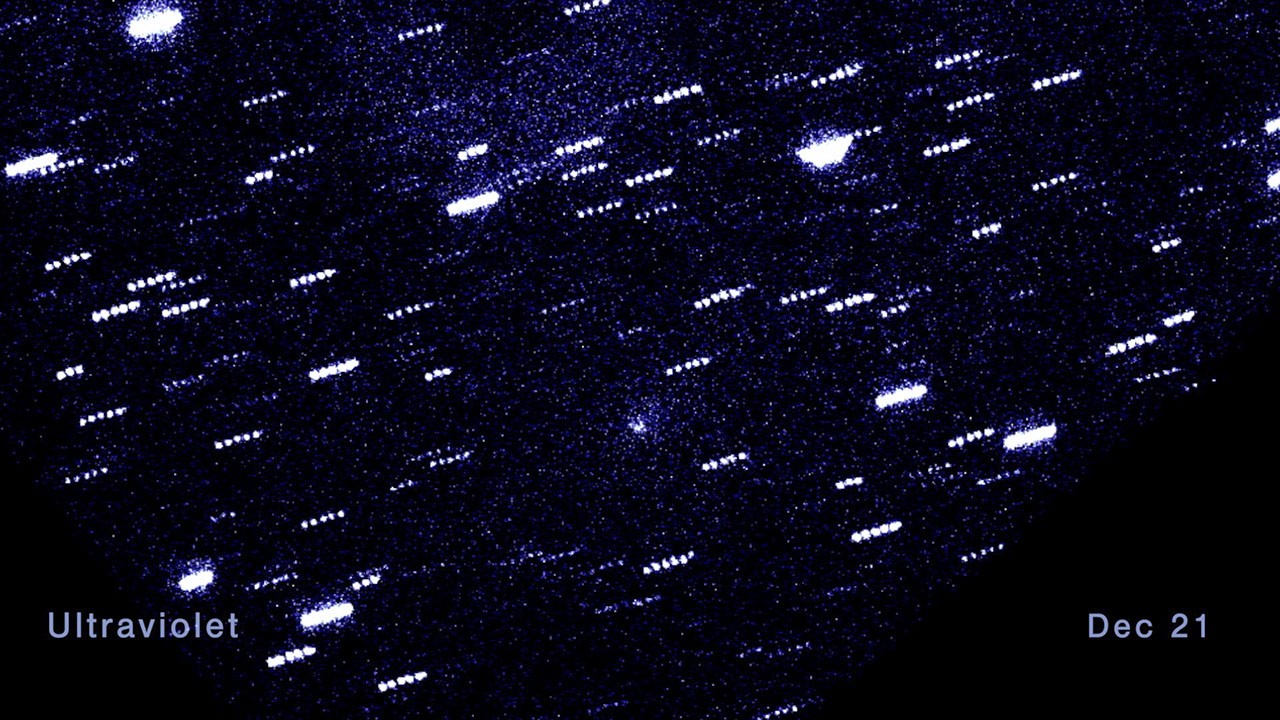 Swift’s UVOT captured several snapshots of comet 2I/Borisov (faint blob below center) as it traveled through the solar system. This one was taken on Dec. 21, 2019, when the comet was about 180 million miles (290 million kilometers) from Earth.NASA/Swift/Z. Xing et al. 2020
 -
2016: Swift discovers the first “wind nebula” around a magnetar
Astronomers discovered a vast cloud of high-energy particles called a wind nebula around a rare ultramagnetic neutron star, or magnetar, for the first time. The find offers a unique window into the properties, environment and outburst history of magnetars, which are the strongest magnets in the universe.
 The X-ray glow associated with a source known as Swift J1834.9-0846, located near the center of the W41 supernova remnant, comes from the first magnetar wind nebula identified (outline).ESA/XMM-Newton and Younes et al. 2016
 -
2015: Swift spots its thousandth GRB
In 2015, Swift detected its 1,000th GRB. Astronomers now have distance measurements for about 30 percent of Swift GRBs, which makes it possible to investigate how these powerful events are distributed across space and time.
 One type of gamma-ray burst originates from the detonation of a massive star at the end of its life. Jets of particles and gamma radiation are emitted in opposite directions from the stellar core as the star collapses, as depicted here.NASA/Swift/Cruz deWilde
 -
2014: Swift observes mega flares from a red dwarf star
In 2014, Swift detected the strongest, hottest, and longest-lasting sequence of stellar flares ever seen from a nearby red dwarf star. The initial blast from this record-setting series of explosions was as much as 10,000 times more powerful than the largest solar flare ever recorded.
 Swift detected a record-setting series of X-ray flares unleashed by DG CVn, a nearby binary consisting of two red dwarf stars, shown in this artist’s concept.NASA's Goddard Space Flight Center
 -
2013: Swift discovers a previously unknown supernova remnant
While performing an extensive X-ray survey of our galaxy's central regions, Swift uncovered the previously unknown remains of a shattered star. Designated G306.3–0.9 after the coordinates of its sky position, the new object ranks among the youngest-known supernova remnants in our Milky Way galaxy.
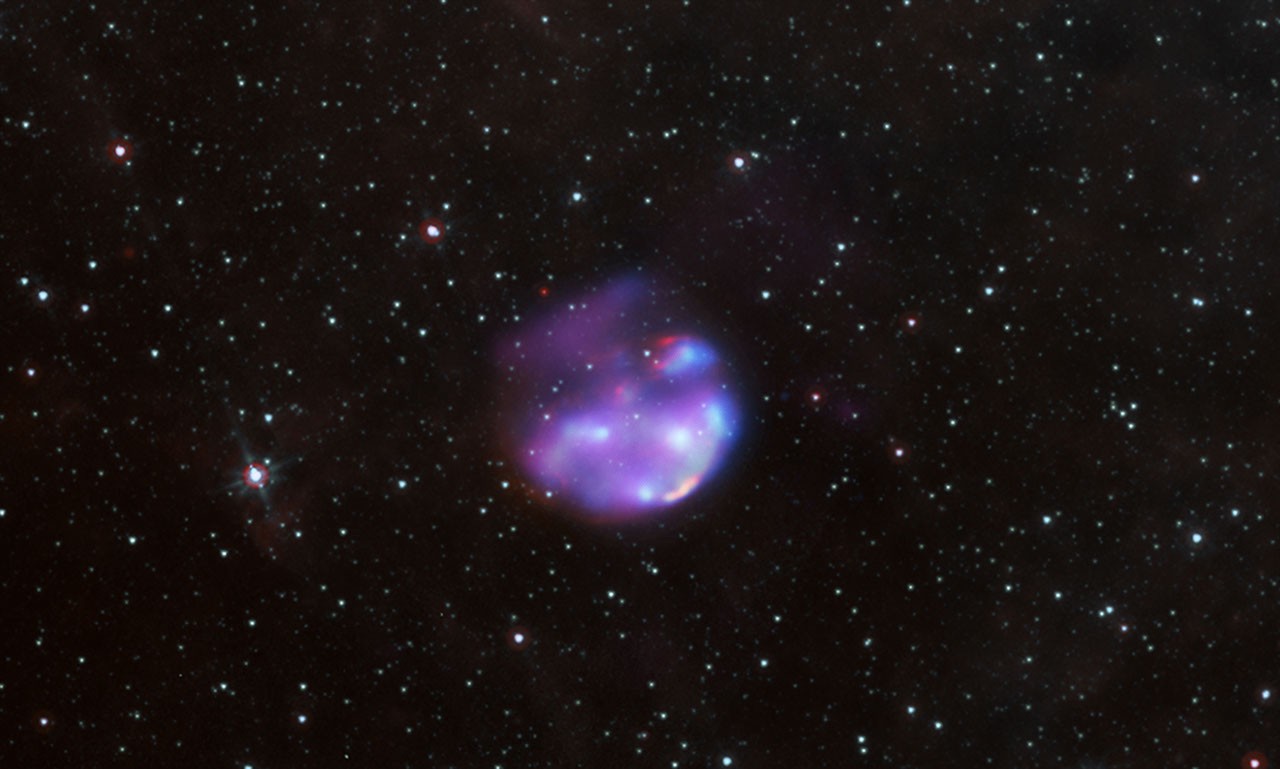 This composite of supernova remnant G306.3-0.9 merges observations from NASA’s Chandra X-ray Observatory (blue), infrared data acquired by NASA’s Spitzer Space Telescope (red and cyan), and radio observations (purple) from the Australia Telescope Compact Array.NASA/CXC/Univ. Of Michigan/M. Reynolds et al., NASA/JPL-Caltech, CSIRO/ANTF/ATCA
 -
2012: Swift discovers an antiglitch in a magnetar
Astronomers using Swift’s XRT observed a spinning neutron star suddenly slowing down, yielding clues they can use to better understand these extremely dense objects.
 A magnetar, as shown in this artist’s concept, is a city-sized ball containing more mass than the Sun and boasting the strongest magnetic fields known. Abrupt changes to the magnetic field can result in powerful outbursts (left).NASA’s Goddard Space Flight Center/Chris Smith (USRA/GESTAR)
 -
2011: Swift discovers the first relativistic tidal disruption event
Swift alerted astronomers to intense and unusual high-energy flares from a new source that turned out to be the awakening of a distant galaxy’s dormant black hole as it shredded and consumed a star. The galaxy is so far away it took the light from the event approximately 3.9 billion years to reach Earth.
 Images from Swift's Ultraviolet/Optical (in white and purple) and X-ray telescopes (in yellow and red) were combined in this view of GRB 110328A. The blast was detected only in X-rays, which were collected over a 3.4-hour period on March 28, 2011.NASA/Swift/Stefan Immler
 -
2010: Swift survey finds 'smoking gun' of black hole activation
Data from a survey by Swift helped astronomers solve a decades-long mystery about why only a small percentage of black holes emit vast amounts of energy.
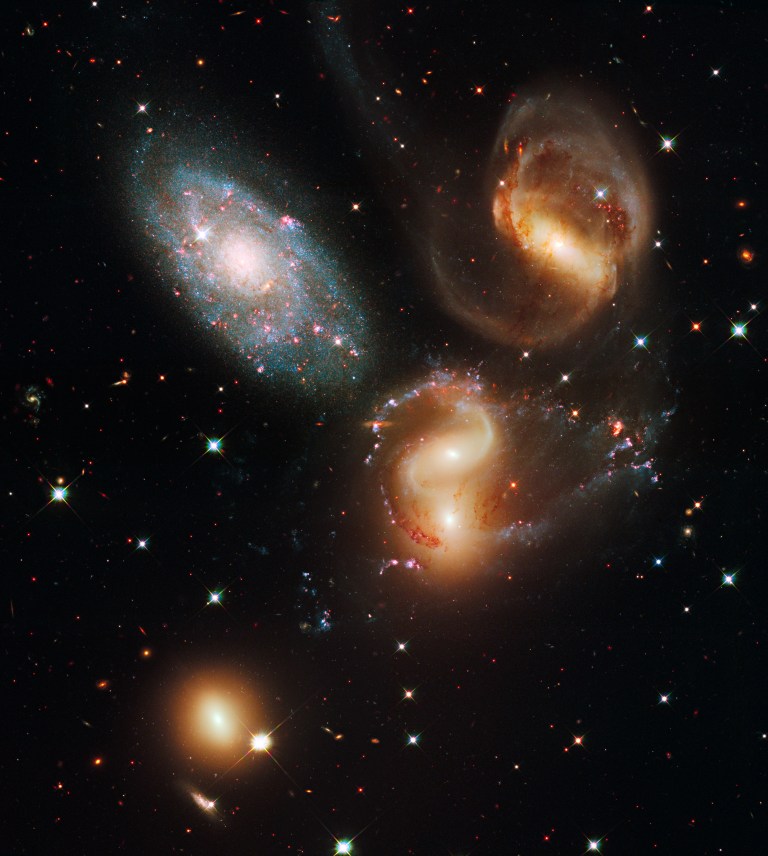 This is a Hubble Space Telescope portrait of a galaxy group known as Stephan's Quintet. The galaxy at the upper right is the optical counterpart of one active galactic nucleus detected by the Swift BAT Hard X-ray Survey.NASA, ESA, and the Hubble SM4 ERO Team
 -
2009: Swift detects the farthest burst, GRB 090423
Swift found a gamma-ray burst from a star that died when the universe was only 630 million years old, or less than five percent of its present age. The event, dubbed GRB 090423, was the most distant cosmic explosion ever seen.
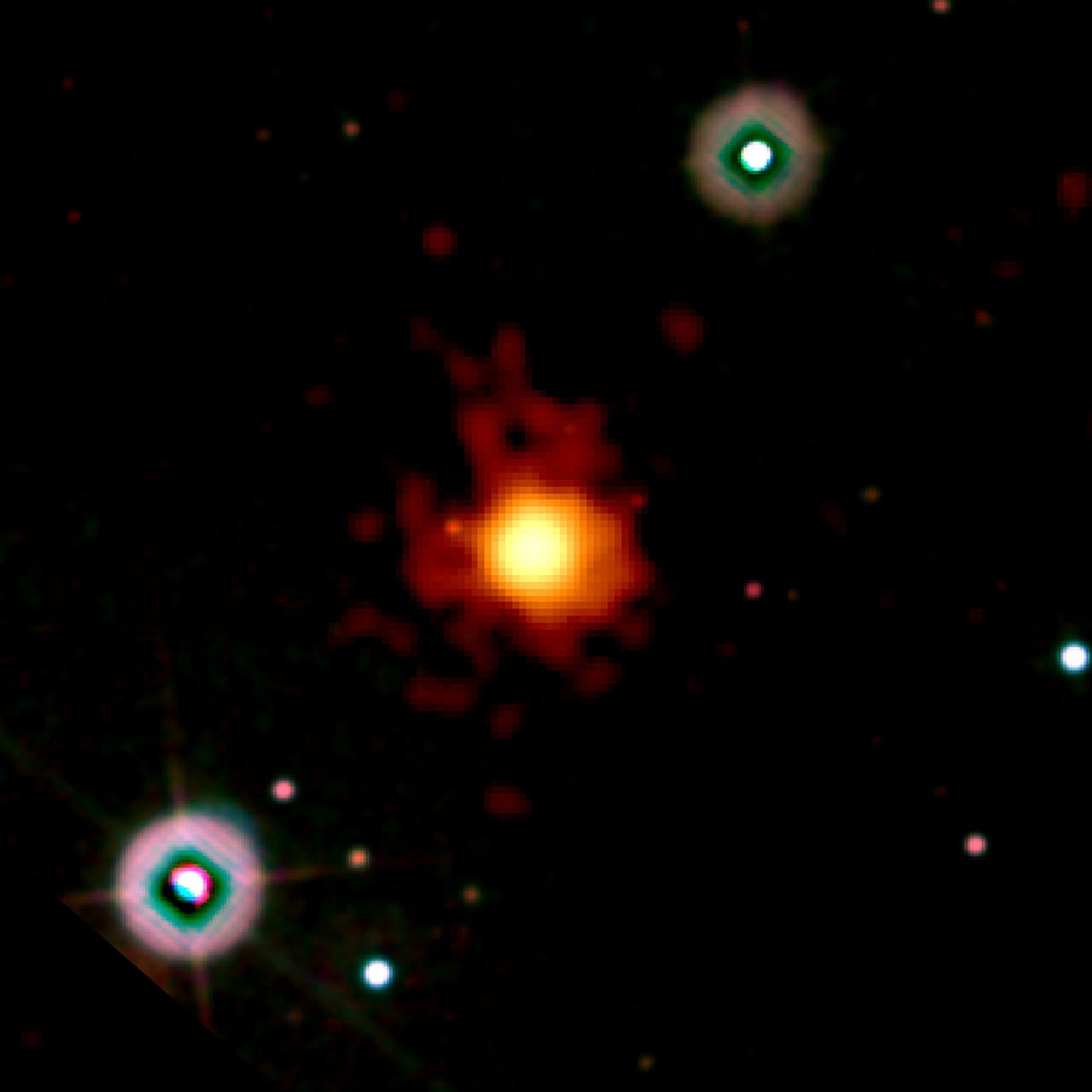 This image of GRB 090423 merges data from Swift’s UVOT (blue, green) and XRT (orange, red) telescopes.NASA/Swift/Stefan Immler
 -
2008: Swift detects the "naked-eye" GRB
In March 2008, Swift detected a gamma-ray burst, which for about a minute was bright enough to see with the unaided eye despite the fact that its light had traveled to us for 7.5 billion years.
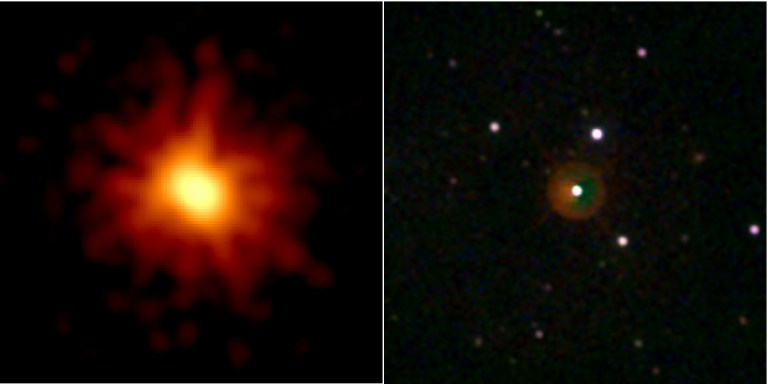 Swift imaged the extremely luminous afterglow of explosion GRB 080319B using its XRT (left) and UVOT telescopes (right). This was the brightest gamma-ray burst afterglow ever seen at the time.NASA/Swift/Stefan Immler, et al.
 -
2008: Swift catches supernova in the act of exploding
Thanks to a fortuitous observation with Swift, astronomers for the first time caught a star in the act of exploding. Astronomers had previously observed thousands of stellar explosions, known as supernovae, but they had always seen them after the fireworks were well underway.
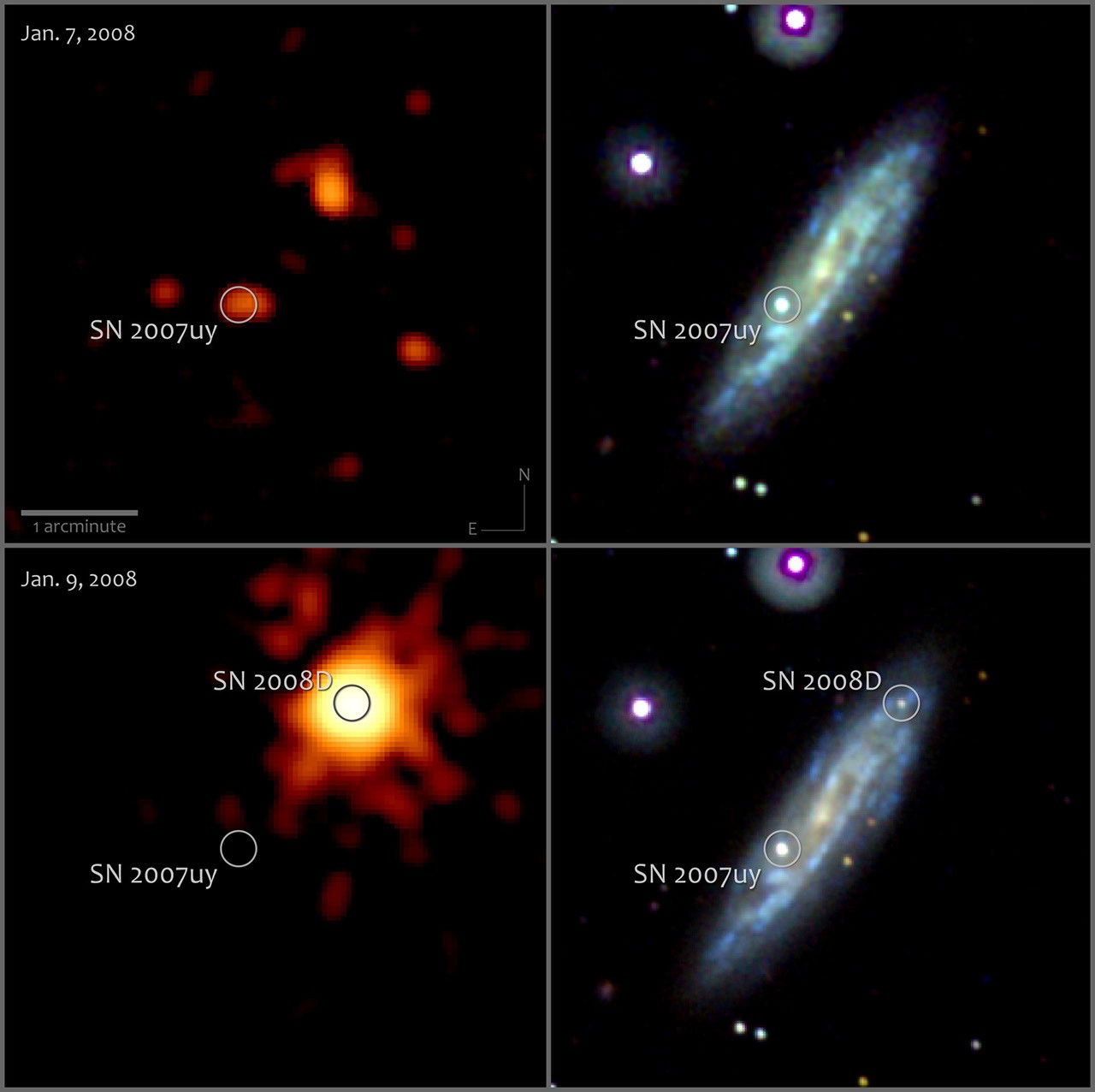 At top is Swift’s X-ray image (left) of supernova SN 2007uy in galaxy NGC 2770, taken on Jan. 7, 2008, along with Swift’s ultraviolet and optical image of the same scene. Bottom: Two days later, on Jan. 9, Swift caught a bright X-ray burst (left) from a new exploding star, with ultraviolet and optical data shown at right.NASA/Swift Science Team/Stefan Immler
 -
2004: Swift detects superburst from magnetar SGR 1806-20
From across the galaxy, scientists detected a flash of light so powerful it bounced off the Moon and lit up Earth's upper atmosphere. The flash was brighter than anything ever detected from beyond our solar system, and it lasted over a tenth of a second.
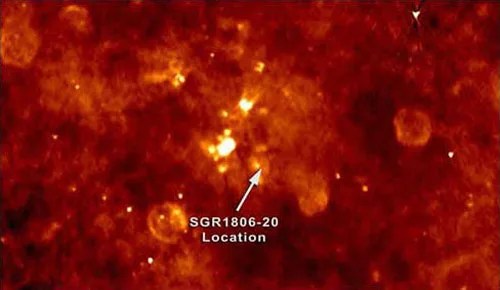 An arrow points to SGR 1806-20, a magnetar that created a flash so bright it lit up the Moon, in this wide-field image taken by a radio telescope at the University of Hawaii. The magnetar itself is not visible in the image, which was taken when SGR 1806-20 was "radio quiet."Univ. of Hawaii