


















Where are Voyager 1 and Voyager 2 Now?
Mission Status
Approaching One Light-Day
On Wednesday, Nov. 18, 2026, at 2:16:07 a.m. PST, NASA’s Voyager 1 spacecraft will be 16.094 billion miles (25.902 billion kilometers) away from Earth — or, the distance light travels in 24 hours, also known as one light-day.
Voyager 1 will be the first human-made object to reach this distance from Earth, adding to a long list of historic firsts for the mission. Voyager 1 and its twin, Voyager 2, are the only spacecraft to ever operate outside the heliosphere, or the protective bubble of particles and magnetic fields generated by the Sun.
Use their cosmic odometers below to follow the progress of Voyager 1 and 2.

Voyager 1 — Current Position Visualization
Voyager 2 — Current Position Visualization
Instrument Status
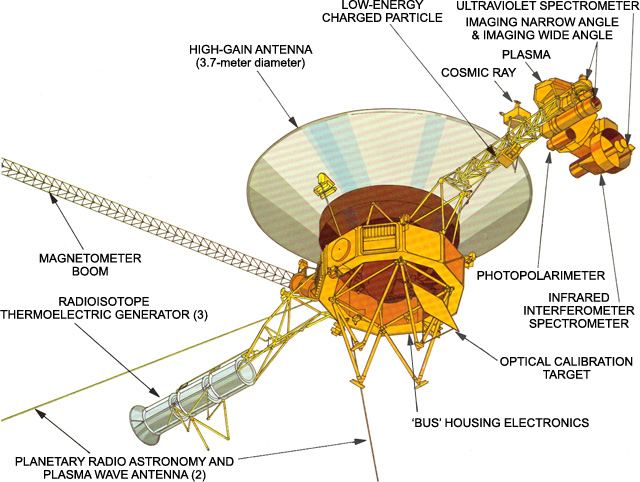
Voyager diagram
NASA/JPL-Caltech
| Instrument | Voyager 1 | Voyager 2 |
|---|---|---|
| Cosmic Ray Subsystem (CRS) | Off to save power (Feb. 25, 2025) | On |
| Low-Energy Charged Particles (LECP) | Off to save power (April 17, 2026) | Off to save power (March 24, 2025) |
| Magnetometer (MAG) | On | On |
| Plasma Wave Subsystem (PWS) | On | On |
| Plasma Science (PLS) | Off because of degraded performance (Feb. 1, 2007) | Off to save power (Sept. 26, 2024) |
| Imaging Science Subsystem (ISS) | Wide-angle and narrow-angle cameras off to save power (Feb. 14, 1990) | Wide-angle and narrow angle cameras off to save power (Oct. 10 and Dec. 5, 1989) |
| Infrared Interferometer Spectrometer and Radiometer (IRIS) | Off to save power (June 3, 1998) | Off to save power (Feb. 1, 2007) |
| Photopolarimeter Subsystem (PPS) | Off because of degraded performance (Jan. 29, 1980) | Off because of degraded performance (April 3, 1991) |
| Planetary Radio Astronomy (PRA) | Off to save power (Jan. 15, 2008) | Off to save power (Feb. 21, 2008) |
| Ultraviolet Spectrometer (UVS) | Off to save power (April 19, 2016) | Off to save power (Nov. 12, 1998) |