





















What Is a Light-Day?
The milestone Voyager 1 is closing in on is about distance, not time.
And it's very, very far.
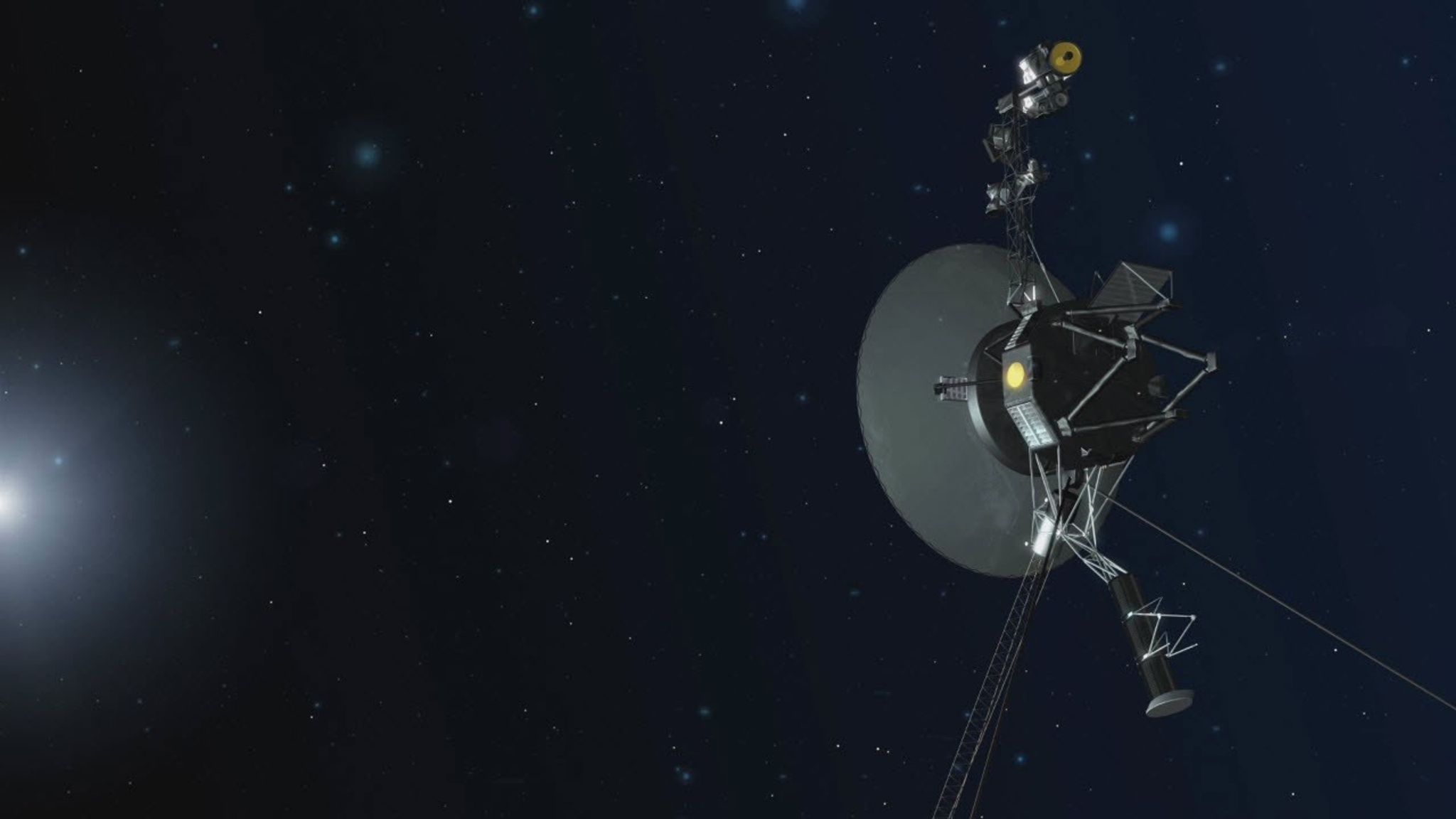
The Voyager 1 spacecraft, traveling for nearly 50 years, will soon cross a mile marker reached by no other human-made object — one light-day away from Earth. That’s the distance a particle of light can travel in 24 hours, equaling about 16 billion miles (about 26 billion kilometers), a point that Voyager 1 will reach on Wednesday, Nov. 18, 2026, at 2:16:07 a.m. PST.
Its twin spacecraft, Voyager 2, took a different path through the solar system after they launched in 1977, in order to visit Uranus and Neptune. Voyager 2 is on pace to be one light-day away from Earth in nine more years, in November 2035.
Why measure with light?
Nothing in the universe travels faster than light. Moving through space about 186,000 miles every second, it crosses enormous distances in a given time period, whether it’s a second, a day, or a year. This is true for any type of electromagnetic radiation, including visible light, microwaves, radio waves, gamma rays, X-rays, or infrared. A light-day is the distance that light will travel in 24 hours, or 16,094,799,096 miles (25,902,068,356 kilometers).
To put this mileage into perspective, consider some other light-distances:
- The Moon is 238,855 miles (384,400 kilometers) from Earth, on average. The astronauts on the Artemis II mission took about three days to get there, but light can traverse that distance in 1.3 seconds.
- Sunlight takes about eight minutes and 20 seconds to travel the 93 million miles from the Sun to Earth (about 150 million kilometers), meaning our nearest star is about 8.3 light-minutes away.
- The distance between Earth and Mars changes as they orbit the Sun, and it can take anywhere from three minutes to 22 minutes for light to travel between the two planets. Same for a radio transmission, either to or from a spacecraft at Mars.
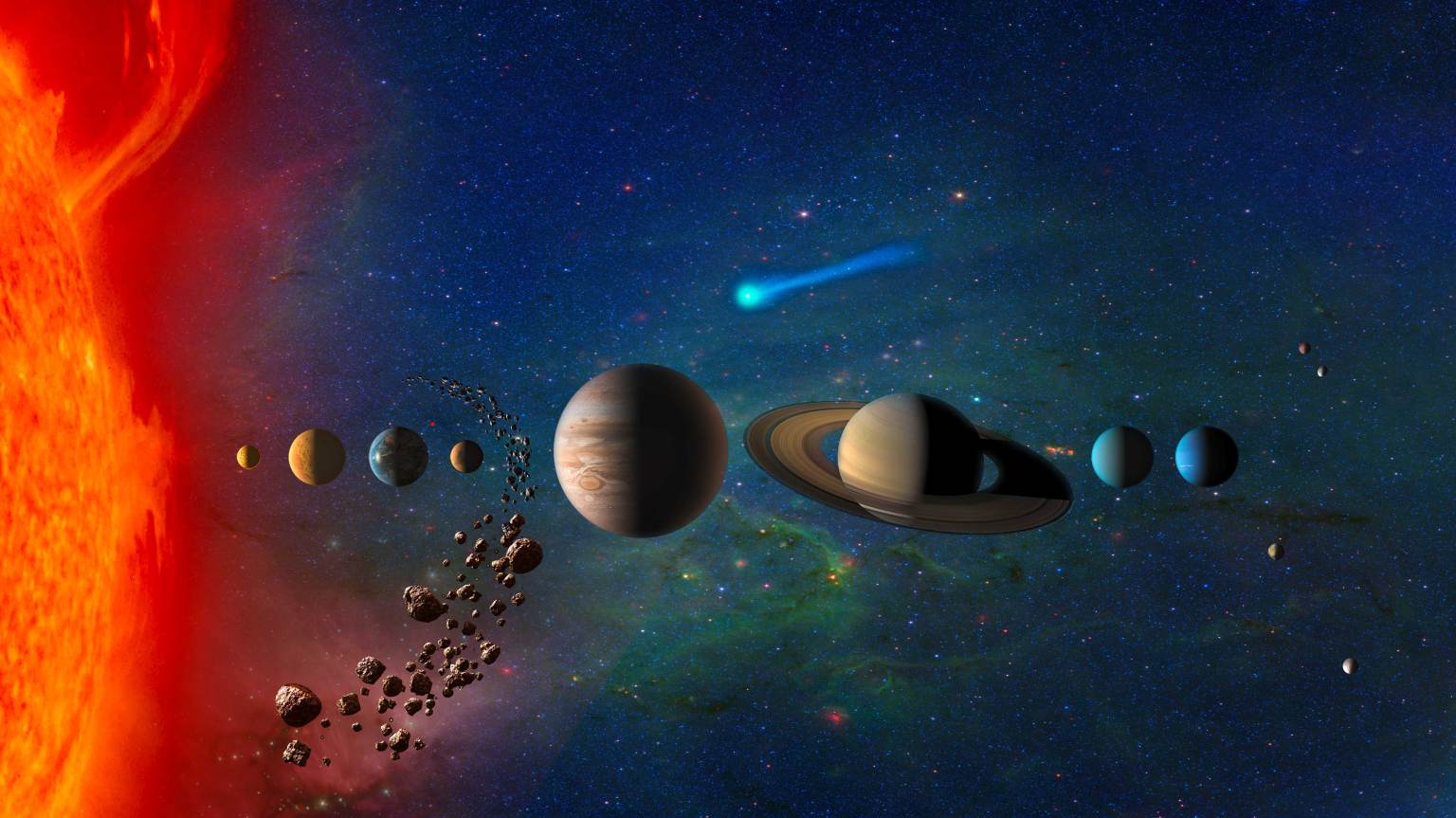
- Neptune, the most distant planet in our solar system, with an average distance from Earth of about 2.8 billion miles (4.5 billion kilometers), is four light-hours and 10 light-minutes away. It took Voyager 2, traveling about 35,000 miles per hour, 12 years to reach Neptune.
That’s why light-year — how far light can travel in a year — is used to measure and convey the vastness of space. It’s about 5.88 trillion miles (9.46 trillion kilometers). The closest neighboring solar system to our own, the star Proxima Centauri and its one or more planets, is about 4.24 light-years away (or, about 24.95 trillion miles, or 40.15 trillion kilometers). And the next-closest galaxy to our own Milky Way, the Andromeda galaxy, is about 2.5 million light-years away.
Where is Voyager 1 going?
Voyager 1 is headed in the direction of a star more than 17 light-years away from Earth called AC +79 3888, also known as Gliese 445. It’s an obscure star now in the constellation Ursa Minor (the Little Bear or Little Dipper), and Voyager 1 is expected to pass within about 1.7 light-years of it — in 40,000 years. Even though the spacecraft, in flight since 1977, is cruising at nearly 38,000 mph (61,000 kph) through the vacuum of space, that’s a relative crawl compared to the speed of light.
When Voyager 1 makes its mark Nov. 18, the spacecraft will have taken 49 years, two months, and 11 days to have traveled one light-day beyond Earth — a huge milestone by any measure, and a day worth celebrating.