










Description
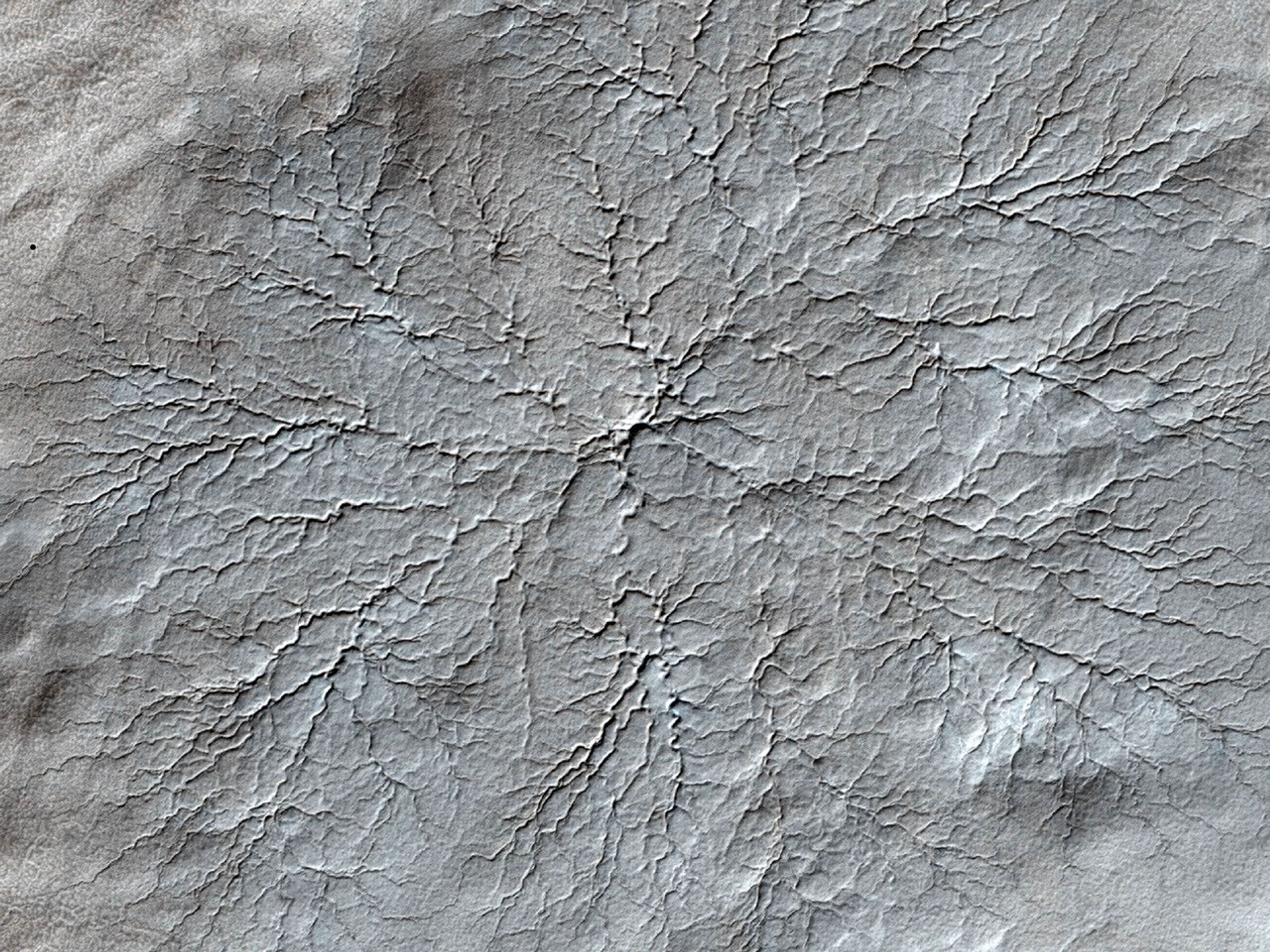
This HiRISE image shows erosional features formed by seasonal frost near the south pole of Mars.
During the winter, high latitudes (near the pole) on Mars build up deposits of carbon dioxide frost that can be several feet thick. In the spring these sublimate and turn back into gas. The gas sublimating at the bottom of the frost can move the underlying dust and even erode channels in it.
These channels form a variety of structures; examples like those at this site have been nicknamed "spiders" because many channels converge, giving a many-armed, spidery appearance.
See PIA14460 for an anaglyph of this image.
NASA's Jet Propulsion Laboratory, a division of the California Institute of Technology in Pasadena, manages the Mars Reconnaissance Orbiter for NASA's Science Mission Directorate, Washington. Lockheed Martin Space Systems, Denver, built the spacecraft. The High Resolution Imaging Science Experiment is operated by the University of Arizona, Tucson, and the instrument was built by Ball Aerospace & Technologies Corp., Boulder, Colo.
Originally released July 13, 2011